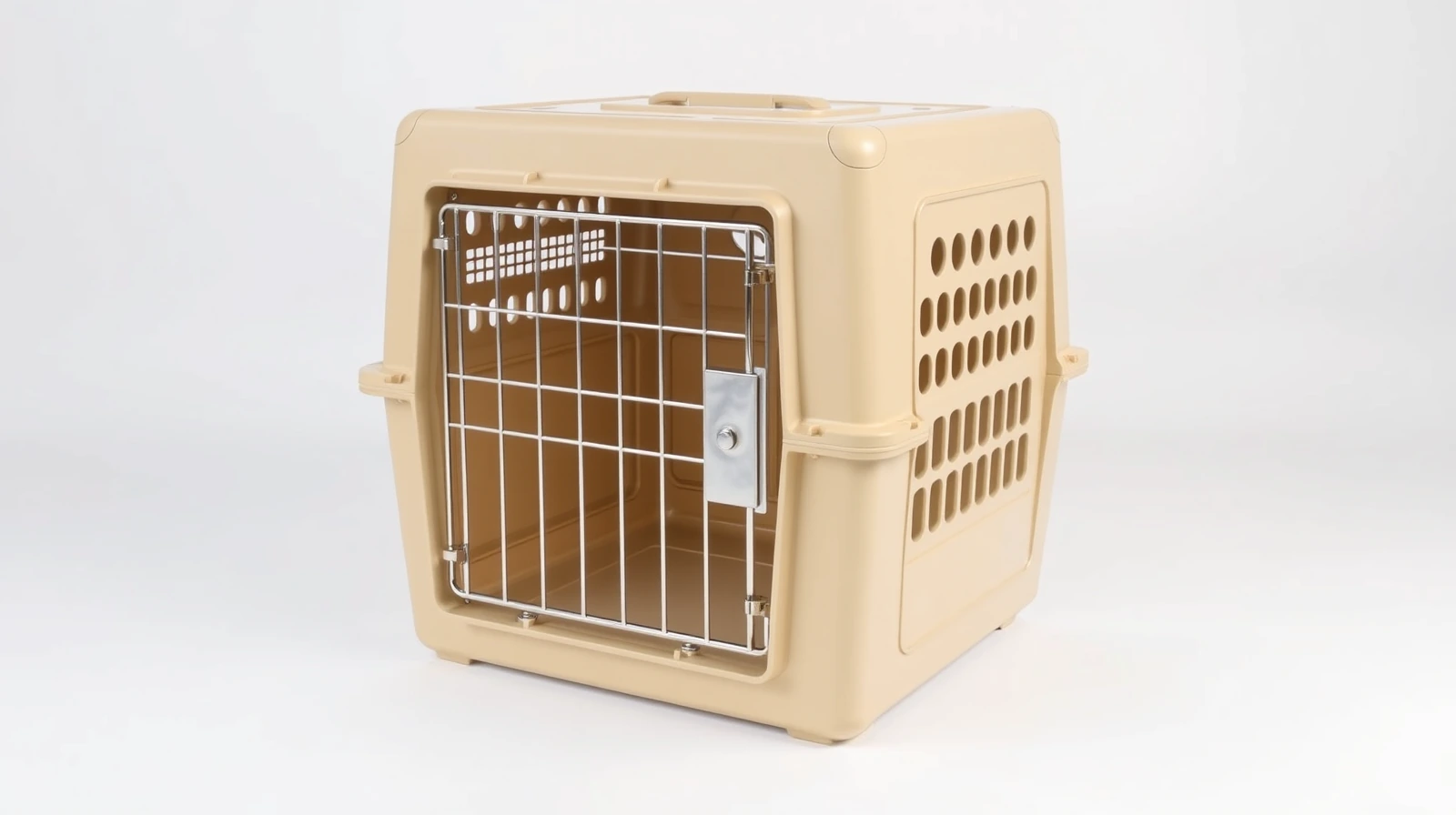
For most cargo or cross-country trips: Petmate Sky Kennel ($50-$250). For in-cabin small pets: Sherpa Original Deluxe ($50-$80). For premium ground transport: Gunner G1 ($400-$700). Avoid wire crates for cargo, soft-sided carriers in cargo, or anything with a snap-clip closure.
The right pet transport crate is the difference between a calm, safe trip and a stressful, potentially dangerous one. The wrong crate can be rejected at the airport, fail in transit, or even injure your pet. This guide covers what makes a crate IATA-compliant, what we recommend across price tiers, and how to size correctly for your pet.
A compliant crate is one half of a safe trip; the other is coverage. See our guide to pet transport insurance for what it covers and when you need it.
Crate sizing for air travel follows a global standard: the IATA pet container requirements specify a compliant carrier must let your pet stand, sit, turn around, and lie down naturally.
For more tested gear picks, browse our pet travel gear reviews hub.
A crate is one piece of the trip: see how to transport a pet for the full process and American Airlines pet transport for in-cabin and cargo crate rules.
Need help picking the right size? Our IATA sizing decoded guide walks through the exact measurements + a 10-airline crate-rules cheat sheet.
Cat carrier instead of a dog crate? Cats need different gear. See our cat transport guide for the Sherpa-style soft carrier specs, multi-cat household setups, and Feliway use on long trips.
Crate or harness for the car? See our car transport safety guide for the Center for Pet Safety crash-test verdicts on which products actually pass.
Still comparing gear? Our roundup of the Best Dog Car Barriers and Cargo Dividers for SUVs covers the current top picks.
Still comparing gear? Our roundup of the Best Orthopedic Dog Beds for Large and Senior Dogs covers the current top picks.
For a deeper look, see our guide to Best Dog Leash.
For a deeper dive, see our guide to best crash-tested dog car harnesses and seats (2026), backed by center for pet safety data.
Related reading: best airline-approved dog carriers for in-cabin flying (2026).
If you are weighing your options, our guide to best gps trackers for pets in 2026 (dogs and cats), tested criteria goes further.
Gearing up for your pet? Compare our pick for the Best Calming Aids for Dog Travel in 2026.
Kitting out for travel? Our other gear picks: airline-approved dog carriers, dog car barriers, dog car seat covers, calming aids for dog travel, dog life jackets, GPS trackers for pets, dog travel water bottles.
What makes a pet transport crate "IATA-compliant"?
IATA - the International Air Transport Association - sets the global standard for live-animal cargo. Most US airlines and pet transport companies require IATA-compliant crates for cargo transport. The standard requires:
- Hard-sided plastic or metal construction (no soft carriers in cargo)
- Ventilation on at least 3 sides (4 sides for international travel)
- Solid floor with absorbent material (no wire-bottom crates)
- Locking mechanism that can't be opened by the pet or accidentally during handling
- Live Animal labels on at least 2 sides
- Food and water dishes attached inside
- Sized so the pet can stand up, turn around, and lie down naturally
Gearing up for your pet? Compare our pick for the Best Dog Backpack Carriers for Hiking and Travel.
How to size a pet transport crate
The IATA size formula:
- Length = nose-to-base-of-tail length + half a leg-length
- Width = shoulder width × 2
- Height = top-of-head-when-standing height
The pet must be able to stand up, turn around, and lie down naturally without their head touching the top. If the pet's head touches the top of the crate, airline cargo will reject it at check-in.
Gearing up for your pet? Compare our pick for the Best Dog Cooling Vests for Hot Weather.
Best pet transport crates by price tier (2026)
Best overall - Petmate Sky Kennel
The default airline-cargo crate. IATA-compliant, available in 5 sizes from XS (small cats) to giant (great danes). Hard-sided plastic, steel-bolt closure, attached food/water dishes. Used by professional pet transport operators globally.
- Price: $50 (small) to $250 (giant)
- Best for: medium and large pets in cargo, cross-country ground transport
- Pros: IATA-certified out of the box, widely accepted by all major airlines, durable, reasonable price
- Cons: bulky to store between trips, plain aesthetic
Best for in-cabin - Sherpa Original Deluxe
Soft-sided airline-approved carrier for in-cabin small dogs and cats. Mesh ventilation on all sides, removable washable liner, fits under most airline seats.
- Price: $50-$80
- Best for: in-cabin pets under 20 lbs total (pet + carrier)
- Pros: meets in-cabin dimensions for American, Delta, United, Southwest, JetBlue, Alaska. Lifetime guarantee.
- Cons: not for cargo. Soft-sided not allowed in airline holds.
Best premium - Gunner G1 (collision-tested)
Heavy-duty rotomolded plastic, crash-tested by the Center for Pet Safety. The crate professional transporters use for high-value pets. Lifetime warranty.
- Price: $400-$700
- Best for: cross-country ground transport, vehicle-collision concerns, working dogs
- Pros: 5-star Center for Pet Safety crash test, virtually indestructible, made in USA
- Cons: expensive, heavy
Best for home use + occasional travel - MidWest iCrate
Wire-frame folding crate. NOT for cargo travel - IATA requires hard-sided plastic or metal. Good for home crating, vet visits, short ground trips.
- Price: $30-$80
- Best for: home crating, short ground transport in your own vehicle
- Pros: folds flat for storage, multiple sizes, affordable
- Cons: NOT airline-approved. Not for cargo.
What to avoid
- Cardboard or plastic-coated cardboard carriers - banned by airlines
- Wire crates for cargo - IATA requires hard-sided
- Snap-clip closures - airlines require steel bolts that can't be released by the pet
- Used crates with broken latches or cracks - even minor damage gets the crate rejected at check-in
- Crates that are too small - if pet's head touches the top, it's rejected
Crate size chart: match your dog to the right series
Hard-sided airline crates are sold in a numbered series (Petmate Sky Kennel and Vari Kennel use the same convention). Sizing off the series number is faster than measuring blind, then you confirm with the IATA stand-turn-lie test. These are the standard interior fits.
| Series | Crate dimensions (approx) | Dog weight | Standing height to match | Example breeds |
|---|---|---|---|---|
| 100 / Small | 21" x 16" x 15" | 10–20 lb | up to ~12" | Yorkie, Pomeranian, small terrier |
| 200 / Medium | 28" x 20.5" x 21.5" | 20–30 lb | ~13–15" | Beagle, French Bulldog (in-cabin/ground only) |
| 300 / Intermediate | 32" x 22.5" x 24" | 30–50 lb | 16–19" | Cocker Spaniel, small Border Collie |
| 400 / Large | 36" x 25" x 27" | 50–70 lb | 20–22" | Labrador, Boxer-sized |
| 500 / X-Large | 40" x 27" x 30" | 70–90 lb | 23–25" | German Shepherd, Golden Retriever |
| 700 / Giant | 48" x 32" x 35" | 90–125 lb | 26"+ | Great Dane, Mastiff |
If your dog's measured standing height lands between two series, always size up. A crate one size too large is accepted; a crate one size too small is rejected at the counter. Need the exact measuring method first, our IATA sizing decoded guide walks the formula step by step.
CR1 vs CR82: the two IATA container standards
Most owners only need one of these, but counter rejections often trace back to confusing them.
- CR1 is the standard container requirement for the vast majority of dogs and cats. It allows hard plastic construction with a metal or heavy-wire door, ventilation on at least three sides (four for international), and metal bolt hardware. The Petmate Sky Kennel and Vari Kennel are built to CR1.
- CR82 is the reinforced standard for strong-jawed and aggressive breeds (and is mandated by many carriers for those breeds). The critical difference: no part of a CR82 crate may be plastic. It must be wood, metal, weld mesh, or wire grate, with the entire door end made of welded wire mesh and the fastening secured by a cable or zip tie that cannot accidentally open.
If you fly a Pit Bull, Cane Corso, or similar strong breed, a CR1 plastic crate will be refused even though it is "airline-approved" for other dogs. Confirm the carrier's breed-specific crate rule before you buy.
Ventilation, door, and hardware rules that fail crates at the counter
IATA spells these out, and check-in agents enforce them literally:
- Ventilation must cover at least 16% of the total wall surface across the four sides, with openings concentrated over the upper two-thirds of the container. International travel requires vents on all four sides.
- Door must be metal or heavy wire mesh with a secure fastening that cannot be opened by the pet or knocked open in handling.
- Hardware must be metal bolts joining the top and bottom halves. Plastic snap clips are an automatic rejection. Many counters now require the two halves bolted with metal nuts and bolts, not the factory clips, on cargo crates.
- Floor must be solid and leak-proof with absorbent bedding. Wire-bottom crates are out.
- Labels require a green "Live Animals" sticker plus "This Way Up" arrows on at least two opposite sides.
- Wheels must be removed or immobilized; a crate that can roll is refused.
What disqualifies a crate at check-in
The most common counter rejections, in order of how often they happen:
- Pet's head touches the top. The single biggest cause. The dog must stand fully upright with clearance.
- Plastic clip closures instead of metal bolts on a cargo crate.
- Cracks, broken latches, or prior repair tape on a used crate.
- Soft-sided or wire crate presented for cargo. Cargo is hard-sided only.
- Wrong standard for breed (CR1 plastic for a breed that requires CR82).
- Missing Live Animal labels or food/water dishes attached to the door.
Crate prep checklist for travel day
A compliant crate still needs to be set up right:
- Attach metal nut-and-bolt fasteners if your crate shipped with plastic clips. Carry spares.
- Add absorbent bedding, a puppy pad or shredded paper layer, never loose blankets that bunch.
- Attach empty food and water dishes to the inside of the door so handlers can fill them without opening the crate. Tape a small bag of food to the top.
- Label the crate with your name, phone, destination address, and the pet's name and feeding notes.
- Freeze a small water bowl the night before so it melts gradually instead of spilling at loading.
- Zip-tie the door as a backup to the latch if your carrier permits it.
- Do not sedate. Most airlines and vets advise against sedation for cargo travel because it affects breathing at altitude. Acclimate the pet to the crate over several weeks instead, and pair the trip with the right pet transport insurance for the legs that carry real risk.
Common questions
What size pet transport crate do I need?
Is the Petmate Sky Kennel airline-approved?
Can I use a wire crate for airline travel?
How early should I get my pet used to the crate?
How much does a good pet transport crate cost?
What is the difference between an IATA CR1 and CR82 crate?
Can I use plastic clips to close my airline crate?
How do I know what size crate to buy?
Bottom line
For most pet owners flying cargo or shipping ground: Petmate Sky Kennel in the right size. For in-cabin pets: Sherpa Original Deluxe. For high-value pets in vehicle transport: Gunner G1. Avoid cardboard carriers, wire crates for cargo, and any crate with a snap-clip closure or visible damage.
Sources & references
- iata.org https://www.iata.org/en/programs/cargo/live-animals/
- faa.gov https://www.faa.gov/travelers/fly_pets
- centerforpetsafety.org https://www.centerforpetsafety.org/