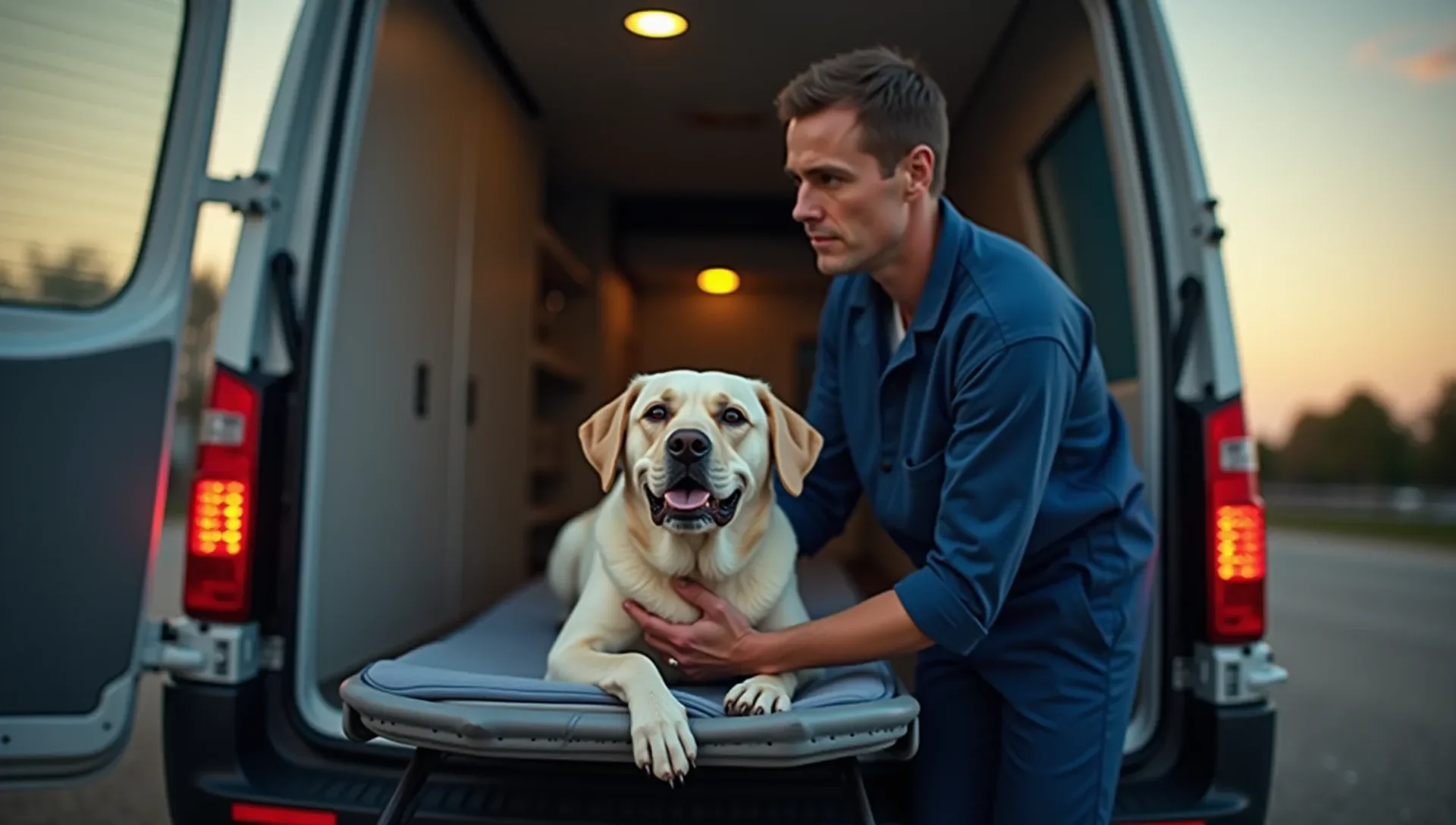
Emergency pet transport options break into 3 categories: 24-hour pet ambulance services (in 30+ US metros, $200 to $650 per trip), expedited interstate ground transport ($1,800 to $4,500), and DIY safe-transport for stable injuries. Call your nearest emergency vet first; they often have a recommended transport provider on file.
If you're reading this in an emergency, here's the 60-second answer. Call the nearest 24-hour emergency veterinary hospital first, not a transport company. Tell the triage nurse what happened in one sentence ("my cat hasn't urinated in 18 hours and is crying," "my dog was hit by a car and can stand but is limping," "post-spay incision opened"). They will tell you whether you have minutes, an hour, or longer, and whether your pet is safe to move in your own car. If the answer is minutes and you cannot drive safely, ask if they have a recommended pet ambulance on file. Most ER vets in major metros do. Skip to the directory table further down if you need a phone number for your city right now.
If you have a few minutes to read, this guide covers the three categories of emergency pet transport in the United States, a 19-metro pet ambulance directory, cost ranges that are actually accurate (not the marketing brochure numbers), step-by-step DIY transport for the five emergencies vets see most often, and what insurance will and will not cover. Everything below is built for the moment you are in. Calm, practical, no fluff.
For a deeper dive, see our guide to petrelocation review 2026: cost, service, and who it's for.
Comparing providers? See our breakdown of Air Animal Pet Movers Review.
Rush moves are the exception. For everything else, learn how far in advance to book pet transport to lock in your dates.
If something goes wrong, knowing how to file a pet transport insurance claim in advance saves precious time.
If your situation is care for a healthy pet rather than a medical emergency, a same-day walker, sitter, or boarding option may solve it faster and cheaper than an emergency transport service; see what to do when you need a dog walker today.
Right now: 60-second emergency triage
Before you pick a transport method, answer four questions out loud. This is the same triage flow the American Veterinary Medical Association (AVMA) recommends owners run before moving an injured animal.
- Is the pet breathing? Watch the chest rise and fall for 10 seconds. If there is no movement, no gum color (pull back the lip, the gums should be pink, not white, blue, or grey), and no response to their name, you are in a CPR situation. Call the ER vet while starting compressions; do not drive yet.
- Is the pet conscious and responsive? A pet that lifts their head when you say their name is in a different category than one that does not. Unresponsive pets need a pet ambulance or a second human in the car to monitor breathing during transport.
- Is there active bleeding? Visible, pulsing, or pooling blood needs direct pressure with a clean towel for a full 5 minutes before any movement. The ASPCA Pet First Aid protocol is unambiguous on this: stop the bleed, then move.
- Can the pet bear weight or move on their own? A pet that can stand and walk is almost always safe to transport in your own car. A pet that cannot stand may have a spinal injury, internal bleeding, or be in shock, and needs to be moved on a flat rigid surface (a baking sheet, a cutting board, a piece of plywood, the removable shelf from a closet).
Once you have those four answers, pick a category.
Comparing providers? See our breakdown of CitizenShipper Pet Transport Review.
The 3 emergency transport categories explained
There are three real options in the United States. Owners often default to "I'll drive them myself" because it feels fastest, but for two of the five most common emergencies, DIY transport in a sedan is the worst choice. Match the situation to the category.
Category 1: Pet ambulance. A climate-controlled van staffed by at least one credentialed veterinary technician, equipped with oxygen, IV fluids, a transport stretcher, and basic stabilization gear. Available in roughly 30 US metros. Best for unconscious pets, pets in active respiratory distress, suspected spinal injuries, post-trauma cases where the owner cannot lift the animal, and any situation where a single owner cannot safely drive and monitor at the same time. Cost: $200 to $650 per local trip.
Category 2: Expedited interstate ground transport. A specialized pet-transport operator who can pick up within 2 to 6 hours and drive non-stop to a specialty veterinary center in another state. Used when the local ER vet stabilizes your pet but the specialist (oncology, neurology, cardiology, ortho) is 400 to 1,200 miles away. Cost: $1,800 to $4,500 depending on distance and oxygen requirements. See our door-to-door pet transport guide for how these operators actually work.
Category 3: DIY safe-transport in your own car. Correct for the majority of emergencies: stable injuries, post-surgical complications a pet owner can manage with a calm passenger, ingestion of something toxic where the pet is still ambulatory, mild seizures that have stopped, and small lacerations after pressure has stopped the bleed. Cost: gas money. Most owners use this category and it is fine, provided you follow the posture rules below.
Category 1: Pet ambulance services
A pet ambulance is not just an Uber with a kennel. The credentialed services run vans with the same basic equipment loadout as a human ambulance, scaled for veterinary use: an oxygen cage or oxygen mask, IV access, a heated or cooled transport stretcher, a pulse oximeter, and a tech who can recognize shock, monitor respiration, and radio ahead to the ER vet with vitals before you arrive.
You want a pet ambulance when the pet cannot be safely contained and monitored by one human in a personal vehicle. The clearest cases: a 90-pound Lab that was hit by a car and cannot stand, a French bulldog in respiratory distress that needs oxygen during the 25-minute drive, a cat seizing every 6 minutes, a post-op dog whose abdominal incision opened in the night.
Response times in major metros run 15 to 45 minutes. Suburbs and exurbs run 45 to 90 minutes. Rural areas often have no service at all, which is why the directory below is metro-anchored.
Pet ambulances are not regulated the same way human EMS is. The International Pet and Animal Transportation Association (IPATA) maintains a member directory that includes emergency operators who have been vetted for insurance, training, and equipment standards. When you call a service, ask three questions: is a credentialed vet tech on board, what is the current ETA to my address, and what is the flat fee plus per-mile rate. Any service that cannot answer those three in 30 seconds is not the one you want.
Category 2: Expedited interstate ground transport
This is the category most owners do not know exists. Your local ER vet stabilizes a pet with a complex cardiac issue, a spinal tumor, a snakebite that needs antivenin not stocked locally, or a fracture that needs an ortho specialist. The nearest qualified specialty hospital is 600 miles away. You cannot fly, because airlines will not accept a pet that is on IV fluids or in a portable oxygen cage as checked baggage or in-cabin.
Expedited interstate ground operators run climate-controlled sprinter vans, drive in shifts to avoid stopping, and can be on the road within 2 to 6 hours of booking. The pet rides in a secured transport crate with continuous monitoring; some operators carry portable oxygen concentrators on board.
The honest cost: $1,800 to $4,500 for a one-way 400 to 1,200-mile trip. The drivers are skilled, the equipment is specialized, the timing is non-negotiable, and the operator is absorbing the deadhead return drive. Compare against the alternative (a $12,000 specialist surgery that does not happen because the pet did not reach the hospital) and the math is straightforward. The full cost framework is in our pet transport cost guide, and the operators with proven emergency-grade equipment are listed in our best pet transport companies 2026 roundup.
Category 3: DIY safe-transport in your own vehicle
For most emergencies, you will drive. Done correctly, this is safe. Done with the pet loose on the back seat of a sedan, it makes the injury worse roughly half the time per the ASPCA's first-aid casework. The rules change by scenario. Here are the five emergencies vets see most often and how to actually move the animal.
Post-surgical complications (incision opened, excessive bleeding from spay/neuter site, post-op pet not eating or drinking)
Place a clean dry towel over the incision and apply gentle pressure if bleeding. Transport in a carrier or on a flat surface in the foot well of the back seat, not on the seat itself (pets fall off seats in turns). Drive smoothly. No food or water in case the pet needs anesthesia again on arrival.
Blocked cat (male cat straining to urinate, crying, not producing urine for 12+ hours)
This is a true emergency. Urethral obstruction kills cats inside 48 hours. Place the cat in a hard-sided carrier with a soft towel. Do not press on the abdomen. Drive directly to the ER vet, call ahead so they can prep an IV catheter and ultrasound bay before you arrive.
Hit by car (HBC)
Even if the pet stands up and walks, internal bleeding is the rule, not the exception. Slide a flat rigid surface under the pet without lifting the spine: a baking sheet, an ironing board, a piece of cardboard. Two people minimum. Keep the pet flat, do not let them curl. Lay a towel across them lightly to reduce shock-related heat loss. Drive smoothly with the rigid surface braced in the foot well. Do not give water.
Seizure
If the seizure is active, do not try to move the pet. Time the seizure (most last under 2 minutes). Clear furniture away. After the seizure stops, the pet will be disoriented for 10 to 30 minutes. Carry them on a folded blanket to the car, lay them in a carrier or the foot well, drive without loud music or sudden movements. Any seizure lasting over 5 minutes or any cluster of seizures within an hour is a critical emergency: call the ER while loading.
GDV / bloat (large deep-chested dog with a distended hard abdomen, unproductive retching, restlessness)
GDV kills in hours. Do not delay to research. Walk the dog into the car if they can walk; do not lift by the abdomen. If they cannot walk, this is a pet ambulance call. Drive directly to the ER, call from the road so the surgical team can prep. Older deep-chested dogs are highest risk; see pet transport for senior dogs for related transport guidance.
Pet ambulance services directory: 19 US metros
Pet ambulance operators change often and vary by metro, so rather than list businesses that may have closed, this directory points you to the most reliable path in each city: call your area's 24-hour emergency veterinary hospital, which keeps current pet-ambulance and pet-transport referrals on file. The IPATA member directory is a useful cross-reference for credentialing.
| Metro | How to find current service | 24-hour | Cost range per local trip |
|---|---|---|---|
| New York, NY | Call a 24-hour ER vet for the current referral | Yes | $250 to $650 |
| Los Angeles, CA | Call a 24-hour ER vet for the current referral | Yes | $300 to $600 |
| Chicago, IL | Call a 24-hour ER vet for the current referral | Yes | $225 to $550 |
| Houston, TX | Call a 24-hour ER vet for the current referral | Yes | $200 to $500 |
| Phoenix, AZ | Call a 24-hour ER vet for the current referral | Yes | $200 to $475 |
| Philadelphia, PA | Call a 24-hour ER vet for the current referral | Yes | $225 to $525 |
| San Antonio, TX | Call a 24-hour ER vet for the current referral | Limited overnight | $200 to $450 |
| San Diego, CA | Call a 24-hour ER vet for the current referral | Yes | $250 to $525 |
| Dallas, TX | Call a 24-hour ER vet for the current referral | Yes | $200 to $500 |
| Austin, TX | Call a 24-hour ER vet for the current referral | Yes | $225 to $475 |
| San Francisco, CA | Call a 24-hour ER vet for the current referral | Yes | $300 to $650 |
| Seattle, WA | Call a 24-hour ER vet for the current referral | Yes | $250 to $550 |
| Denver, CO | Call a 24-hour ER vet for the current referral | Yes | $225 to $500 |
| Boston, MA | Call a 24-hour ER vet for the current referral | Yes | $275 to $600 |
| Atlanta, GA | Call a 24-hour ER vet for the current referral | Yes | $225 to $525 |
| Miami, FL | Call a 24-hour ER vet for the current referral | Yes | $250 to $550 |
| Portland, OR | Call a 24-hour ER vet for the current referral | Limited overnight | $225 to $475 |
| Minneapolis, MN | Call a 24-hour ER vet for the current referral | Yes | $200 to $475 |
| Nashville, TN | Call a 24-hour ER vet for the current referral | Limited overnight | $200 to $450 |
If your metro is not listed, the fastest path is to call the nearest 24-hour emergency animal hospital, which will know every credentialed transport operator in the region.
5 emergency scenarios: what to do, what NOT to do, transport posture
| Scenario | What to do | What NOT to do | Transport posture |
|---|---|---|---|
| Hit by car | Slide rigid flat surface under pet, call ER en route | Lift by belly, let pet walk if they tried to stand once | Flat on rigid surface, foot well of back seat, towel across body |
| Blocked cat | Hard-sided carrier with soft towel, drive direct, call ahead | Press abdomen, force water, wait until morning | Carrier flat on back seat floor |
| Post-surgical incision opened | Clean towel over site with gentle pressure, no food or water | Apply ointment, use a tight wrap, give pain meds from home | In carrier or on towel in foot well, on uninjured side |
| Active seizure | Time seizure, clear furniture, wait for it to stop, then load | Put hands near mouth, restrain limbs, transport mid-seizure | In carrier or on folded blanket, low light, quiet drive |
| GDV / bloat (large dog) | Walk to car if possible, call ER, drive direct | Lift by abdomen, delay to "see if it passes," feed water | Standing or sternal (chest down) in cargo area or back seat |
Cost ranges: what each category actually charges
Pet ambulance, local: $200 to $650 per trip. Most metros land $250 to $450 for a 0 to 20-mile run, with a per-mile surcharge after that. Overnight and holiday calls add 25 to 50 percent. Stretcher-and-oxygen runs sit at the top of the range.
Pet ambulance, longer regional run (40 to 150 miles): $500 to $1,400. This covers transfers from a primary ER vet to a regional specialty hospital when ground transport with a tech aboard is medically necessary.
Expedited interstate ground (400 to 1,200 miles, climate-controlled, oxygen-capable): $1,800 to $4,500. Add $400 to $900 for portable oxygen monitoring or in-transit IV fluid management.
DIY transport in your own car: the cost is gas and time. If you damage the interior, a detail runs $150 to $300, which is still a tenth of any of the above.
Insurance can offset Categories 1 and 2 in many cases; see the insurance section.
When to call 911 vs the emergency vet directly
Call the emergency vet first in almost every case. 911 dispatchers in most US jurisdictions cannot dispatch animal-specific emergency services and will redirect you to animal control, which is not the same as a pet ambulance. The exceptions where 911 is correct: a pet involved in a multi-vehicle accident where humans are also injured, a pet attack in progress, a pet trapped in a structure fire or vehicle. In every other scenario, your local 24-hour emergency veterinary hospital is the right first call, and they will dispatch or recommend a pet ambulance if one is needed.
The AVMA's emergency care guidelines reinforce this: the veterinary triage call drives the transport decision, not the other way around.
Insurance coverage for emergency transport
Most US pet insurance policies do not cover transport as a standalone line item. Coverage typically attaches to the medical event: if the underlying ER visit is a covered claim, ambulance transport billed as part of that episode is often reimbursable as part of the diagnostic and stabilization workup, subject to the policy's per-incident cap and deductible.
Three things to check on your policy before you assume coverage:
- Does the policy explicitly include or exclude "ambulance" or "transport" services in the definitions section?
- Is there a separate sub-limit for emergency transport, or does it draw down the same annual cap as the medical claim?
- Does the policy require pre-authorization for non-vet services? Some do, which means a 3 AM ambulance call may not qualify without a documented exception.
Full coverage breakdown is in our pet transport insurance guide.