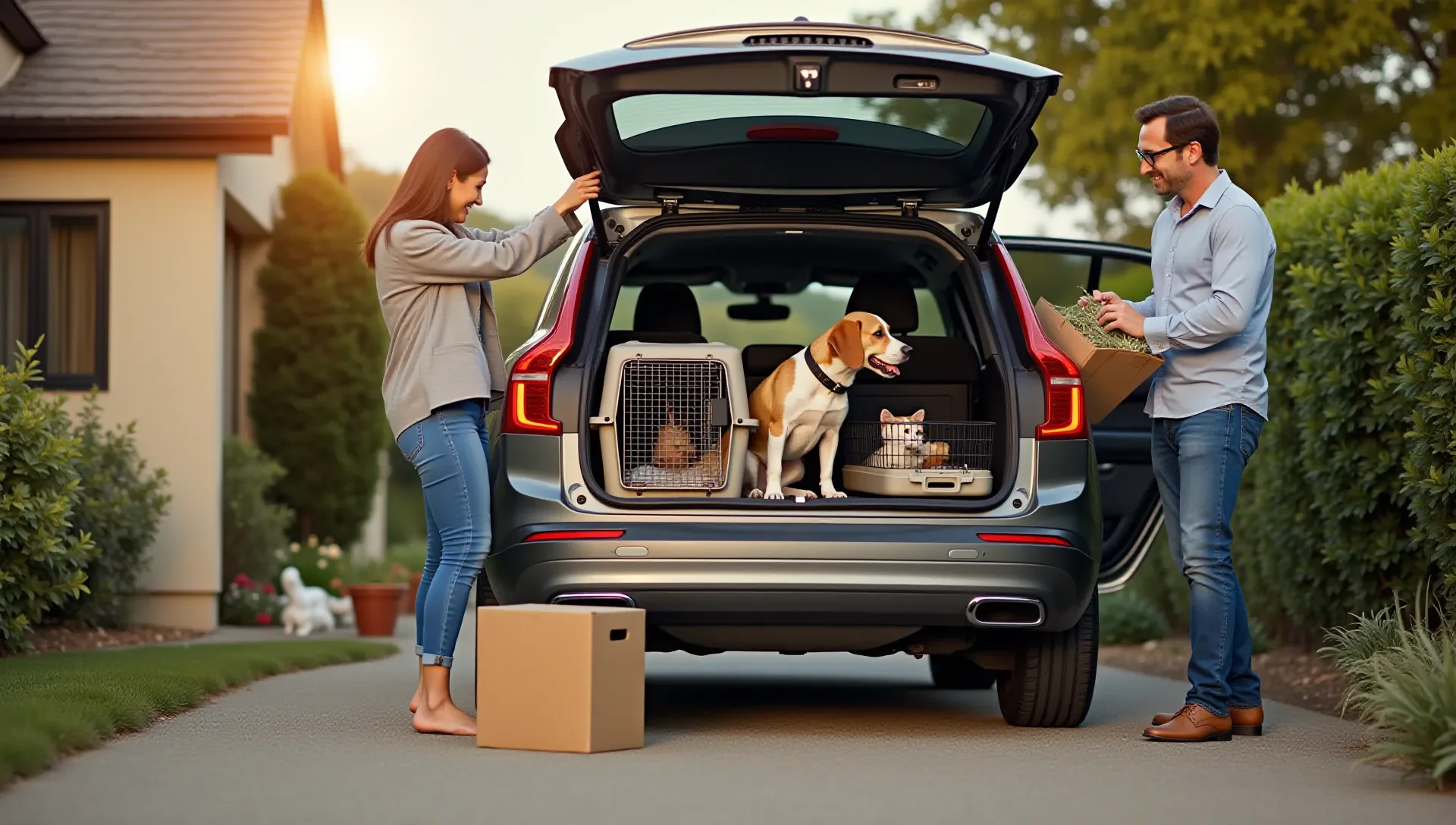
Moving 2+ pets across state lines requires interstate health certificates (CVIs) for each animal, multi-pet hotel reservations (12% of major chains accept 3+ pets per room), and either a private ground transport van or a self-drive with strict crate stacking. Plan vet visits 7-10 days before move.
Moving one pet is a checklist. Moving two pets is the same checklist done twice, with twice the paperwork, twice the vet fees, and a back seat that suddenly feels small. Moving four pets is a different category of problem. Most pet-friendly hotels cap at two animals per room. Most ground transport quotes assume one or two crates, not five. A standard SUV runs out of crate footprint somewhere between the third and fourth medium dog.
Six or more pets is professional-relocation territory. At that count, the math on a private van, a co-driver, and overnight kennel stops usually beats the math on stuffing everyone into a personal vehicle and praying for the best.
This guide is for the 2-to-7-pet household: the family with two dogs and a cat, the couple with three rescues, the foster home with five animals on the move. We will walk through the interstate health certificate rules that catch most movers off guard, the hotel chains that will actually take three pets in one room, the vet appointment strategy that saves several hundred dollars in exam fees, and the day-of arrival sequence that keeps a multi-pet introduction to a new home from going sideways.
Crossing the border? Our guide to pet transport to Canada from the US covers the rabies certificate, vet paperwork, and air-vs-ground cost.
See also Can You Bring a Dog in an Uber or Lyft? Policy Guide.
For a deeper dive, see our guide to road trip with a dog: the complete checklist and what to pack.
Related reading: pet transport to switzerland from the us: dog and cat import requirements (2026 guide).
If you are weighing your options, our guide to puppy's first car ride: prepare for the trip home and build lifelong car confidence goes further.
Moving more than one animal? Here is the cost to ship multiple pets and how the second-pet fee usually works.
It is also worth checking whether your pet insurance covers travel before you hit the road.
Crossing a national border is a different exercise from crossing a state line, as relocating a pet internationally explains.
Crossing a border rather than a state line changes the math; see relocating internationally with multiple pets.
Once everyone has settled in after the move, our guide to managing a multi-pet household covers the ongoing day-to-day side of running a smooth multi-pet home.
Why multi-pet moves are different
Four things change when you cross from one pet to several.
Paperwork multiplies. Every animal crossing a state line needs its own Certificate of Veterinary Inspection (CVI), its own rabies certificate, and in many cases its own state-specific entry permit. Three dogs and a cat means four CVIs, four rabies records, and possibly four permit numbers logged with the destination state's animal health office.
Lodging shrinks. Most major hotel chains that advertise "pet-friendly" mean one or two pets per room. Once you hit three, your list of options collapses by roughly 80%. The chains that still take you (Red Roof, Motel 6, La Quinta, Kimpton, Best Western Pet-Friendly properties) become non-negotiable waypoints on the route.
Vehicle space gets tight fast. A 36-inch crate is not a small object. Stacking is sometimes possible with the right hardware, but stacking is not legal in every state for transport, and it requires crates rated for it. A six-pet move in a personal vehicle usually means a cargo van or a co-driver in a second car.
Vet logistics compound. Three pets at separate appointments is three exam fees, three trips, three sets of paperwork errors waiting to happen. Batching them into one appointment saves money and catches inconsistencies before they become a border problem.
Interstate CVIs explained
The Certificate of Veterinary Inspection is the document that proves a pet is healthy enough to cross a state line. It is issued by an accredited veterinarian after a physical exam and verification of vaccination status (rabies in particular).
The USDA Animal and Plant Health Inspection Service (APHIS) sets the federal framework. APHIS requires a CVI for any pet crossing state lines for sale, exhibition, or commercial purpose. For a private household move, the federal rule is softer: APHIS recommends a CVI for all interstate pet movement, but state law is what actually controls whether you need one to enter.
Every US state's veterinarian office sets its own entry requirements. In practice, almost every state requires a CVI for any dog or cat entering from another state, regardless of the reason. The CVI is typically valid for 30 days from issue. A few states (Florida, for example) have shorter windows or specific endorsements for certain species.
If you are pulled over with pets in a state you are passing through, you will not be asked for paperwork. The CVI matters at the destination: when registering pets with a new municipality, boarding them, taking them to a new vet, or in the rare case of an animal control encounter. It also matters if a pet gets sick mid-transit and needs to be seen by a vet in another state.
State-by-state CVI requirements (quick reference)
| State | CVI required for entry | Rabies cert required | Notable rules |
|---|---|---|---|
| California | Yes, within 30 days | Yes, current | Dogs 4+ months need rabies; no permit required |
| New York | Yes, within 30 days | Yes, current | NY State Dept of Ag tracks entries; cats also require rabies |
| Florida | Yes, within 30 days | Yes, within 12 months | OCVI must list rabies tag #; FL endorsement preferred |
| Texas | Yes, within 30 days | Yes, current | Reciprocal with most states; no permit required |
| Illinois | Yes, within 30 days | Yes, current | Cats and dogs both covered |
| Arizona | Yes, within 30 days | Yes, current | Permit not required for personal pets |
| Colorado | Yes, within 30 days | Yes, current | Standard 30-day window |
| Washington | Yes, within 30 days | Yes, current | Cats also need CVI (some states exempt cats) |
| Pennsylvania | Yes, within 30 days | Yes, current | Standard small-animal rules |
| Hawaii | Yes, plus quarantine pre-clearance | Yes, with FAVN test | Strict: 5-day-or-less program requires advance work months before move |
Hawaii is the outlier. Moving pets there is not a 30-day vet visit and a drive. It is a months-long process involving microchip verification, FAVN rabies titer tests, and quarantine pre-clearance through the Hawaii Department of Agriculture. If Hawaii is your destination, start six months out.
For every other state, the working assumption for a multi-pet move is: each pet gets a CVI within 30 days of departure, each pet has a current rabies certificate in hand, and you carry physical copies in a folder in the car, not just on your phone.
Pre-move vet appointment strategy
The single biggest money and time saver in a multi-pet move is batching vet appointments. Most clinics will charge a full exam fee per animal at separate visits. Bring three pets in together and many practices apply a multi-pet discount, typically 20-40% off the second and subsequent exams. Some accredited vets specifically offer a "moving package" that covers CVI exams, rabies updates if needed, and a parasite check at a flat per-pet rate.
Schedule the batch visit 7-10 days before your departure. That window does three things: it leaves the CVIs well inside their 30-day validity, it gives you time to address anything the vet flags (a missing vaccination, a heartworm test, an ear infection that needs a course of antibiotics), and it lets you order a refill of any prescription medication so you do not arrive in a new state with three days of pills left.
Bring to the appointment: every pet's existing vaccination records, microchip numbers, the destination state, the destination address, and a list of any medications. The vet needs the destination to know which state's specific CVI form to fill out and whether a state-specific endorsement is required. If your route passes through a state with stricter rules than your destination, mention that too.
Ask the vet to write each CVI legibly and to attach a printed copy of each rabies certificate to its matching CVI. A loose-paper folder per pet, color-coded if you have four or more animals, will save you in any situation where someone official asks for documents.
Self-drive logistics: crates, water, rest stops
For a 2-pet move, a standard SUV with the back row folded usually works. Two medium crates fit side by side, with room above for soft bags.
For 3-4 pets, you are looking at a minivan or a full-size SUV with crates arranged in a single layer. Crate stacking is possible but only with crates specifically rated for stacking (Impact, Ruff Land, Gunner) and proper tie-down hardware. Wire crates and most plastic airline-style crates are not rated to be stacked with a live animal in the lower crate.
For 5-7 pets, the realistic options are a cargo van, a small box truck, or two vehicles with a co-driver. The cargo van approach gives you room for proper crate spacing (each crate needs a few inches of airflow on each side) and a small aisle to reach each pet at rest stops.
Water schedule: offer water at every rest stop, not in the crate while moving. A spill turns a crate into a wet box for the next four hours. Collapsible silicone bowls and a gallon jug per two pets per day is the working ratio.
Rest stop timing: stop every 2-3 hours on the road, every 4 hours at night. Each stop, every pet comes out one at a time on a leash, gets a bathroom break, gets water, goes back in. With four pets, that is a 30-minute stop, not a 10-minute stop. Build it into the day's mileage.
Multi-pet harness vs crate in the vehicle: crates are safer in a crash, full stop. Crash-test data from the Center for Pet Safety shows that even top-rated harnesses underperform a properly secured crate. Use harnesses only when crate space genuinely is not available, and pick one of the three harnesses that passed CPS testing.
Hotels that accept 3+ pets in one room
The pet-friendly hotel market is wide. The 3+ pets per room market is narrow.
| Hotel chain | Max pets per room | Fee structure | Size limit | Notes |
|---|---|---|---|---|
| Red Roof Inn | 1 pet per room (most), some properties accept more | Free at most locations | None | Property-by-property; call ahead |
| Motel 6 | 2 pets per room (corporate rule); some independent franchises allow more | Free | None | Call the specific property; managers have discretion |
| La Quinta (Wyndham) | 2 pets per room standard; manager can approve more | Free at most; up to $20 at some | Combined under 75 lbs typical | Best-in-class for 2-pet moves; ask for 3+ |
| Kimpton Hotels | No limit on number, size, or breed | Free | None | The only major chain with a true no-limit policy |
| Best Western Pet Friendly | 2 pets per room standard | $20-$40 per stay | Under 80 lbs combined typical | Property-specific; filter their site for pet-friendly |
| Drury Hotels | 2 pets per room | $35 per stay flat | Under 80 lbs | Free hot breakfast and evening reception are a multi-pet-move win |
| Residence Inn (Marriott) | 2 pets per room | $100 per stay non-refundable | Under 50 lbs each | Kitchenettes help for cooking instead of restaurant runs |
| Home2 Suites (Hilton) | 2 pets per room | $75 per stay typical | Under 75 lbs combined | Suite layout gives crates floor space |
Kimpton is the clear winner for households with 3+ pets and the budget to match. Their no-pet-limit, no-size-limit, no-breed-restriction policy is genuinely unique among national chains.
For everyone else, the practical playbook is: book two adjoining rooms when you have 3+ pets. Most properties will not formally allow a third pet in one room but will not police adjoining rooms booked under the same reservation. Call the specific property (not the central reservation line) and explain the situation. Front desk managers have more flexibility than the booking engine suggests.
When to hire a private ground transport van vs DIY
The break-even point on a private ground transport van for a multi-pet move depends on three variables: total distance, number of pets, and whether anyone in your household can safely drive long days with multiple animals.
Under 500 miles with 2-4 pets: self-drive almost always wins on cost.
500-1,500 miles with 4-6 pets: it gets closer. A self-drive with a co-driver, two hotel nights, and the wear-and-tear on your vehicle compared against a $2,500-$4,500 private van quote is often within $1,000 either way. Time and stress become the tiebreakers.
1,500+ miles with 5+ pets: a private van usually wins. Professional transporters specialize in this. The vehicles are climate-controlled, drivers run in shifts so the van moves overnight when pets are sleeping anyway, and you arrive at destination rested instead of cooked.
For a more detailed cost breakdown of these scenarios, see our pet transport cost guide and cross-country pet transport pricing.
Multi-pet ground transport cost ranges
Private ground transport pricing for multi-pet households is typically built as a base route fee plus a per-pet surcharge after the first one or two.
Typical ranges, US 2026 market:
- 2 pets, 500 miles: $900-$1,400
- 3 pets, 1,000 miles: $1,800-$2,800
- 4 pets, 1,500 miles: $2,800-$4,200
- 5-7 pets, 2,000+ miles: $4,500-$7,500
The premium over single-pet transport is not linear. Adding a second pet to an existing route typically adds $200-$400. Adding a fifth pet often requires the operator to switch to a larger vehicle or run a private (not shared) trip, which can add $1,500+ to the quote.
Get quotes from at least three operators that specifically advertise multi-pet capacity. See our vetted operator reviews for 2026 for a starting list.
Special situations
Senior pet + young pet mix. The senior sets the schedule. More frequent stops, lower-stress transitions, and a quieter crate position in the vehicle (away from a barker, closer to the driver). For an older animal with mobility or medical concerns, our senior dog pet transport guide covers the additional steps.
Reactive pet in the group. Crate the reactive pet first at every stop, last out, and use a visual barrier (a sheet over the crate, a divider between crates) so reactive sight-lines do not trigger an escalation in the vehicle. Trazodone or gabapentin prescribed by your vet for travel days is reasonable and widely used; do not start a medication on move day, run a trial dose two weeks earlier.
Brachycephalic + non-brachycephalic mix. Brachy breeds (pugs, bulldogs, Persians) overheat faster, cannot fly in cargo on most US airlines, and need the coolest crate position in the vehicle (closer to the air vents, never near a sunny window). If a brachy pet is in your group, the household effectively becomes a ground-only move; do not split the group between ground and air just to save on a single airline ticket.
Day-of arrival: settling pets in the new home
The order of introductions on arrival is the single most overlooked piece of a multi-pet move. The instinct is to open the doors and let everyone explore. That goes wrong fast.
The working sequence:
- Walk the perimeter first, no pets. Check for open doors, gaps in fencing, unattended hazards.
- Set up the calmest pet's safe room first. One bedroom or bathroom with crate, water, bed, familiar toy. This becomes the staging area.
- Bring pets in one at a time, calmest first. Each pet gets 20-30 minutes to explore alone before the next one comes in.
- Reactive or anxious pet comes in last. By the time they arrive, the house already smells like the rest of the household, which lowers the threat signal.
- Crate everyone for the first night. Even pets that have not been crated in years benefit from a single contained night in a new space. Free roam from night two onward.
- Hold off on the backyard for 24 hours if possible. Multi-pet groups in an unfamiliar yard with unfamiliar smells, off-leash, on day one is the most common runaway scenario.
For households moving with valuable or hard-to-replace animals, pet transport insurance is worth pricing before the move. Standard homeowners and renters policies typically do not cover pets in transit.