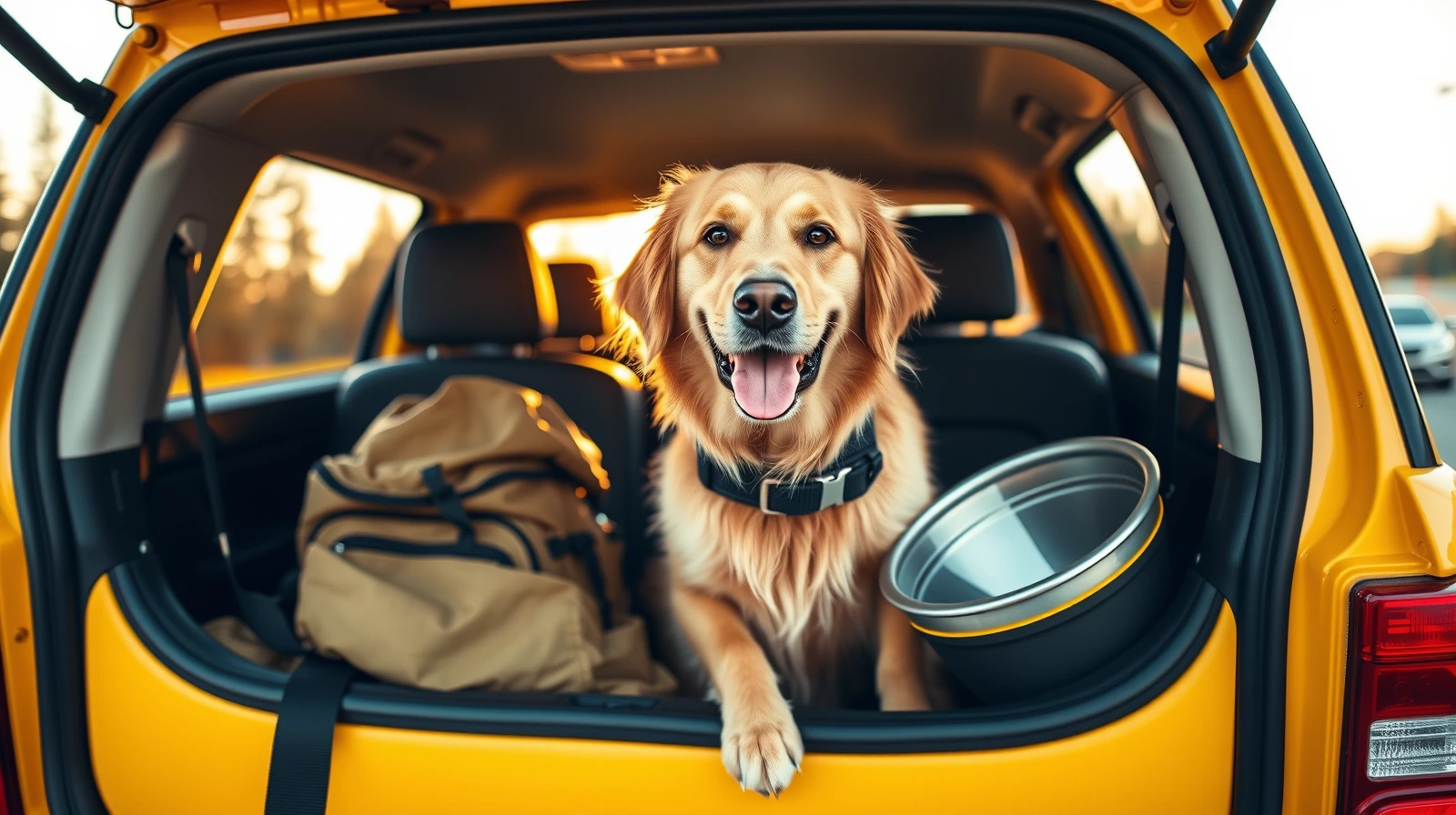
For a road trip with a dog, pack food, water, bowls, meds, a leash, ID tags plus an updated microchip, bedding, waste bags, and a pet first-aid kit, then restrain your dog in the back seat with a crash-tested harness or crate. The AVMA suggests stopping roughly every two to three hours.
For a road trip with a dog, pack food, water, bowls, meds, a leash, ID tags plus an updated microchip, bedding, waste bags, and a pet first-aid kit, then restrain your dog in the back seat with a crash-tested harness or crate. The American Veterinary Medical Association suggests stopping roughly every two to three hours for a bathroom and exercise break.
That is the short version. The long version is a planning problem: what you bring, how your dog rides, how often you stop, what you feed, and where you sleep all shape whether the trip is calm or chaotic. This guide is the broader planning and packing playbook. If you only need the safety and restraint mechanics, read our companion piece on how to transport a dog in a car, then come back here to plan the rest of the journey.
Moving somewhere specific? See our guide to Pet Transport to Singapore for that route's import requirements.
Moving somewhere specific? See our guide to Pet Transport to Costa Rica for that route's import requirements.
Related reading: How Hot Is Too Hot for a Dog in a Car? A Vet-Informed Guide.
Planning a pet move? Read our guide on Military Pet Transport.
Traveling with a working service dog instead of an ordinary pet changes some of this road-trip planning; see our guide to road-tripping with a service dog for the handler-specific details.
Bringing more than one dog along changes some of this planning; see our guide to traveling with multiple pets for the multi-pet specifics.
Taking a rental car? Check our comparison of rental car pet policies before you book, because most companies charge for pet hair left in the car.
Pet fees add up on a long drive. Our list of hotels with no pet fee covers Kimpton, Motel 6, Red Roof and other chains where pets stay free.
Planning to stop at a national park? Our guide on whether dogs are allowed in national parks compares trail rules at Acadia, Shenandoah, Grand Canyon, Yellowstone and more.
For highway stops with a big dog, pet-friendly Best Western hotels allow two dogs up to 80 lb each; our Best Western pet policy guide explains the daily fee.
Planning interstate stops? Our Wyndham pet policy guide shows how Super 8 and Days Inn pet fees and limits vary by hotel.
For free overnight stops, our Motel 6 pet policy guide explains how two dogs can stay at no charge.
Camping on the way? Our KOA pet policy guide covers the 6 foot leash rule, cabin fees and breed limits.
The complete dog road trip packing checklist
A good packing list is organized by what the item is for, not just thrown in a bag the morning you leave. We grouped the essentials into five jobs: feeding and hydration, health and safety, identification, comfort, and cleanup. Pack a dedicated dog bag so nothing competes with the cooler and the suitcases.
| Category | What to pack | Why it matters |
|---|---|---|
| Food and water | Measured meals in a sealed container, treats, collapsible bowls, bottled water, a portable spill-proof bowl | A sudden diet change on the road can cause stomach upset. Bring your dog's usual food. |
| Health and safety | Current medications, a pet first-aid kit, vet and vaccination records, your vet's phone number, any prescribed anti-nausea or calming meds | You may need records to board your dog, cross a state line, or be seen by an unfamiliar clinic. |
| Identification | Collar with an ID tag, a backup tag with your cell number, a current photo of your dog, proof of microchip registration | An ID tag plus an updated microchip is the fastest path back if your dog bolts at a rest stop. |
| Restraint and gear | Crash-tested harness or crate, a sturdy leash (and a backup), a long line for stretching legs | The restraint is the single most important item. More on this below. |
| Comfort | Familiar bedding or a blanket, a favorite toy, a chew, a worn t-shirt with your scent | Familiar smells lower stress in a strange car and a strange hotel room. |
| Cleanup | Waste bags (more than you think), paper towels, an enzyme cleaner, an old towel for muddy paws | Accidents happen on long days. Pack for them so they are a non-event. |
Two items punch above their weight. The first is your dog's own food in measured portions: buying a new bag at a gas station mid-trip is the fastest way to a car full of digestive trouble. The second is a pet first-aid kit. The AVMA recommends keeping a basic kit on hand for travel, including gauze, non-stick bandages, tape, and your vet's contact details, per its travel guidance for pet owners.
Planning a pet move? Read our guide on Pet Transport to Australia.
Car safety and restraint: the part most people skip
An unrestrained dog is a safety problem for everyone in the car. AAA reports that 31 percent of drivers admit a pet has distracted them while driving, yet only a small share use any restraint at all, according to its pet travel guidance. The physics are blunt: AAA estimates an unrestrained 10-pound dog in a 50 mph crash can exert roughly 500 pounds of force, and an 80-pound dog in a lower-speed 30 mph crash can exert around 2,400 pounds. Treat those figures as illustrative rather than exact, but the direction is clear.
Use a crash-tested harness or crate, in the back seat
Not every product labeled "safety harness" has actually been tested. The Center for Pet Safety runs independent crash testing on harnesses, carriers, and crates, and publishes a list of certified products on its CPS Certified page. CPS testing is conducted with the product secured in the back seat at roughly 30 mph. The group also advises against harnesses with long extension tethers, which can let a dog travel too far in a sudden stop. If you are shopping, start with our roundup of the best crash-tested dog car harness options.
Two placement rules from the AVMA's pet vehicle safety page matter most. First, keep your dog out of the front passenger seat: a deploying airbag can seriously injure or kill a dog, even a restrained one. Second, never let a dog ride in the driver's lap or roam the footwell. The back seat or a secured cargo area is the right place. For the full mechanics of harness fit, crate anchoring, and seat-belt tethers, see how to transport a dog in a car.
How often to stop: the rest-stop cadence
The standard guidance is a break every two to three hours. The AVMA advises planning to stop roughly every two hours so your dog can relieve itself and get some exercise, and to keep your dog leashed with a collar and tags any time it is outside the car. Adjust for your dog: a puppy, a senior, or a small bladder needs stops closer to every two hours, while a settled adult on a quiet highway can often stretch toward three.
At each stop, run the same short routine: leash on before the door opens, a bathroom break, a few minutes of walking, a small drink of water, then back in the restraint. Senior dogs need extra patience here, and stiff joints mean shorter, more frequent breaks. If you are traveling with an older dog, our guide to pet transport for senior dogs covers the adjustments that matter.
Hydration math and feeding on the road
As a baseline, the American Kennel Club notes that most adult dogs need roughly one ounce of water per pound of body weight per day. So a 40-pound dog needs about 40 ounces on a normal day, and more in heat or with activity. On a travel day, do not let your dog camel up at every stop, but do offer small drinks frequently. Pack more water than you expect to use, plus a portable bowl, so you are never relying on a clean source being available.
Feeding is the opposite: less, not more. Many veterinarians suggest feeding a light meal a few hours before departure and avoiding a full meal right before driving, which lowers the odds of car sickness. The ASPCA and partner veterinary sources recommend feeding small portions rather than a big meal on travel days. Keep the cabin cool, and never leave your dog alone in the car, where temperatures climb dangerously fast even on mild days.
Motion sickness and anxiety: prevention beats cleanup
Car sickness is common, especially in puppies, and it is often as much about anxiety as motion. Veterinary sources cited by the AKC and the ASPCA suggest a few low-tech fixes: withhold a heavy meal before the trip, keep the car cool and quiet, crack a window for fresh air, and use a crate with solid sides to limit the visual motion that triggers nausea. A worn t-shirt or familiar blanket in the crate helps a nervous dog settle.
If your dog has never done a long drive, build up to it. The classic acclimation ladder, recommended by veterinary behavior resources, is to start with your dog in a parked car with the engine running, then a trip down the driveway, then around the block, gradually extending to 20 to 30 minutes of comfortable riding before you attempt hundreds of miles. For dogs that still struggle, ask your veterinarian about anti-nausea medication such as maropitant or a calming aid. Do not give human motion-sickness drugs without veterinary direction. Always confirm any medication and dose with your vet first.
Pet-friendly lodging: book before you drive
"Pet friendly" is not a guarantee. Policies vary by property, by manager, and by season, so confirm directly before you rely on a listing. When you call, ask the questions that actually decide whether a stay works.
- Pet fee and deposit: per night, per stay, or refundable? Fees of $20 to $75 per night are common, but confirm the exact figure.
- Size and breed limits: many properties cap weight or restrict certain breeds.
- Number of pets allowed per room.
- Can the dog be left alone in the room? Many properties say no, or require crating.
- Designated relief areas and the nearest grass.
Book pet-friendly rooms ahead rather than gambling on availability after a long driving day, and keep your dog's vaccination records handy in case a property asks. AAA's pet travel resources and major pet-travel directories let you filter for pet-friendly stays along your route.
Before you leave: the vet and records pre-trip checklist
Most road-trip problems are prevented a week before departure, not on the highway. Run this pre-trip list a few days out so there is time to fix anything.
- Vet check for long trips: confirm your dog is healthy enough to travel and that vaccinations and parasite prevention are current.
- Update the microchip registry. A microchip only works if its contact info is correct. The AKC and AAHA both stress verifying your registration details before you travel, since a chip with an old phone number cannot reunite you.
- Refresh ID tags with a phone number you will actually answer on the road.
- Carry records: a vaccination certificate (especially rabies) and your vet's contact info. Some states, boarding facilities, and international destinations require a health certificate.
- Refill medications with enough for the whole trip plus a buffer.
- Map vet clinics near your overnight stops in case of emergency.
If your trip is a long cross-country relocation rather than a vacation, the calculus changes and a professional may be worth it. Our overview of how to transport a pet walks through when driving yourself makes sense versus when to hand it off.
What to do at each stage of the trip
Here is the same plan organized by timeline, from the week before to the drive home.
| Stage | What to do |
|---|---|
| 1 week before | Vet check, update microchip registry and ID tags, refill meds, acclimate a nervous dog to short drives, book pet-friendly lodging. |
| Morning of departure | Light meal a few hours before driving, a long walk to burn energy, load the dog bag, install the harness or crate in the back seat. |
| On the road | Stop every 2 to 3 hours for a bathroom break, short walk, and small drink. Keep the cabin cool. Never leave the dog alone in the car. |
| At each rest stop | Leash on before the door opens, relieve, walk, hydrate, check paws on hot pavement, re-secure the restraint. |
| Overnight | Set up familiar bedding, stick to the normal feeding schedule, do not leave the dog alone in the room unless the property allows it. |
| Drive home | Repeat the cadence, watch for fatigue or stress, and give your dog a quiet recovery day after a long trip. |
One small add-on worth considering for nervous escape artists or busy rest stops is a GPS tracker that clips to the collar, so a bolt for the tree line does not become a frantic search. We compare options in our guide to the best GPS tracker for pets.
How we sourced this
The rest-stop cadence, airbag warning, and restraint placement come from the AVMA's pet-owner travel and vehicle-safety pages. The crash-force figures and distraction statistics are AAA's published estimates. Crash-testing standards and the back-seat, no-extension-tether guidance come from the Center for Pet Safety. Hydration and motion-sickness guidance draws on the AKC and ASPCA, plus the veterinary sources they cite. Prices and policies are ranges that change, so confirm current fees and any health-certificate requirements with the specific facility, lodging, or your veterinarian before you travel.
How often should I stop on a road trip with my dog?
What is the single most important thing to pack?
Where should my dog sit in the car?
How much water does my dog need on a travel day?
How do I prevent car sickness?
Should I feed my dog before a long drive?
What should I do about the microchip before traveling?
Do I need any documents to travel with my dog?
Sources & references
- avma.org https://www.avma.org/resources-tools/pet-owners/petcare/traveling-your-animal
- avma.org https://www.avma.org/resources-tools/pet-owners/petcare/pets-vehicles
- aaa.com https://www.aaa.com/pettravel/pet-travel-tips/Driving-With-Your-Pet
- centerforpetsafety.org https://centerforpetsafety.org/cps-certified/
- akc.org https://www.akc.org/expert-advice/health/puppy-drinking-enough-water/