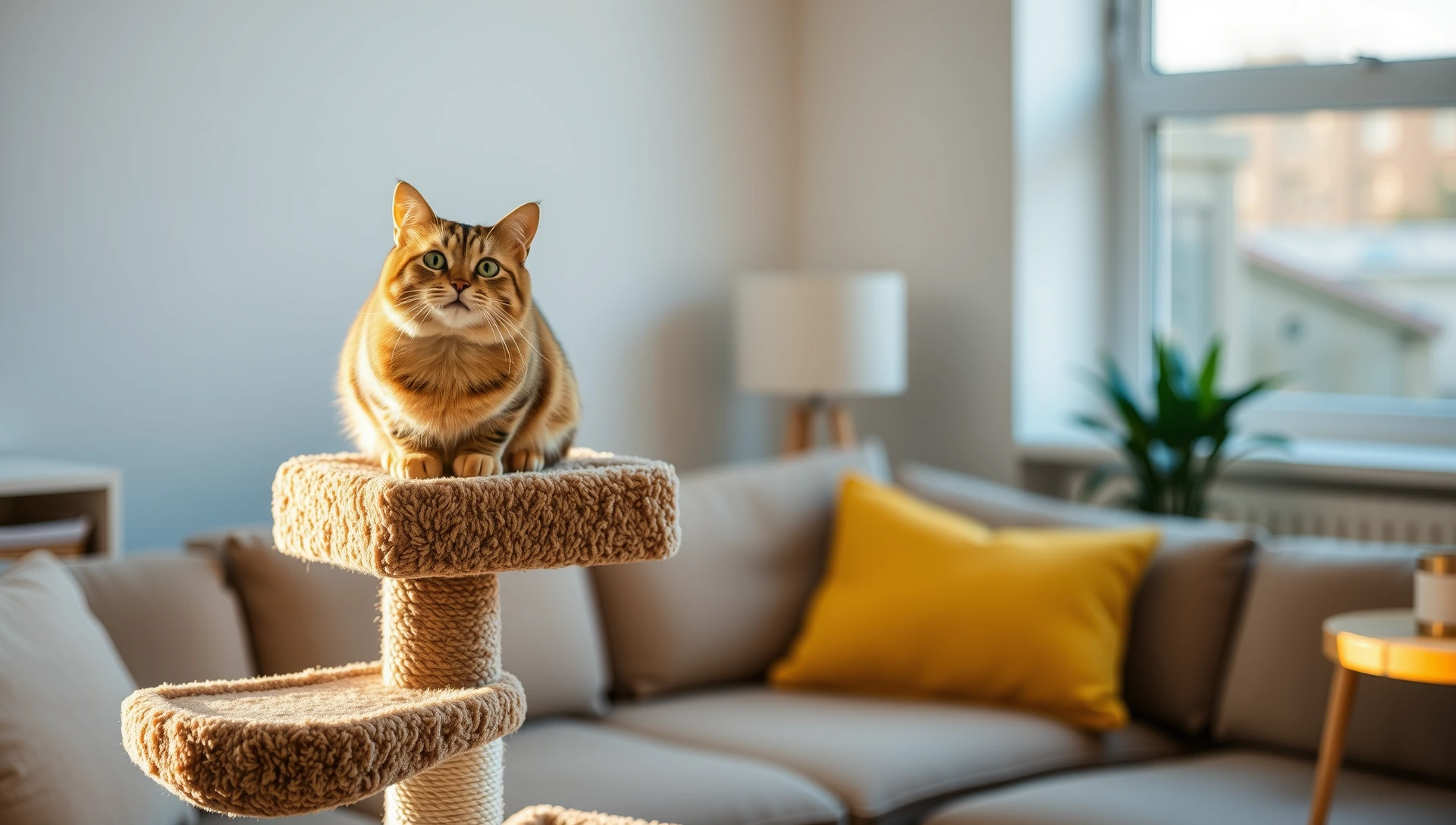
The best cat tree is the one that is stable enough not to tip, sized for your cat, and placed where your cat wants to be. Match height and base weight to your cat's size and age, favor sisal posts and a wide base, and always confirm the current price and specs before you buy.
A cat tree is one of the few pieces of furniture you can buy that your cat will actually use every day. The trouble is that "best cat tree" means something different for a 6-pound senior, a 16-pound Maine Coon, and a household juggling three cats who would rather not share. This guide skips the affiliate hype and walks through what actually matters: why vertical space is a need rather than a treat, the main types of trees, how to match one to your specific cat, and the single safety issue that sends most trees back to the store. We name representative brands by category, but we do not invent prices or specs, so treat every figure here as a starting point and confirm the current details on the seller's page before you buy.
Gearing up for your pet? Compare our pick for the Best Heated Dog Bed.
Why cats need vertical space
Cats are climbers by instinct. In the wild a high perch is both a lookout for prey and an escape route from threats, and that drive does not switch off indoors. Veterinary and behavior groups treat vertical space as part of basic environmental enrichment, not a luxury. The Cornell Feline Health Center and International Cat Care both recommend giving indoor cats elevated places to climb, rest, and observe, because the ability to get up high gives a cat a sense of control over its surroundings.
That control pays off in a few ways. A cat on a perch can watch the room, see movement before it arrives, and feel safe enough to relax. Climbing and stretching to a high platform is also real exercise for an indoor cat that does not hunt for a living. And in multi-cat homes, vertical space is a peace treaty. Cats do not share territory the way dogs do, so adding levels lets each cat claim its own height and reduces the standoffs that happen when everyone is stuck on the floor. If you are already managing tension between pets, pairing more vertical space with the steps in our guide to introducing two cats tends to work better than either fix alone.
Gearing up for your pet? Compare our pick for the Best Cat Grooming Brush.
The main types of cat trees
"Cat tree" is a loose label that covers several very different products. Knowing the categories makes it much easier to shop.
- Tall multi-level towers. The classic shape: a base, several posts, and stacked platforms, often with a perch on top. Best for cats that love to climb and survey, and the most common format from value brands.
- Wall-mounted shelves. Floating shelves and steps anchored into studs. They free up floor space and let cats traverse a wall, but installation and weight ratings matter, and they are harder to reposition.
- Window perches. A simple platform that mounts to the glass or sill. Not a full tree, but a cheap, high-value add for sunbathing and bird-watching.
- Modern and furniture-style trees. Designed to blend with your decor, often using wood and neutral fabric instead of beige carpet. You pay a premium for looks.
- Sisal scratching-post trees. Trees built around tall, sturdy sisal posts so the cat can scratch and stretch fully. A good fit if scratching the couch is the problem you are trying to solve.
- Cat condos with hideaways. Towers that include enclosed cubbies or "caves." Great for shy cats or those who like to nap out of sight.
Gearing up for your pet? Compare our pick for the Best Dog Toys for Aggressive Chewers.
Stability and base weight: the number one safety issue
If you read only one section, read this. The most common complaint about cat trees is not looks or fabric, it is tipping. A tall tree on a small, light base is a hazard, because a cat does not climb gently. It launches, lands hard, and shifts its weight near the top, where a wobble is most dangerous. A tree that rocks even slightly teaches a cat to distrust it, and a tree that actually falls can injure the cat or scare it off the tower for good.
What to look for: a wide, heavy base relative to the tree's height, a low center of gravity, and ideally a wall-anchor strap for the tallest models. Heavier is generally safer here, so a tree that feels reassuringly hard to drag across the floor is doing its job. For big or enthusiastic cats, a slightly shorter tower with a broad footprint beats a skinny tree that reaches the ceiling. When you assemble it, tighten everything fully and do a firm shake test before you let the cat near it.
Materials: sisal vs carpet, particleboard vs solid wood
Materials decide how long a tree survives and how much your cat enjoys it. For scratching surfaces, sisal rope and sisal fabric hold up better and longer than carpet, which frays and pills under repeated clawing. Carpet still has a place as a soft surface for platforms and perches, just not as the main scratching target. Giving cats an appealing, durable post to scratch is also the standard behavior advice for protecting your furniture, as the ASPCA notes in its guidance on destructive scratching.
For the structure itself, most budget towers use particleboard or MDF wrapped in fabric, which is fine for light to average cats and keeps the price down. Solid wood costs more, weighs more (which helps stability), and tends to last for years, so it is the better long-term buy for large or hard-on-their-stuff cats. One practical detail that gets overlooked: replaceability. Trees with swappable sisal posts or removable, washable cushions extend the useful life of the whole unit, since the scratching post is usually the first thing to wear out.
How to choose for your specific cat
Start with the cat in front of you, not the photo on the box.
- Kittens. Want low platforms and short hops while they build coordination. Avoid tall trees with big gaps between levels until they are bigger and surer.
- Seniors and arthritic cats. Need a low entry and closely spaced, easy steps so they can still reach a perch without a painful leap. A ramp or a perch near a sofa helps.
- Large breeds (Maine Coon, Ragdoll, Norwegian Forest Cat). Need oversized platforms, thick posts, generous weight ratings, and a heavy base. Standard towers often have perches too small for them to actually fit on.
- Overweight cats. Need a low entry point and sturdy, wide platforms, since high jumps are hard on their joints and a thin platform may not hold them comfortably.
- Multiple cats. Need more total perches than you have cats, spread across heights, so no single cat can block the only good spot.
Bonded or social cats may happily share a large tree; cautious ones do better with separate climbing options in different rooms. If you are blending species, the same logic applies, and our guide to introducing a cat to a dog covers why an elevated retreat the dog cannot reach matters so much.
Placement: where the tree actually goes
A great tree in the wrong spot gets ignored. Two placements win most of the time. First, by a window, where the cat gets sun, a view, and free entertainment from birds and street activity. Second, in a social room such as the living room, where the cat can be near you and the household action while keeping a safe perch above it. Tucking a tree into a spare bedroom nobody uses is the classic mistake, because cats want to be where the warmth, light, and people are.
Avoid high-traffic doorways, drafty corners, and spots right next to a loud appliance. If your cat is often home by itself, a window perch plus a comfortable tree is a meaningful upgrade to its day, which matters more than people think given how long cats are sometimes left alone.
Representative brands by type
These are well-known names grouped by the role they tend to fill. We are not ranking specific models or quoting exact prices, because lineups and pricing change constantly. Use these as a starting point and verify the current model, dimensions, weight rating, and price on the seller's page before buying.
- Value towers: Frisco, Feandrea, and Yaheetech are commonly recommended for solid, affordable multi-level towers, typically in the lower price band.
- Modern and furniture-style: Tuft + Paw and The Refined Feline focus on design-forward trees that suit a styled home, generally at a premium price.
- Large and sturdy: Vesper and On2Pets are often cited for bigger, more substantial builds suited to large cats or owners who want a tree that doubles as decor.
Brand reputation is a useful filter, but the specific model's base weight, platform size, and weight rating matter more than the logo. Read recent owner reviews for any tipping or wobble complaints before you commit.
Quick comparison by use-case
| Use-case | What to prioritize | Type that usually fits | Typical price band |
|---|---|---|---|
| Large cats | Big platforms, thick posts, heavy wide base, high weight rating | Large sturdy tower, solid wood | Mid to high |
| Multiple cats | More perches than cats, spread across heights | Tall multi-level tower or condo | Mid |
| Kittens | Low, closely spaced platforms, soft surfaces | Compact tower or condo | Low to mid |
| Seniors | Low entry, easy steps, gentle climb | Short tower or window perch | Low to mid |
| Small space | Small footprint, vertical reach | Wall shelves or window perch | Low |
| Modern decor | Wood, neutral fabric, clean lines | Furniture-style tree | High |
| Budget | Stability over height, sisal posts | Value multi-level tower | Low |
Frequently asked questions
How tall should a cat tree be?
Why does my cat ignore the cat tree?
Are sisal posts better than carpet?
How do I stop a cat tree from tipping over?
What is the best cat tree for a Maine Coon or other large breed?
Is a cat tree worth it for one indoor cat?
How do I get a kitten or nervous cat to use a new tree?
Where should I put a cat tree in a new home?
Sources & references
- aspca.org https://www.aspca.org/pet-care/cat-care/common-cat-behavior-issues/destructive-scratching
- vet.cornell.edu https://www.vet.cornell.edu/departments-centers-and-institutes/cornell-feline-health-center/health-information/feline-health-topics/environmental-enrichment-cats
- icatcare.org https://icatcare.org/articles/keeping-your-cat-happy-indoors
- chewy.com https://www.chewy.com/b/frisco-2697
- therefinedfeline.com https://www.therefinedfeline.com/