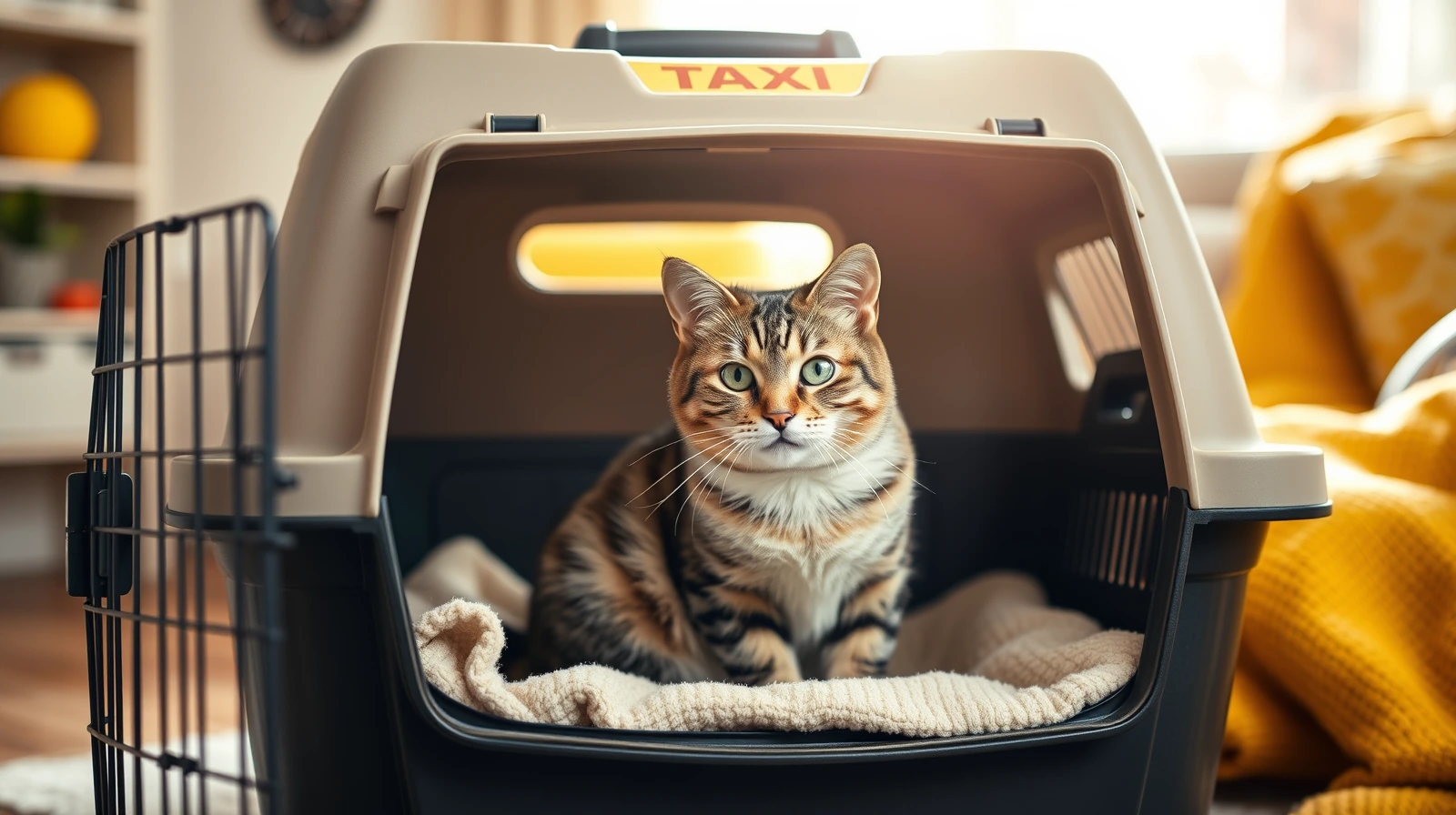
To crate train a cat, leave the carrier out as everyday furniture with the door open, make it inviting with familiar bedding and treats, feed your cat inside to build a positive association, then slowly add closed-door time, lifting, and short car rides. Go at the cat's pace, ideally starting 8 or more weeks before travel.
To crate train a cat, leave the carrier out as everyday furniture with the door open, make it inviting with familiar bedding and treats, feed your cat inside to build a positive association, then slowly add closed-door time, lifting, and short car rides. Go at the cat's pace, ideally starting 8 or more weeks before any planned travel.
Most cats hate the carrier because it appears once a year and means a stressful vet trip. The fix is not a better carrier alone, it is acclimation: turning the carrier into a familiar, safe spot the cat chooses on its own. Done patiently, the same box that triggers a hiding-under-the-bed panic becomes a nap den. Below is a calm, vet-informed, step-by-step plan, plus what to do if you only have a few days.
See also How to Stop a Cat From Scratching Furniture.
For cat owners: our guide to How to Stop Cats From Fighting.
Why cats fight the carrier (and why patience wins)
Cats are territorial and sensitive to change. The American Animal Hospital Association (AAHA) and the cat-behavior nonprofit International Cat Care both note that carrier and travel stress is largely learned: the carrier predicts confinement, car motion, and the vet, so the cat reacts before anything bad has even happened. Forcing a frightened cat into a box on the day of a trip reinforces that the carrier equals fear, and makes next time worse.
The behavioral counter to this is simple but slow: repeated, low-pressure exposure paired with good things (food, comfort, calm) so the carrier stops predicting anything scary. This is the same desensitization-and-counterconditioning logic veterinary behaviorists use for other feline fears. It works at any age, but it is gentler and faster when you start well ahead of need. If you are reading this the night before a move, jump to the fast-track section, but know your expectations have to drop accordingly.
For cat owners: our guide to How to Cool Down a Cat in Summer.
Start early: the 8-week head start
If you have a planned trip, vet appointment, or relocation on the calendar, begin acclimation roughly 8 or more weeks out. That cushion lets you move one small step at a time and repeat each step until the cat is bored by it rather than bothered. A bored cat is a calm cat. There is no penalty for going slower than the timeline, the only mistake is rushing.
If there is no trip on the horizon, train anyway. A carrier-comfortable cat makes emergencies (a sudden illness, a wildfire evacuation, a last-minute boarding need) dramatically less traumatic for everyone. Treat carrier training like a standing life skill, not a one-off project.
For cat owners: our guide to How Much Does Cat Boarding Cost in 2026? Rates by Night, Cattery Type, and Region.
Choosing the right carrier
The carrier itself matters more than people expect. International Cat Care and many feline-friendly veterinary practices recommend a hard-sided carrier that is large enough for the cat to stand up, turn around, and lie down comfortably, with a removable or hinged top. A top-loading or top-removable design lets you lower a calm cat in from above instead of shoving it through a small front door, and it lets a vet examine the cat while it sits in the familiar base. That single feature removes most carrier-day wrestling.
- Hard-sided over soft-sided for everyday training and vet trips: it feels secure, holds its shape, and is easy to clean.
- Top-loading or removable top so you can lift the cat in gently and take the lid off for exams without dragging the cat out.
- Right size: big enough to stand and turn, not so cavernous the cat slides around in the car.
- Non-slip mat or liner inside so the floor does not feel unstable. A towel that smells like home doubles as bedding.
- Seatbelt-friendly: a shape and handle that let you secure it with a seatbelt in the car.
For specific picks across hard-sided, top-loading, and airline-cabin styles, see our guide to the best cat carrier for travel. Match the carrier to the trip: a sturdy top-loader for vet visits and car travel, an airline-compliant soft carrier if you are flying with a cat in cabin.
The step-by-step crate training plan
Work through these steps in order. Spend days or even a couple of weeks on each one if needed. Only advance when the current step is genuinely boring to the cat, meaning relaxed body language, eating normally, no freezing or fleeing. End every single session on a calm, positive note before the cat gets uneasy.
- Leave the carrier out as furniture. Set it in a room the cat likes, door open or top off, and just leave it there for days. The goal is for the carrier to stop being an event and become part of the scenery.
- Make it inviting. Add familiar bedding or a worn t-shirt, drop a few treats inside, and try a pinch of catnip or a favorite toy. Let the cat discover it with zero pressure. Reward any voluntary sniff or step toward it.
- Feed near, then inside. Put meals beside the carrier first, then just inside the opening, then fully inside over successive days. Eating inside is the single strongest signal that the carrier is safe. This positive-association phase can take days to weeks, and that is normal.
- Close the door for seconds, then minutes. Once the cat eats and relaxes inside, gently close the door for a few seconds while it finishes a treat, then open it. Build up to a minute, then several minutes, always pairing closed-door time with something good and never letting the cat panic.
- Practice lifting and carrying. Lift the closed carrier a few inches, set it down, reward. Progress to carrying it short distances around the house. Always support the bottom with both hands or a hand under the base, never swing it by the handle alone.
- Short car rides, then longer. Carry the cat to the car, buckle the carrier in, sit briefly, then bring it back inside. Next, drive around the block. Build up to longer trips. End each ride calmly at home, not only ever at the vet, so the car does not become its own trigger.
Once your cat rides calmly, the same foundation carries over to bigger journeys. Our guides to traveling with a cat in a car and longer long-distance cat transport cover route planning, breaks, and safety restraint for the trips this training is preparing you for.
Do and do not: a quick reference
| Do | Do not |
|---|---|
| Leave the carrier out year-round as normal furniture | Hide it in a closet and pull it out only on vet day |
| Feed meals and treats inside to build a positive link | Lure the cat in then immediately slam the door |
| Move one small step at a time, repeating until boring | Skip ahead because you are short on time |
| Lift and carry supporting the bottom with both hands | Swing or tilt the carrier by the handle alone |
| End every session calm and positive, before stress builds | Push until the cat freezes, hisses, or tries to bolt |
| Use a towel cover and a pheromone spray to lower arousal | Scruff or shove a distressed cat into the carrier |
| Sometimes drive somewhere pleasant or just home again | Only ever use the carrier for the vet |
Calming a stressed cat
Even with good training, some cats stay anxious. A few calming tools, used together, take the edge off without forcing anything.
- Synthetic pheromones. A feline facial-pheromone spray such as Feliway, applied to the bedding and inside of the carrier roughly 15 minutes before you put the cat in (so the propellant dissipates), can signal safety. Let it dry first. Our roundup of the best cat calming aids compares sprays, diffusers, and other options.
- Cover the carrier. Draping a towel or blanket over the carrier creates a dark, den-like space that reduces visual stimulation and helps many cats settle. Make sure airflow is not blocked.
- Never force or scruff. Scruffing or shoving a frightened cat into a carrier escalates panic and erases your training progress. If the cat is distressed, stop and go back a step.
- See your vet for severe anxiety. If a cat is intensely fearful, vocalizing, drooling, or panicking despite gradual training, talk to your veterinarian. Prescription anti-anxiety or anti-nausea medication for travel is sometimes appropriate, but that is a veterinary decision based on your individual cat, not something to source or dose on your own.
According to veterinary guidance summarized by Veterinary Partner (VIN) and AAHA, the combination of gradual desensitization, a familiar covered carrier, and pheromone support resolves most everyday carrier stress without medication. Medication, when needed, supports the training rather than replacing it.
Fast-track: if you only have a few days
Sometimes there is no 8-week runway: an emergency vet visit, a sudden move, an unplanned flight. You can compress the plan, but be realistic. A few days of work will not undo a lifetime of carrier fear, the goal shifts to making one trip as low-stress as possible, not to a fully trained cat.
- Set the carrier out now, top off or door open, in the cat's favorite room with familiar bedding inside.
- Feed every meal in or right next to it for the days you have, plus high-value treats only available inside.
- Spray a pheromone product on the bedding about 15 minutes before each session and before the trip itself.
- Use a top-loading carrier if you can borrow or buy one, so you can lower the cat in gently rather than fighting it through a front door.
- Cover the carrier with a towel for the journey to reduce stress.
- Call your vet ahead of time. If your cat has a history of extreme travel panic, ask whether a one-off anti-anxiety or anti-nausea medication is appropriate. This is a vet-only decision and needs to be arranged before the day.
After the trip, do not pack the carrier away. Keep it out and resume the slow plan so the next trip starts from a better place. If the move is a major one, our guide to introducing a cat to a new home picks up where the carrier work leaves off.
Carrier-day and vet-visit tips
- Prep the carrier early. Bring it out hours ahead, not minutes, with pheromone spray applied and dry, and bedding in place.
- Lower the cat in calmly through the top if possible, or back the cat in rear-first through a front door so it does not see the opening as a trap.
- Secure it in the car. Place the carrier on a seat and run the seatbelt through or over it so it cannot slide or tip. An unsecured carrier becomes a projectile in a sudden stop.
- Keep it covered and quiet on the way, with steady driving and low noise.
- At the vet, ask whether the top can come off so the cat can be examined in the familiar base rather than dragged out.
- End on a good note at home with food, calm, and quiet.
How we sourced this
This guide follows feline-friendly handling and low-stress travel principles published by the American Animal Hospital Association (AAHA), the veterinary-reviewed Veterinary Partner library from the Veterinary Information Network (VIN), and the cat-behavior nonprofit International Cat Care. The training method described is standard desensitization and counterconditioning. Calming products such as pheromone sprays vary by cat, and any medication is a decision for your own veterinarian. For your specific cat and trip, confirm current advice and any prescription options directly with your veterinarian before traveling.
Primary references: AAHA cat-friendly handling, Veterinary Partner (VIN) on cat carriers and travel, and International Cat Care on choosing and using cat carriers. For motion and travel safety, see the AVMA traveling-with-your-pet FAQ.
How long does it take to crate train a cat?
What kind of carrier is best for training?
Should I use Feliway or another pheromone spray?
Is it ever okay to force or scruff a cat into the carrier?
Can I crate train an older or already carrier-fearful cat?
My cat panics in the car even after training. What helps?
I only have a few days before a trip. What should I do?
When is medication appropriate for travel anxiety?
Sources & references
- aaha.org https://www.aaha.org/your-pet/pet-owner-education/cat-friendly-handling/
- veterinarypartner.vin.com https://veterinarypartner.vin.com/default.aspx?pid=19239&id=4951446
- icatcare.org https://icatcare.org/advice/cat-carriers/
- avma.org https://www.avma.org/resources-tools/pet-owners/petcare/traveling-your-pet-faq