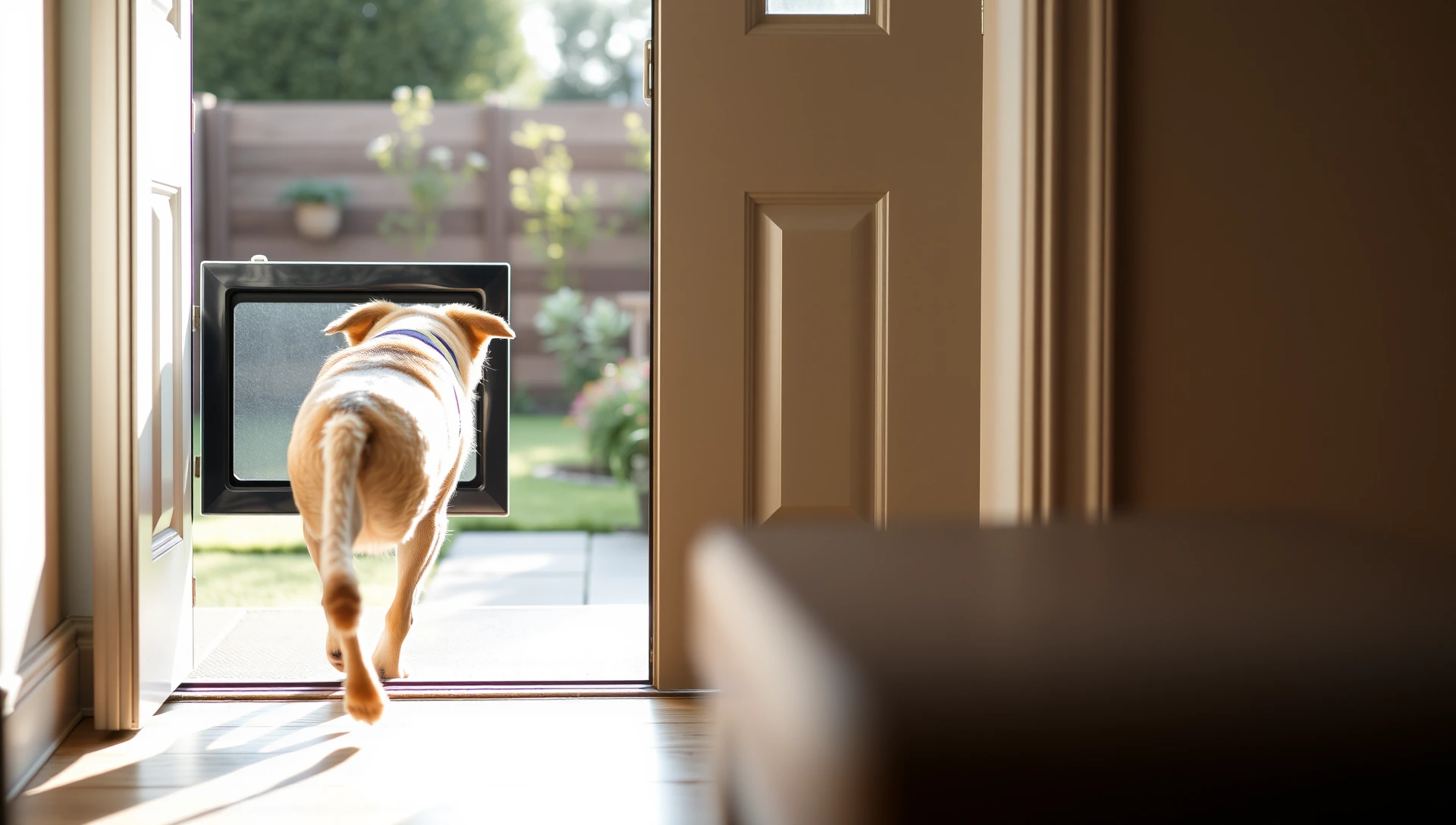
There is no single best dog door. The right pick depends on where it installs (exterior door, sliding glass, wall, or window) and whether you need an electronic microchip model to keep strays out. Measure your dog's shoulder width and step-over height first, then match the type to your home.
A dog door buys your dog freedom and buys you back the hours you spend playing doorman. But "best dog door" is the wrong way to shop, because the right model depends almost entirely on where it goes and what it has to keep out. A flap that suits a wood exterior door is useless for a rental with a sliding glass slider, and a basic plastic flap that a Labrador shoulders through in seconds is the wrong choice if raccoons share your yard. This guide walks the major types, the trade-offs (energy, security, durability), how to size correctly, and which brands tend to show up in each category.
Gearing up for your pet? Compare our pick for the Best Dog Treat Pouch.
Start by measuring your dog, not the door
Sizing is the one step people skip and then regret. Two measurements matter most. First, shoulder width: the widest point of your dog, usually the chest or hips, which sets how wide the flap opening must be. Second, step-over height, sometimes called the rise: measure from the floor to the top of the shoulders (the withers), then add a couple of inches so your dog can clear the bottom of the flap without crouching. The American Kennel Club's overview of doggie doors is a good primer on whether a door suits your dog and home at all before you measure.
- Flap width should comfortably exceed your dog's widest point, with a little margin for a winter coat.
- Flap height should clear the dog from the top of the shoulders.
- Step-over height (the gap from the floor to the bottom of the flap) should be low enough for an older or short-legged dog to step over, but not so low it weakens the door or sits below your weatherstripping line.
- Plan for the largest pet who will use it, including the puppy who is still growing.
Manufacturers publish flap opening dimensions and recommended pet weight or height ranges. Measure your dog, write the numbers down, and shop to those numbers rather than to a vague "small, medium, large" label, since sizing varies between brands.
Gearing up for your pet? Compare our pick for the Best Dog Grooming Clippers.
The main types and where each one installs
Most dog doors fall into five installation families. Pick the one that matches your wall or door before you compare features.
Gearing up for your pet? Compare our pick for the Best Dog Paw Balm.
Flap doors for exterior doors
The classic: a framed flap cut into a solid exterior door, usually wood, steel, or fiberglass. This is the most common and generally the cheapest type, and it suits homeowners who can cut into their own door. PetSafe is the volume brand here, with plastic and aluminum framed flaps across small to large sizes. The downside is that you are permanently modifying a door, so renters usually look elsewhere.
Wall-mount doors
A wall-mount unit passes through the wall itself with a tunnel that spans the wall thickness. It is the most flexible placement (you are not limited to where a door happens to be) and it tends to be the most weatherproof because it can use thick, double-flap construction. It is also the most involved install, since you are cutting through framing and exterior cladding, and you need to check for wiring or pipes first. PetSafe's wall-entry models and premium makers like Hale and Endura Flap all offer wall kits with tunnel extenders for thicker walls.
Sliding glass and patio panel inserts
This is the renter's friend. A patio panel is a tall, narrow insert with a built-in flap that drops into the track of an existing sliding glass door, shortening the slider's travel rather than cutting any hole. Nothing is permanent, so it comes out when you move. Ideal Pet Products is the brand most often cited for affordable aluminum patio panels; premium panels exist too. The trade-offs are that the panel narrows your doorway slightly and a single-pane panel can be a weak point for insulation unless you choose a dual-pane model.
Window inserts and screen-door doors
Less common but useful in specific cases. A window-mount door fits a sash window (often for cats and very small dogs, since the opening is limited by the window width). A screen-door insert mounts into a screen or storm door for warm-weather access. Both are typically lighter duty and best for small dogs, and they are not strong on insulation or security.
Manual flap vs electronic, microchip, and RFID doors
A manual flap opens for anyone or anything that pushes on it: your dog, a neighbor's cat, a raccoon, a possum, sometimes a determined wild animal. For many homes that is fine. If it is not, electronic doors solve it by staying locked until they sense an authorized pet.
- Microchip doors read your pet's existing vet-implanted microchip and unlock only for registered chips. SureFlap (Sure Petcare) is the best known name, and PetSafe also makes microchip and RFID models. SureFlap states its microchip door is compatible with the common microchip types and only opens for your pet's chip or an RFID collar tag, which keeps strays and wildlife out (see the SureFlap microchip pet door page).
- RFID collar-tag doors read a small fob on the collar instead of a chip, which works if your pet is not chipped.
- Motion or sensor doors use a collar sensor to trigger a motorized panel that slides or lifts, sometimes with an automatic deadbolt, which doubles as a security feature.
The catch with electronic doors is cost, battery dependence, and a learning curve for nervous dogs who dislike the click or motor sound. Note that most microchip doors are sized for cats and small dogs, so confirm the flap opening fits a larger breed before buying. If you are introducing any new door to a hesitant dog, the patience approach we describe in crate training a dog for travel transfers well: short sessions, treats, and never forcing them through.
Weatherproofing and energy efficiency
A hole in your wall is a hole in your thermal envelope. A cheap single flap with a loose seal will leak conditioned air year round. The features that reduce that loss are a tight magnetic closure that pulls the flap shut, weatherstripping around the edges, and, most effective of all, a dual-flap design that traps an insulating air pocket between two flaps. Premium makers lean on this: Hale and Endura Flap both build double-flap, magnetically sealed doors marketed for thermal performance and wind resistance, and Hale's comparison page describes the magnetic seal and insulated construction on its models. The U.S. Department of Energy's guidance on weatherstripping is a useful reminder that any gap, including the one your dog door creates, is worth sealing.
If you live somewhere with real winters or hot summers, a dual-flap or insulated patio panel pays for itself in comfort and energy over a single-flap budget door.
Security: a dog door is a hole in your house
This deserves blunt treatment. A large dog door is a security consideration, full stop. A flap big enough for a 70-pound dog is big enough for a small adult or a child to reach through or climb through. That does not mean you should not install one, but it does mean you should think it through.
- Use the locking cover. Most quality doors ship with a rigid security panel that slides in to seal the opening when you are away or asleep.
- Consider an electronic locking door. Models that stay deadbolted until they sense your pet remove the open-flap vulnerability entirely.
- Place it thoughtfully. A door that is not visible from the street, or that opens into a fenced and secured yard, is lower risk than one facing an alley.
- Right-size it. Do not buy a door larger than your dog needs. A smaller opening is a smaller vulnerability.
Durability for chewers and big dogs
Some dogs treat the flap as a chew toy, and powerful dogs put real force on the frame and hinge every time they bolt through. If that is your dog, skip the thin vinyl flaps and look for heavy-duty flexible flaps, aluminum or steel frames, and well-reviewed hinge or magnet hardware. Replacement flaps are sold separately for most major brands, which is worth checking before you buy, since a tough flap that you can replace cheaply beats a sealed unit you have to scrap. A door that survives a determined dog is the same engineering mindset that goes into a good travel crate, which we cover in our best dog crate guide.
Comparison by use case
Use this to narrow the field by your situation, then verify the exact model fits your dog's measurements. Price bands are broad and approximate, and dog door pricing moves often, so always confirm the current price at the retailer before buying.
| Use case | Door type | Representative brands | Typical price band |
|---|---|---|---|
| Exterior door (homeowner) | Framed flap, single or dual | PetSafe, Ideal Pet Products | Budget to mid (roughly $40-$150) |
| Sliding glass / patio (renter) | Patio panel insert | Ideal Pet Products | Mid (roughly $130-$350) |
| Through-the-wall | Wall-mount with tunnel | PetSafe, Hale, Endura Flap | Mid to premium (roughly $150-$500+) |
| Keep strays / wildlife out | Electronic microchip or RFID | SureFlap, PetSafe | Premium (roughly $150-$350) |
| Large dog | Large framed flap or wall-mount | PetSafe, Endura Flap, Hale | Mid to premium (roughly $120-$500+) |
| Energy efficiency | Dual-flap, magnetic seal | Endura Flap, Hale, PetSafe Ruff Weather | Premium (roughly $200-$500+) |
| Budget pick | Single-flap framed door | PetSafe, Ideal Pet Products | Budget (roughly $40-$90) |
Installation difficulty, briefly
Patio panels are the easiest, since they drop into the slider track with no cutting and come out when you move, which is why they suit renters. Door-mount flaps are moderate: you trace a template, cut a hole in the door, and screw the frame in place, doable in an afternoon with basic tools. Wall-mount doors are the hardest and the one most people hire out, because you are cutting through structural framing and exterior cladding and must avoid wiring and plumbing. Electronic doors add battery and programming steps but the physical mounting matches whichever family they belong to.
One last thought on cost in context: a dog door is a small one-time outlay against the ongoing convenience it buys. If you are weighing it against paying for help, our breakdowns of how much a dog walker costs and how much pet sitting costs put the numbers side by side. And if your dog struggles with steps or jumping, a door pairs naturally with mobility aids like the ones in our best dog ramp for car guide.
Frequently asked questions
How do I measure my dog for a dog door?
Can I install a dog door if I rent?
Do electronic microchip dog doors really keep strays out?
Is a dog door a security risk?
What is the most energy-efficient dog door?
Which type of dog door is best for a large dog?
Will a dog door let in drafts?
How hard is it to install a dog door myself?
Sources & references
- akc.org https://www.akc.org/expert-advice/training/doggie-doors-pros-cons/
- surepetcare.com https://www.surepetcare.com/en-gb/pet-doors/microchip-pet-door
- halepetdoor.com https://www.halepetdoor.com/dog-doors/compare/endura-flap
- energy.gov https://www.energy.gov/energysaver/weatherstripping