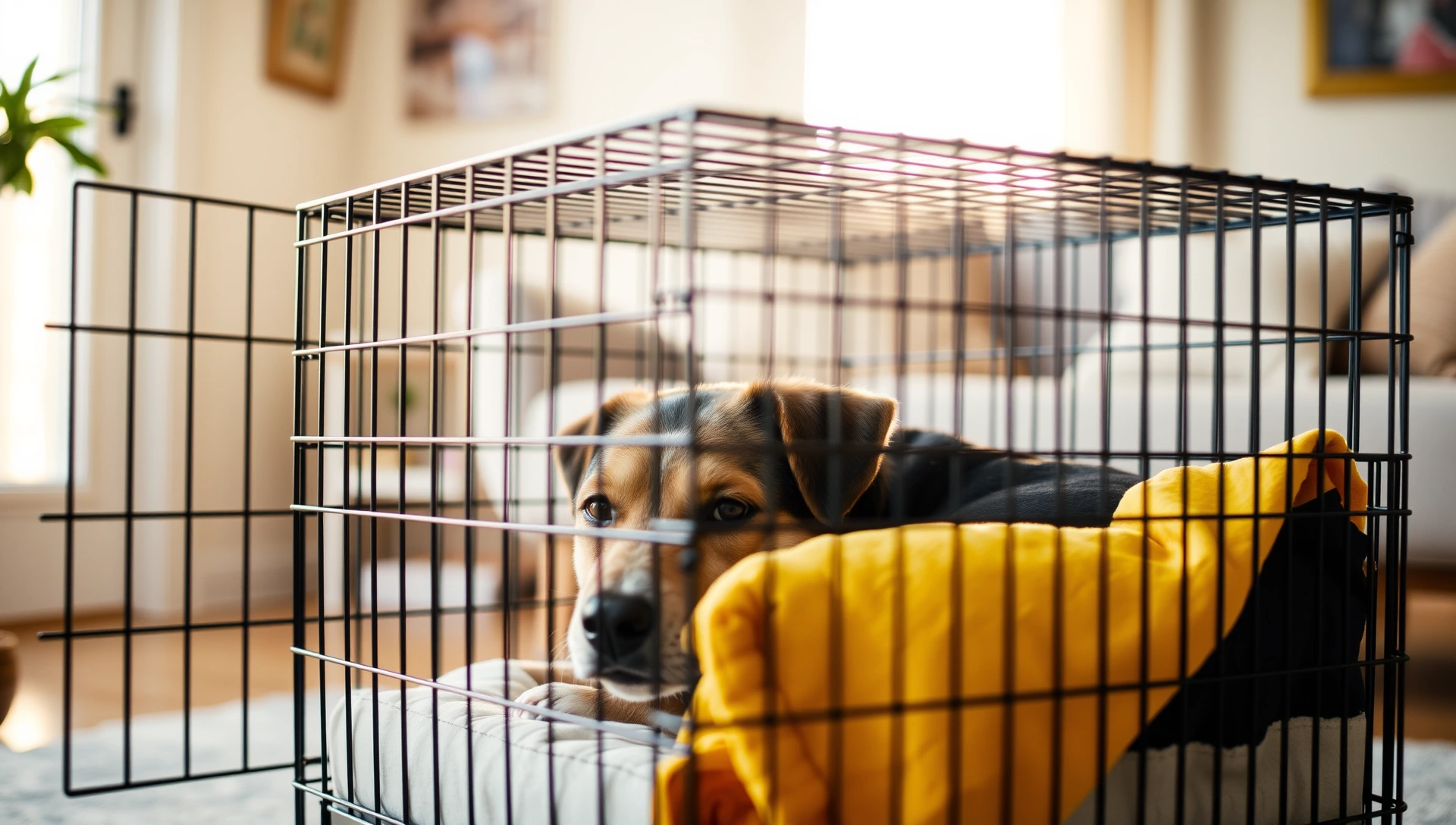
The best dog crate depends on your dog, not a single winner. Wire crates suit most homes, plastic feels cozier, heavy-duty handles strong or anxious dogs, and furniture crates blend in. Size it so your dog can stand, turn and lie down, then build positive associations.
A good home crate gives your dog a den: a quiet, defined space that helps with house-training, calms a busy household, and keeps a dog out of trouble when you cannot watch them. The hard part is that "best dog crate" means something different for a chewing puppy, a 90-pound escape artist, and a calm senior in a small apartment. This guide walks through the main crate types, how to size one correctly, and which well-known brands fit which use case. We focus on everyday home crates here. If you are flying or shipping your dog, see our separate guide to airline-approved travel crates.
Gearing up for your pet? Compare our pick for the Best Calming Aids for Dog Travel in 2026.
A crate is only part of a safe setup, see how to puppy proof your house for the rest.
The five home crate types, decoded
Most home crates fall into a handful of categories. Each trades something off, so the right pick depends on your dog's temperament and your living space rather than a single "winner."
Gearing up for your pet? Compare our pick for the Best Dog Backpack Carriers for Hiking and Travel.
Wire crates (collapsible, great airflow, most popular)
Wire crates are the default choice for a reason. They fold flat for storage, offer the best airflow and visibility, and almost always include a removable plastic tray and an adjustable divider panel. The open sides let your dog see the room, which suits social dogs but can over-stimulate anxious ones (a crate cover helps). Budget wire crates such as the commonly recommended MidWest iCrate typically sit in the low price band, while the MidWest Life Stages line adds a sturdier build and reinforced corners for a bit more. Confirm the current size chart and price on the retailer's listing, since these come in roughly five sizes.
Gearing up for your pet? Compare our pick for the Best Dog Cooling Vests for Hot Weather.
Plastic / kennel-style crates (cozy, less visibility)
Plastic crates have solid walls with ventilation slots, so they feel more enclosed and den-like. Many dogs that get anxious in open wire crates settle better here. The trade-off is less airflow and visibility, and they do not collapse flat. They are also easy to wipe down. These are distinct from the rigid, reinforced shells used for air travel, although the styling looks similar. For flying, use a true IATA-compliant crate and read our dedicated guide rather than a standard home kennel.
Heavy-duty / escape-proof crates (for anxious or powerful dogs)
If your dog bends wire, pops latches, or panics and tries to break out, a standard crate is not safe for them. Heavy-duty crates use thick steel, welded frames, and reinforced latches, while aluminum models from brands like Gunner, Impact, and Ruffland are popular with hunters and serious travelers. These run in the highest price band, often several hundred dollars or more, and the aircraft-grade aluminum models can run well past that. Confirm current pricing and the right size on each brand's own site. A heavy-duty crate manages the symptom; pair it with help from a trainer or vet for the underlying anxiety.
Furniture / wooden crates (look like an end table)
Furniture crates hide the kennel inside a wooden cabinet that doubles as a side table or TV stand. They are the most attractive option for a living room, and many include a flat top you can actually use. The downsides: they are heavy, harder to clean than a wipe-down tray, and not appropriate for a determined chewer who will gnaw the wood. Best for calm, crate-trained adult dogs in a space where looks matter. Prices vary widely by size and finish, so check the listing.
Soft-sided crates (calm, trained dogs only)
Soft crates use fabric panels over a lightweight frame. They are easy to carry and fine for a settled dog at a friend's house or a dog show. They are not containment: a bored or anxious dog can claw or chew through the mesh in minutes. Reserve these for dogs that are already reliably crate-trained and relaxed.
Premium collapsible crates (a hybrid)
A newer category sits between wire and heavy-duty. Crates like the Diggs Revol and various Frisco models use a steel mesh with rounded corners, a puppy-safe pattern, and a one-motion collapse. They cost more than basic wire crates but are easier to move and have safety touches that reduce the risk of a paw or jaw getting caught. Good middle ground for owners who want something nicer than a budget wire crate without going full heavy-duty.
How to size a dog crate
Sizing is where most people go wrong, and it matters more than brand. The rule the AKC uses is simple: your dog should be able to stand up without ducking, turn around fully, and lie down stretched out. That is all. A crate much larger than that defeats house-training, because the dog can soil one end and sleep in the other.
To measure, take your dog's length from nose to base of tail, and height from the floor to the top of the head (or ears, for upright-eared breeds). Add three to four inches to each number, and match that to the crate's stated dimensions. Manufacturers like MidWest publish breed-based size charts that are a useful starting point, but measure your own dog when you can, since two dogs of the same breed can differ.
The divider trick for growing puppies
For a puppy, buy the crate sized for the adult dog, then use the included divider panel to wall off the extra space. Give the puppy just enough room to stand, turn, and lie down, and slide the divider back as they grow. This keeps the den right-sized for house-training at every stage so you only buy one crate. Most wire and premium collapsible crates include a divider; many plastic and furniture crates do not, so check before you buy.
Doors, materials, and easy cleaning
Beyond type and size, a few build details decide how livable a crate is day to day.
- Single-door vs double-door: a double-door crate gives you a front and side opening, which makes placement far more flexible in a tight room and lets you load a reluctant dog from the easier angle. Single-door crates are usually a little cheaper and slightly more rigid.
- Materials and durability: wire gauge matters. Thin wire saves money but flexes; reinforced corners and heavier gauge resist bending. For strong dogs, welded steel or aluminum beats coated wire. Wood looks good but cannot survive a chewer.
- Easy-clean trays: a removable, leak-proof plastic or metal tray is the single best feature for cleanup. Avoid crates where the floor is fixed or the tray warps. A tray that slides out from either side is a bonus.
- Latches: slide-bolt and lever latches hold better than simple spring clips. Anxious dogs learn to nose open weak latches quickly.
Comparison: which crate type fits your dog
| Use case | Best crate type | Representative brands | Typical price band |
|---|---|---|---|
| Growing puppy | Wire with divider | MidWest iCrate, MidWest Life Stages | Budget to mid |
| Determined chewer | Heavy-duty steel | Heavy-gauge welded-steel crates | Mid to high |
| Anxious / escape artist | Heavy-duty aluminum | Gunner, Impact, Ruffland | High to premium |
| Small or calm dog | Plastic kennel or soft-sided | Standard plastic kennels | Budget to mid |
| Budget-first | Single-door wire | MidWest iCrate | Budget |
| Furniture look | Wooden furniture crate | Various wooden cabinet crates | Mid to high |
| Nicer everyday crate | Premium collapsible | Diggs Revol, Frisco | Mid to premium |
Crate safety and how long is too long
A crate should make your dog safer, not put them at risk. Take a few precautions seriously.
- Remove the collar. Tags and buckles can snag on wire or latches and choke a dog left alone. Crate your dog naked, or use a breakaway collar at most.
- Do not crate too long. The general guidance is that adult dogs should not be crated more than a few hours at a stretch during the day, and puppies far less. A crate is a tool for short-term management and sleep, not all-day confinement.
- Watch the temperature. Plastic and furniture crates hold heat. Keep any crate out of direct sun and away from vents.
- Skip the soft crate for unsupervised time with any dog that is not fully settled.
If your dog already dreads the car or panics when left alone, the crate alone will not fix it. See our notes on dog car anxiety and consider a behavior plan alongside the right equipment.
Crate training: association, not punishment
The most expensive crate in the world fails if the dog hates being in it. Crate training works by building a positive association, so the dog chooses the crate as a calm, safe spot. The AKC's step-by-step method and the Humane Society's crate training guide both stress going slowly: feed meals in the crate, toss treats inside, leave the door open at first, and never use the crate as a place of punishment. A dog sent to the crate in anger learns to fear it.
Bring the dog in when they are already calm and they are more likely to treat it as a resting place. Crate training also pays off well beyond the home: it makes boarding a puppy far less stressful, and a dog that is comfortable in a crate travels better too. If you are heading toward road trips, our guide to crate training a dog for travel covers the next steps.
What about travel and the car?
Home crates and travel crates are different products. A folding wire crate is wrong for the car: in a crash it offers little protection and can collapse. For driving, look at a crash-tested travel crate, a secured plastic kennel, or a barrier system, and read our roundup of the best pet transport crates plus how to choose a pet transport crate. If you would rather keep your dog in the back seat or cargo area without a full crate, a dog car barrier is a lighter alternative. For air travel specifically, only an airline-approved, IATA-compliant crate will do, so do not assume a home kennel qualifies.
What is the best dog crate type for most home dogs?
How big should my dog's crate be?
What is the divider trick for puppies?
Do I need a single-door or double-door crate?
Are soft-sided crates safe to leave a dog in?
What crate works for an escape artist or anxious dog?
Is it cruel to crate a dog?
Can I use a home crate for car or air travel?
Sources & references
- akc.org https://www.akc.org/expert-advice/lifestyle/choose-best-crate-dog/
- akc.org https://www.akc.org/expert-advice/training/how-to-crate-train-your-dog-in-9-easy-steps/
- midwesthomes4pets.com https://www.midwesthomes4pets.com/resources/cratesizing/
- diggs.pet https://www.diggs.pet/products/revol-collapsible-dog-crate
- humanesociety.org https://www.humanesociety.org/resources/crate-training-101