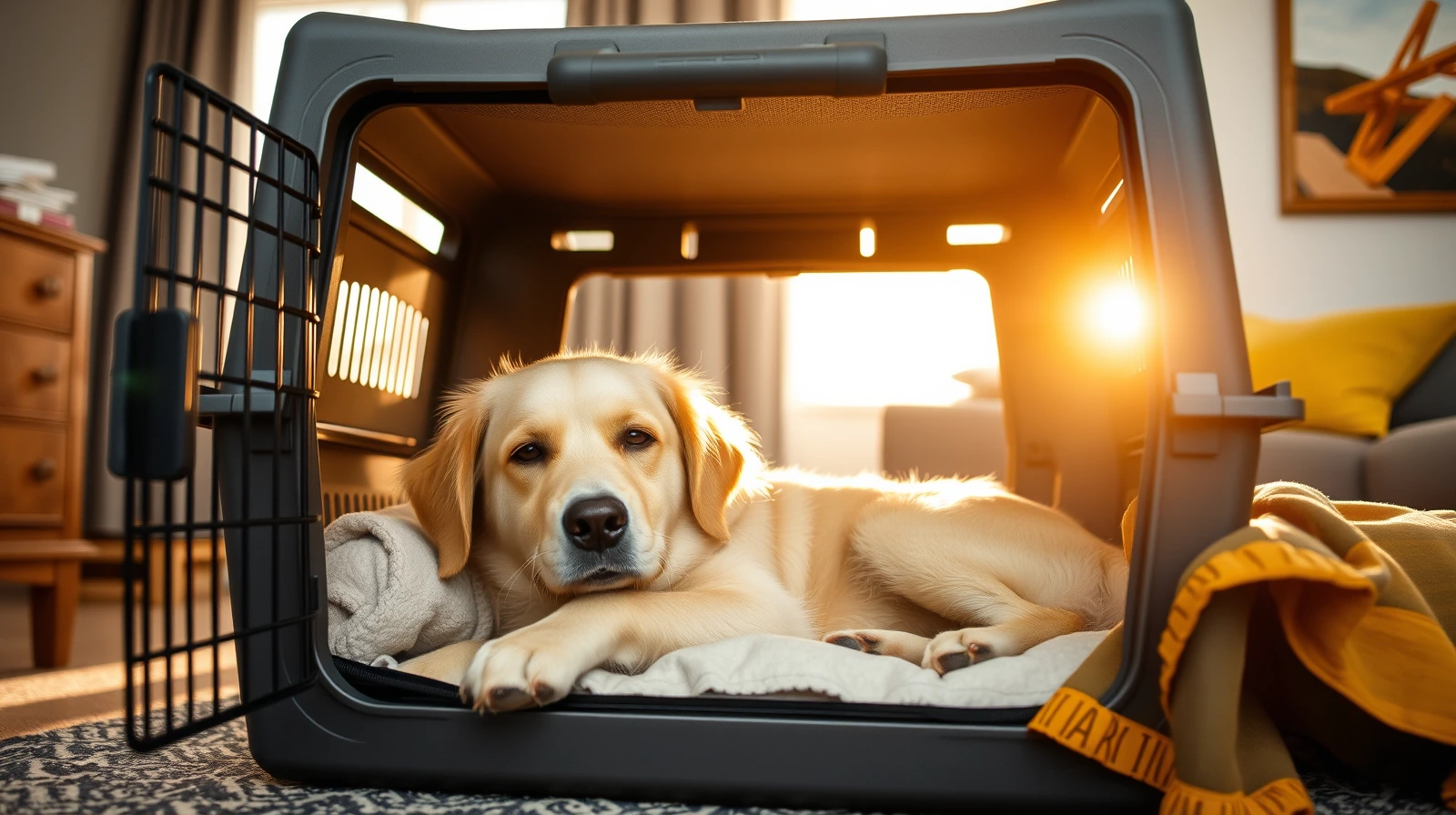
To crate-train a dog for travel, start 4 to 6 weeks out and move in stages: let the dog explore an IATA-compliant crate with the door open, feed every meal inside, slowly build closed-door duration, then add motion and airport sounds. Never sedate before air travel; the AVMA advises against it.
To crate-train a dog for travel, start 4 to 6 weeks out and move in stages: let the dog explore an IATA-compliant crate with the door open, feed every meal inside, slowly build closed-door duration, then add motion and airport sounds. Never sedate before air travel. The AVMA advises against it.
You may also want our guide to Can You Sedate a Dog for Travel? A Safety-First Guide.
Flying a different airline? See our guide to Southwest Airlines Pet Policy in 2026.
Crate comfort is one piece of the puzzle. Here is the full picture of how to prepare your dog for transport.
A well-acclimated crate reduces motion sickness risk too; see our guide to what to do if your pet gets sick during a flight for what to do if it happens anyway.
Why training the crate matters more than buying it
The crate is the single most controllable variable in a pet's flight. The aircraft, the tarmac noise, and the cargo-hold temperature are out of your hands. Whether your dog walks into the kennel calmly or fights it at the counter is entirely down to the weeks of work you put in beforehand. A dog that already sees the crate as a safe den rides quietly. A dog meeting the crate for the first time at the airport is stressed before the engines even start.
This guide is about the behavioral work: the week-by-week acclimation plan that turns a strange plastic box into the dog's bedroom. It is deliberately separate from choosing which crate to buy. For the hardware decision, see our best pet transport crate roundup and our guide on how to choose a pet transport crate. Here we assume you already have, or are about to buy, the right kennel, and we focus on getting the dog comfortable inside it. If you are still deciding whether your dog flies in the hold at all, read pet cargo vs in-cabin first, because the training is more critical for cargo travel.
Flying a different airline? See our guide to JetBlue Pet Policy and JetPaws in 2026.
First, the crate has to be the right one (and IATA-compliant)
You cannot train a dog to be comfortable in a crate that the airline will reject at check-in, so the hardware sets the boundaries of the plan. For air travel, the International Air Transport Association (IATA Live Animals Regulations) sets the standard that nearly every airline enforces. The non-negotiables:
- Rigid construction. Hard plastic, fiberglass, or metal. Soft-sided or collapsible wire crates are not accepted for cargo air travel. The walls must be solid and the door inescapable.
- Ventilation on the correct number of sides. IATA requires ventilation on at least three sides for domestic flights and all four sides for international flights, with openings concentrated over the upper two-thirds of the kennel.
- Correct size. The dog must be able to stand fully without the ears or head touching the top, turn around comfortably, and lie down in a natural position. Too small fails the welfare check; too large lets the dog get thrown around in turbulence.
- Secure door and hardware. Bolted (not snap-together) two-piece shells and metal door hardware are expected by most carriers.
Sizing is calculated from the dog's body, not its weight class. Measure nose to the base of the tail, ground to the top of the head or ear tips when standing, and width across the shoulders, then match those to the kennel's interior. Use this as a quick reference before you measure.
| IATA crate size | Interior length (approx) | Typical dog example |
|---|---|---|
| Small (100) | 21 in | Small terriers, Dachshunds, toy breeds |
| Medium (200) | 28 in | Beagles, Shelties, small Spaniels |
| Intermediate (300) | 32 in | Border Collies, Cocker Spaniels, mid-size mixes |
| Large (400) | 36 in | Labradors, Boxers, Aussie Shepherds |
| Extra-large (500) | 40 in | German Shepherds, Golden Retrievers, large mixes |
| Giant (700) | 48 in+ | Great Danes, Mastiffs, St. Bernards |
Buy the actual travel crate early, not a temporary stand-in, because the dog needs to acclimate to the exact kennel it will fly in. Set it up at home weeks ahead so it stops being a novelty.
Flying a different airline? See our guide to Frontier Airlines Pet Policy.
The week-by-week acclimation plan
Most pet relocation specialists recommend at least three to four weeks of gentle preparation, and PetRelocation advises giving the dog several weeks so the move stays low-stress. Starting 4 to 6 weeks out gives you margin if your dog is slower to settle. The plan below uses the positive-association method the American Kennel Club teaches: never force the dog in, always make the crate the place where good things happen.
| Week | Goal | What you do |
|---|---|---|
| Week 1 | Introduce and explore | Crate stays open in a busy room. Toss treats and toys inside, feed meals at the doorway, praise any voluntary approach. No door closing. |
| Week 2 | Feed inside, close the door | Move the bowl to the back. Close the door while the dog eats, open it when finished or after 10-15 minutes. Build calm, brief confinement. |
| Week 3 | Build duration | Dog enters 15 minutes before meals. Extend closed-door time from minutes to an hour, rewarding calm with treats through the door. Step out of the room briefly. |
| Week 4 | Simulate the trip | Add motion (car rides in the crate) and airport sounds (engines, PA chimes, crowd noise) at low volume, increasing gradually. |
| Weeks 5-6 | Overnight and dress rehearsal | Dog sleeps in the crate overnight. Add a scent item. Do a full dry run: crate in the car, drive, sit in a loud parking lot, return. |
Step 1: Make the crate part of the furniture (Week 1)
Place the assembled crate in a room where the family spends time, door fixed open so it cannot swing and startle the dog. Drop treats and a favorite toy inside and let the dog discover them on its own. Feed meals just inside the doorway. Praise every voluntary step toward the crate. The only goal this week is that the dog chooses to go near and inside without any pressure. Do not close the door at all.
Step 2: Feed every meal inside, then close the door (Week 2)
Move the food bowl to the back of the crate so the dog walks fully in to eat. Once it is eating calmly, gently close the door. Open it when the meal is finished or after 10 to 15 minutes. If the dog whines, you likely advanced too fast: shorten the door-closed time and rebuild. The point is to pair the crate with the most reliable good thing in a dog's day, its dinner.
Step 3: Stretch the duration (Week 3)
Now build time. Have the dog go in 15 minutes before meals, and extend closed-door sessions from a few minutes toward an hour. Reward calm behavior by passing treats through the door, and stop the rewards the moment the dog comes out so the crate is where the good stuff happens. Start stepping out of the room for short stretches so the dog learns it can settle alone.
Step 4: Simulate motion and airport sounds (Week 4)
A quiet living room is not a cargo hold. Secure the crate in the car and take short, calm drives so the dog associates movement with the den it already trusts. Separately, play recordings of jet engines, PA announcements, and airport crowd noise at low volume during crate time, raising the volume only as the dog stays relaxed. This is classic desensitization: the sounds become background, not threats.
Step 5: Overnight stays and a full dress rehearsal (Weeks 5-6)
Have the dog sleep in the crate overnight so a long enclosed stretch is familiar. Then run a complete dry rehearsal: crate the dog, drive to a busy, noisy parking lot (an actual airport cell-phone lot is ideal), sit for the length of a check-in wait, and drive home. Add a worn t-shirt or unwashed blanket carrying your scent. PetRelocation notes that a scent item provides reassurance, and you can pack it in the crate on flight day. Line the crate with absorbent bedding and attach a water dish that clips to the door.
What not to do: sedation comes first
One of the most common mistakes owners make is sedating the dog to "help it relax." It is best avoided. The American Veterinary Medical Association advises against tranquilizing pets for air travel because sedatives can increase the risk of heart and respiratory problems at altitude. IATA takes the same position: sedation can reduce an animal's ability to respond to the stress of the trip. A sedated dog may look calm on the ground, but cabin-pressure and oxygen changes can affect the drug's effects unpredictably, and a pet in the hold cannot be easily monitored or treated mid-flight. Most major airlines will refuse a pet that appears sedated. If your dog is genuinely too anxious to fly safely, that is a conversation with your vet about whether to fly at all, not a prescription to mask the problem.
Other avoidable errors:
- Forcing the dog in. Pushing or shoving creates a lasting negative association that can undo weeks of work in one session.
- Using the crate as punishment. If the crate is where the dog goes when it is in trouble, it will never become a safe den.
- Starting too late. Cramming acclimation into the last few days produces a stressed dog at the counter.
- Feeding a full meal right before the flight. Most guidance suggests a light meal a few hours before, not immediately prior, to reduce nausea and the need to relieve itself in the crate.
- Adding loose hard toys. They become projectiles in turbulence. Use soft, safe bedding instead.
If you only have a few days
Sometimes a move is sudden and you cannot run the full plan. You can still meaningfully lower the dog's stress. Compress the steps but keep the order:
- Day 1-2: Set up the crate and feed every single meal and treat inside it, door open. Make it the only place food appears.
- Day 3-4: Close the door during meals and for short rewarded sessions afterward. Take one or two short crate car rides.
- Day 5-6: Add a scent item, do an overnight if the dog tolerates it, and play airport sounds during crate time.
- Flight day: A light meal a few hours before, a good walk to burn energy, and the scent item in the crate.
A few days will not produce a fully crate-confident dog, but a dog that has eaten in the crate and ridden in it once is far calmer than one seeing it for the first time at the airport. For anxious, brachycephalic, or older dogs, a rushed timeline is a real risk. Senior dogs in particular need extra runway, which we cover in pet transport for senior dogs. If the dog cannot be reasonably acclimated and is high-risk, consider ground transport or postponing the move.
Final week and flight-day checklist
Airlines have their own crate and labeling rules layered on top of IATA, so confirm them directly. United, for example, publishes detailed kennel guidance on its United Airlines pet transport page, and we summarize the major carriers on our pet airlines hub. Before flight day:
- Label the crate with "Live Animal," directional arrows, and your name, phone, and destination address.
- Attach feeding and watering instructions and a small bag of food taped to the top for long or connecting itineraries.
- Freeze water in the clip-on dish the night before so it does not spill during loading and thaws into drinking water.
- Add the scent item and absorbent bedding, no loose hard objects.
- Confirm the crate latches and the door hardware is metal and secure.
- Walk the dog well before departure and offer a final bathroom break.
For the full pre-flight picture beyond the crate, confirm health certificates, breed and temperature embargoes, and booking windows with your airline and vet well ahead of departure.
How we sourced this
The crate-construction and ventilation requirements come from the IATA Live Animals Regulations, the standard airlines enforce worldwide. The sedation guidance is the published position of the American Veterinary Medical Association. The week-by-week training structure follows the positive-reinforcement method taught by the American Kennel Club, cross-checked against the acclimation timelines published by professional pet relocation services. Where airline-specific rules apply, we point to the carrier's own documentation, because individual airlines add requirements on top of the IATA baseline.
How long does it take to crate-train a dog for travel?
Can I sedate my dog so it stays calm in the crate during the flight?
What kind of crate is required for flying a dog?
Should I put my dog's favorite toy in the crate for the flight?
How do I get my dog used to airport noise before flying?
Should my dog eat before the flight?
My move is in five days. Is it too late to crate-train?
Do all airlines use the same crate rules?
Sources & references
- iata.org https://www.iata.org/en/programs/cargo/live-animals/pets/
- ebusiness.avma.org https://ebusiness.avma.org/files/ProductDownloads/mcm-client-brochures-travel-with-pet-2023.pdf
- akc.org https://www.akc.org/expert-advice/training/crate-training-step-by-step/
- petrelocation.com https://www.petrelocation.com/blog/post/how-to-crate-train-your-dog-for-travel