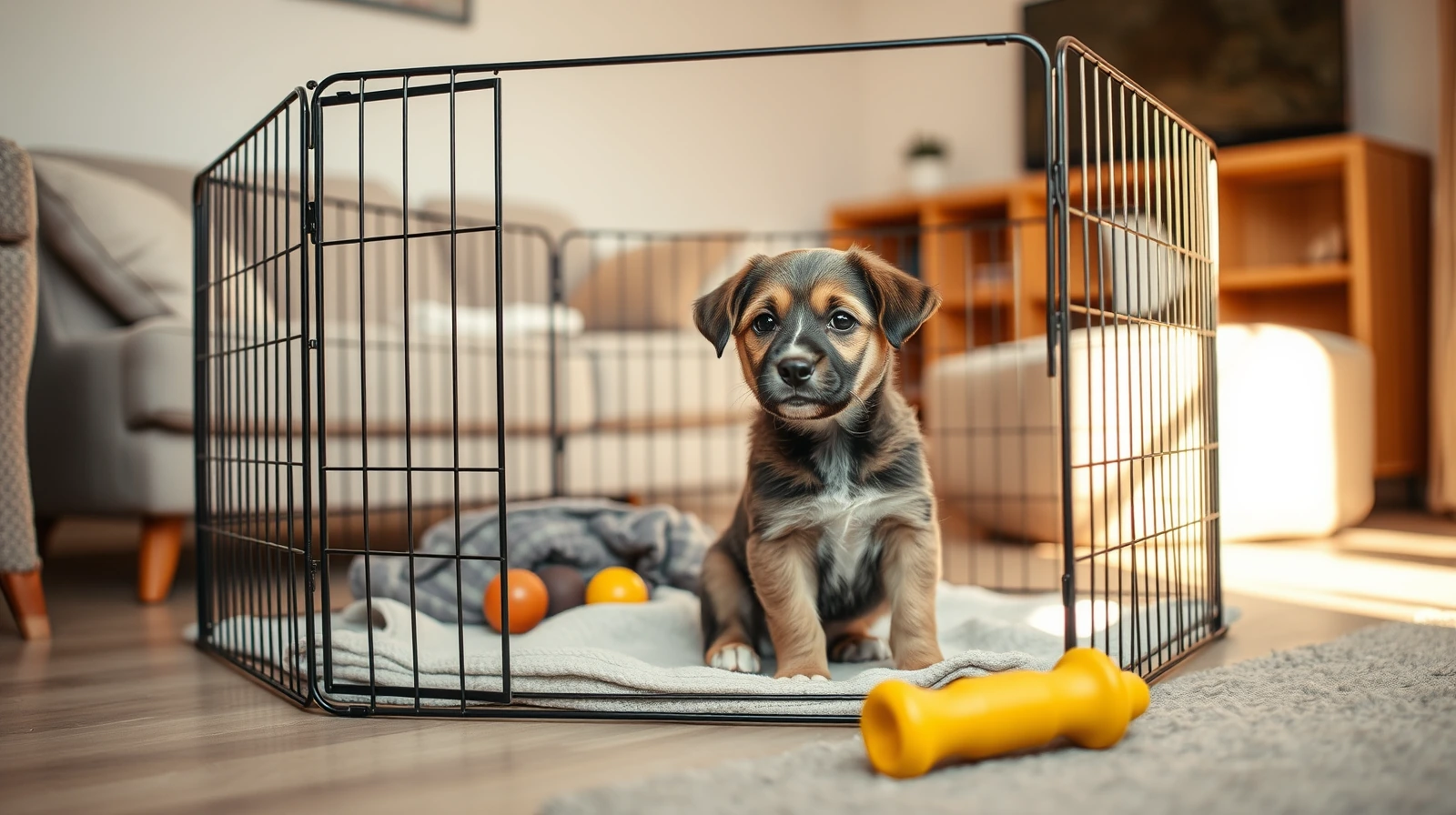
The best dog playpen depends on your dog more than the brand. Match panel height to your dog's jump, pick metal for strong chewers, plastic or soft-sided for calm dogs and travel, and always supervise. A playpen contains, it does not replace training or exercise.
A dog playpen, also called an exercise pen or x-pen, gives your dog a contained space that is bigger than a crate but still safely fenced off. It is the tool you reach for when a puppy needs a potty-training zone, a recovering dog needs enforced rest, or you want to camp with your dog without losing track of where they wander. The catch is that "best" depends almost entirely on your dog. A folding wire pen that is perfect for a calm senior is a stepping stool for a determined Border Collie. This guide walks through what a playpen actually does, the main types, how to size and choose one, and which style fits which use case.
Gearing up for your pet? Compare our pick for the Best Dog Cooling Mat.
What a playpen is for, and how it differs from a crate
A crate is a den: a small, enclosed box meant for short-term rest and travel security. A playpen is a room: an open-topped fenced area where your dog can move around, stretch, change position, and play while still being contained. The two solve different problems, and many owners use them together.
The most common reasons people buy a playpen are a safe contained space for a new puppy, a long-term confinement area for potty training, enforced post-surgery or post-injury rest, travel and camping containment, and separating multiple pets who need their own space. The American Kennel Club describes the playpen as a middle ground that gives a dog room to move while keeping them out of trouble when you cannot watch every second.
For potty training in particular, Preventive Vet recommends a long-term confinement area that pairs a sleeping spot (often a crate) with an open pen, so a puppy who cannot yet hold it has a defined place to go without ruining the whole house. If you are weighing a crate alongside a pen, our guide to the best dog crate covers the den side of that pairing.
Gearing up for your pet? Compare our pick for the Best Elevated Dog Bowl.
The main types of dog playpen
Playpens fall into a few clear categories, each built for a different dog and situation. Understanding the type matters more than the brand on the box.
- Metal wire folding x-pens. The classic exercise pen: connected steel panels that fold flat for storage and expand into a ring or rectangle. Affordable, reconfigurable, and easy to move room to room. The most popular all-around choice for puppies and medium dogs.
- Heavy-duty welded metal pens. Thicker gauge steel, tighter welds, and reinforced panels built to resist chewing, pushing, and bending. The right pick for strong, large, or destructive dogs that flatten a standard wire pen.
- Plastic panel pens. Interlocking molded plastic panels, often convertible into different shapes or a room divider. Easy to wipe clean, rust-proof, and good for indoor or covered-outdoor use. Vertical slats on better models help discourage climbers.
- Soft-sided fabric pens. Lightweight mesh-and-fabric enclosures that pop up and pack down small. Excellent for travel, camping, and calm dogs, but offer no resistance to a chewer or a digger. A containment aid, not a security device.
- Crate-and-pen combinations. Not a separate product so much as a setup: attach a pen to a crate door so the dog has a den to sleep in and a pen to potty and play in. The standard long-term confinement layout for puppies.
Gearing up for your pet? Compare our pick for the Best Dog Nail Grinder.
How to choose: the features that actually matter
Once you know the type, a handful of specs decide whether the pen works for your dog or fails on day one.
- Height versus the jump. This is the number one mistake. The AKC and most trainers suggest at least 30 to 40 inches for small and medium dogs, and up to 48 inches for larger or athletic dogs and jumpers. Buy for your dog's adult size and energy, not their current size. A puppy that fits a 24-inch pen at eight weeks may clear it by week twelve.
- Number of panels and footprint. More panels mean a bigger or differently shaped enclosure. Measure your floor space first, then count how much room your dog needs to lie down, turn around, and have a separate potty zone.
- Indoor versus outdoor. Indoor pens prioritize floor protection and easy cleaning. Outdoor use calls for ground anchors or stakes, a weather-resistant finish, and ideally a top cover for sun and escape control.
- A door panel. A built-in walk-through door with a secure latch saves you from lifting your dog in and out and from knocking the whole pen over every time.
- Climb resistance for escape artists. Vertical bars are harder to climb than horizontal ones, which dogs use like ladder rungs. Look for double latches, narrow gaps, and the option to add a top.
- A floor tray for potty zones. A removable, washable tray turns part of the pen into a contained potty area and protects your floors during training.
- Portability and weight. Heavier steel is more secure but harder to carry; fabric and lightweight metal travel better. Decide whether this pen lives in one room or rides in the car.
- Finish and floor protection. A powder-coated or electro-coated finish resists rust, scratches, and fading, which matters most outdoors. Indoors, look for non-skid rubber feet so the pen does not slide or scuff hardwood, and consider a washable mat underneath.
- Reconfigurability. Folding metal and interlocking plastic pens can be reshaped into a ring, a rectangle, or a room divider as your needs change. A pen that adapts to a new room or a growing dog earns its keep longer than a fixed-shape enclosure.
Representative options by type
These are well-known examples to illustrate each category, not ranked picks. Prices and exact specs change constantly across retailers and configurations, so always confirm the current price, panel count, and height on the seller's page before you buy.
- MidWest Foldable Metal Exercise Pen (metal wire folding). A widely sold folding steel x-pen available in a range of heights and panel counts, generally in the budget to mid price band. A common starting point for puppies and medium dogs. See MidWest Homes for Pets for current models.
- Frisco Wire Dog Exercise Pen (metal wire, door panel). An eight-panel steel pen with a walk-through door, sold as a freestanding or wall-mounted enclosure, typically in the mid price band.
- Richell Convertible Playpen (plastic panel). A molded plastic pen with vertical slats that converts between shapes and a room divider, usually in the higher price band. See Richell USA for configurations.
- Iconic Pet Heavy Duty Pet Pen (heavy-duty welded metal). A thicker-gauge welded option marketed for larger and stronger dogs, generally mid to higher price band depending on size.
- Etna or similar soft-sided pop-up pen (fabric, travel). A lightweight mesh enclosure that folds into a carry bag, typically in the budget to mid band, best for calm dogs and trips.
Pet retailers such as Chewy keep current pricing, dimensions, and customer reviews for most of these lines, which is the fastest way to verify a model still ships in the height and panel count you need.
Comparison by use case
| Use case | Best type | Height to look for | Key feature |
|---|---|---|---|
| Puppies / potty training | Metal wire folding x-pen | 30 to 40 in (buy for adult size) | Floor tray, door panel, paired with a crate |
| Large or strong dogs | Heavy-duty welded metal | 42 to 48 in | Thick gauge, ground anchors, secure latch |
| Indoor everyday use | Plastic panel or wire | 30 to 36 in | Easy to clean, vertical slats, floor protection |
| Outdoor / yard / camping | Metal with anchors | 36 to 48 in | Weather-resistant finish, stakes, optional top |
| Travel (calm dogs) | Soft-sided fabric | 24 to 36 in | Lightweight, packs flat, carry bag |
| Budget setups | Metal wire folding x-pen | Match the dog | Lowest cost per square foot, reconfigurable |
Safety: a playpen contains, it does not train
A playpen keeps a dog in a defined area, but it is not a substitute for supervision, training, or exercise. A few rules keep it safe and effective.
- Supervise, especially early on. Soft-sided pens in particular are not built for unsupervised containment of a chewer, digger, or escape artist. Treat a fabric pen as a boundary cue, not a locked door.
- Remove snag-prone collars. A dangling tag or buckle can catch on bars or mesh. Many trainers take the collar off entirely while the dog is penned, or use a breakaway collar.
- It is not exercise. Time in a pen is contained time, not a walk. Dogs still need daily physical and mental activity, or they will treat the pen as a problem to solve.
- Introduce it positively. Short, rewarded sessions help a dog associate the pen with calm and safety rather than isolation, which also reduces the urge to escape.
- Match height to the athlete. Underestimating jump or climb ability is how dogs end up loose, or worse, hung up on the top rail. When in doubt, go taller or add a cover.
Where a playpen fits in your wider setup
A pen rarely works alone. For most puppy owners it pairs with a crate for sleep and a baby gate or dog door for managed access to the rest of the house. If you are house-training, the pen plus crate layout in our notes on crate training a dog for travel translates directly to home use. And when you are away, knowing whether your puppy is ready for boarding or better suited to doggy daycare helps you decide how much pen time is reasonable versus when your dog needs hands-on care.
Frequently asked questions
What is the difference between a dog playpen and a crate?
How tall should a dog playpen be?
Which type of playpen is best for a strong or large dog?
Are soft-sided fabric playpens safe?
Can I use a dog playpen outdoors?
How do I stop my dog from escaping the playpen?
Is a playpen a substitute for walks and training?
Should my dog wear a collar inside the playpen?
Sources & references
- akc.org https://www.akc.org/expert-advice/health/playpens-for-dogs/
- preventivevet.com https://www.preventivevet.com/dogs/how-to-set-up-puppy-long-term-confinement-area
- chewy.com https://www.chewy.com/education/dog/training-and-behavior/best-dog-playpens
- midwesthomes4pets.com https://www.midwesthomes4pets.com/
- richellusa.com https://richellusa.com/