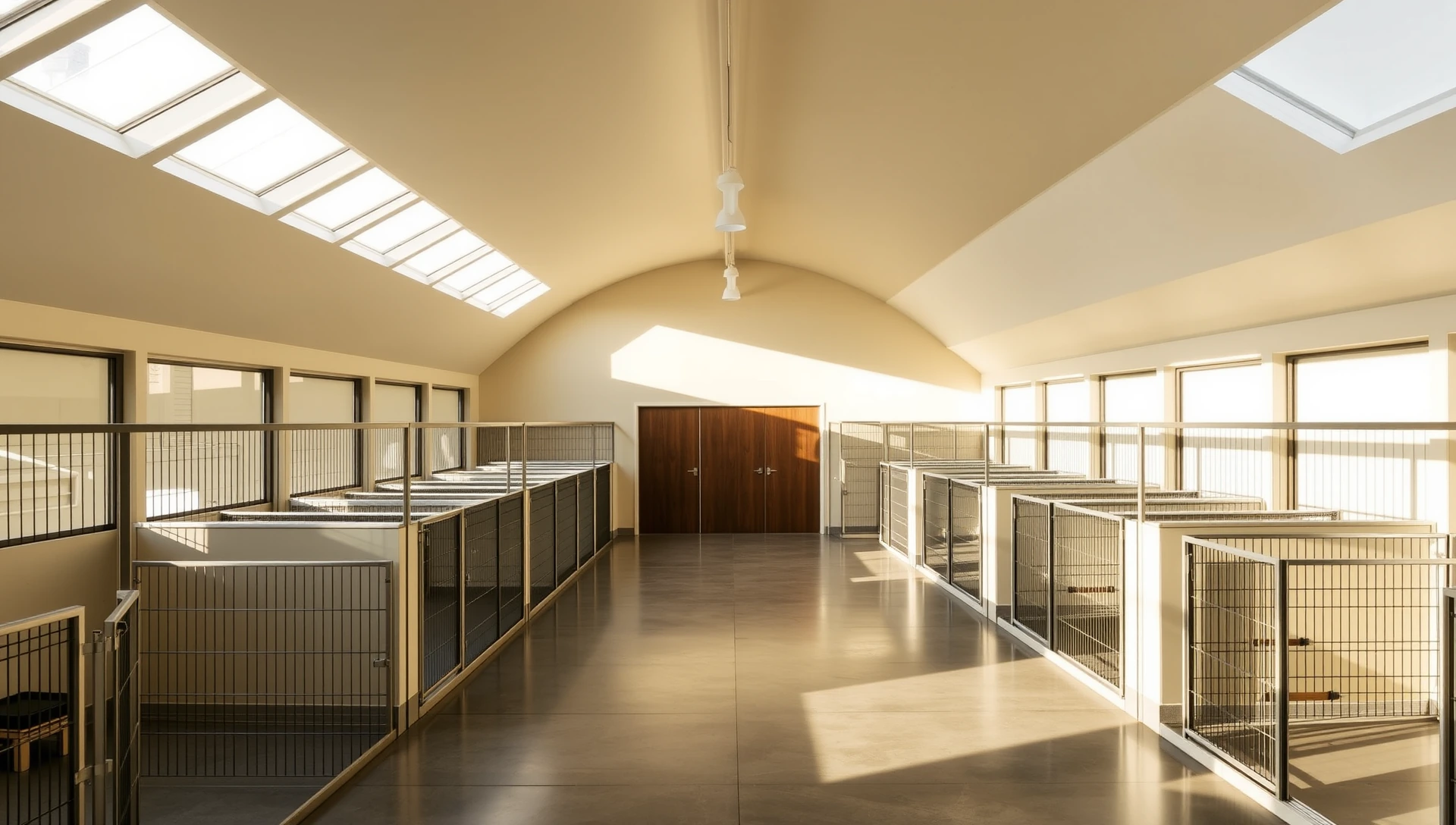
Most new dog boarding facilities lose money for the first two years because the building was designed by a kennel vendor with a catalog to sell, not by an operator with a P&L to defend. The result is predictable: too few runs, aisles you cannot push a cleaning cart through, drainage that backs up, a sound profile that injures staff hearing, and a layout that forces three people to do the work of one. This guide walks through every load-bearing decision in a boarding-facility build, with sources, dimensions, and the five most expensive mistakes to avoid.
[cc_quick_take]
A profitable boarding facility starts with three numbers: target dog capacity, square feet per dog (kennel plus circulation), and air changes per hour. Get those right, and materials, zones, and acoustic treatment fall into place. Get them wrong, and no amount of branding or staff training will rescue the unit economics.
[/cc_quick_take]
Boarding your dog? See our guide to Why Won't My Dog Eat After Boarding?.
Why facility design makes or breaks a boarding business
Boarding is a fixed-cost business. Your rent, mortgage, insurance, and utilities do not care whether your kennels are 80 percent full or 30 percent full. Design decisions made on day one set the ceiling on capacity, the floor on labor cost, and the loss rate to infectious disease for the life of the building.
A 24-run facility designed with 4-foot aisles, sealed concrete with proper trench drains, 12 air changes per hour, and acoustic ceiling treatment can be cleaned end-to-end by one staff member in roughly 90 minutes. The same 24-run facility built with 3-foot aisles, painted concrete, residential HVAC, and a flat ceiling needs two staff, doubles its kennel-cough incidence, and burns through employees who develop tinnitus inside a year. The build cost difference is typically 8 to 12 percent. The five-year operating cost difference is six figures.
If you are still validating the business case before you build, read our companion guides on how to start a dog boarding business and how operators differentiate, then come back here for the construction-grade detail.
Boarding your dog? See our guide to Small Dog Boarding.
Sizing the building by capacity
Capacity is not just kennel count. A workable boarding facility needs roughly 80 to 110 square feet of conditioned building per boarded dog when you add up kennel footprint, aisles, intake, play space, isolation, grooming, food prep, laundry, staff, mechanical, and storage. The variance depends on whether you run indoor-outdoor runs (less indoor area per dog) or fully enclosed indoor kennels (more).
| Target dog capacity | Typical conditioned building size | Outdoor run area | Realistic crew size |
|---|---|---|---|
| 16 to 20 dogs (entry-level) | 1,800 to 2,200 sq ft | 1,200 to 1,800 sq ft | 1 to 2 on shift |
| 20 to 24 dogs (single-operator viable) | 2,400 to 2,800 sq ft | 1,500 to 2,200 sq ft | 2 on shift |
| 27 to 32 dogs (small commercial) | 3,200 to 3,800 sq ft | 2,000 to 3,000 sq ft | 2 to 3 on shift |
| 40 to 60 dogs (mid-size commercial) | 4,800 to 6,500 sq ft | 3,000 to 5,000 sq ft | 3 to 5 on shift |
The most common sizing mistake is building for the dog count and forgetting the support areas. A 24-run kennel block by itself is about 720 sq ft. The other 1,800 sq ft is what makes the business work. Skip it and you end up grooming in the aisle and storing food in the bathroom.
Boarding your dog? See our guide to Dog Boarding for Reactive, Anxious & Aggressive Dogs.
Kennel dimensions by dog size
USDA APHIS sets the federal floor for any commercially licensed kennel under 9 CFR 3.6. The minimum primary-enclosure floor space is calculated as: (length of dog from nose to base of tail in inches plus 6) squared, divided by 144, giving required floor space in square feet. Interior ceiling height must be at least 6 inches above the tallest dog standing normally. These are minimum legal floors, not target dimensions. Source: eCFR 9 CFR 3.6 and APHIS Animal Care Tech Note.
The ASPCA and most welfare bodies recommend going materially above the federal minimum. ASPCA outdoor-run guidance suggests a minimum of 10 by 10 feet for most dogs, or 5 by 15 feet for dogs that like a straight-line run. Source: ASPCA Pro: Animal Housing in Shelters.
| Dog size | USDA legal floor | Operator-recommended indoor | Outdoor run |
|---|---|---|---|
| Toy / small (under 20 lb) | ~6 sq ft | 4 ft x 4 ft (16 sq ft) | 4 ft x 8 ft |
| Medium (20 to 50 lb) | ~9 to 10 sq ft | 4 ft x 6 ft (24 sq ft) | 5 ft x 10 ft |
| Large (50 to 90 lb) | ~12 to 16 sq ft | 5 ft x 8 ft (40 sq ft) | 6 ft x 12 ft |
| Giant (90 lb+) | ~18 to 24 sq ft | 5 ft x 10 ft (50 sq ft) | 8 ft x 12 ft or 10 ft x 10 ft |
Build at least 30 percent of your kennels to the large or giant spec. You can always put a small dog in a large kennel. You cannot do the reverse, and giant-breed turn-aways during the holiday peak are the most painful revenue you will ever lose.
Aisle widths, ADA compliance, fire codes
The single biggest day-to-day labor multiplier in a boarding facility is aisle width. The ADA Standards for Accessible Design require a minimum continuous clear width of 36 inches for accessible routes, with 32 inches allowed at doorways for a maximum of 24 inches of run. Source: U.S. Access Board, Chapter 4: Accessible Routes.
The 36-inch ADA minimum is a starting point, not a target. Practical operating aisle widths for a kennel block:
- 48 inches (4 ft): the realistic minimum for a single-row layout. Allows one cleaning cart and a staff member to pass a leashed dog. Compliant with ADA.
- 60 inches (5 ft): the sweet spot for double-row layouts. Two people can pass with dogs. ADA-compliant for passing other shoppers, per the 60-inch rule on aisles over 200 feet.
- 72 inches (6 ft): needed when you also use the aisle for grooming triage or vet visits.
Fire-code requirements vary by jurisdiction but generally follow the International Building Code: assembly and animal-care occupancies need at least one 36-inch egress route, with a second exit when occupant load exceeds 49. Check your local AHJ before slab pour. A facility designed without two exits cannot legally board over the threshold no matter how many runs you fit.
Layout types: single row, double row, hybrid
Three layouts cover roughly 95 percent of viable boarding builds.
Single row. Kennels along one wall, aisle along the other, indoor-outdoor doors on the kennel side leading to fenced runs. Best for facilities under 20 runs and for any building where natural light along the non-kennel wall is desirable. Lower acoustic load because there is one less reflective hard surface. Cheaper per run because you only need one wall of plumbing and drainage.
Double row. Kennels along both walls, aisle down the middle. Most square-foot-efficient layout for 20 to 40 runs. Halves your foundation cost per run but doubles your acoustic problem: barking dogs face each other across the aisle, and sound bounces wall to wall. Mandatory acoustic treatment on the ceiling and end walls if you use this layout.
Hybrid (pod or H-shaped). Multiple small kennel blocks of 6 to 10 runs each, separated by fire doors or solid walls. The most disease-resilient layout: an outbreak in one pod does not infect the rest of the facility. Best for 30+ runs and for any facility that takes shelter-transfer dogs or unvaccinated puppies. Costs roughly 10 to 15 percent more per run than a double row but pays for itself the first time you avoid a full-facility kennel-cough shutdown.
Noise management: acoustic materials and target decibels
Noise is the single most underestimated risk in dog-boarding design. Acoustic studies of operating kennels have measured equivalent sound levels of 100 to 108 dB SPL, with peaks reaching 115 dB during group barking events. Source: PubMed: Effect of kennel noise on hearing in dogs (Scheifele et al.) and Pet Boarding & Daycare Magazine.
OSHA's permissible exposure limit for occupational noise is 90 dB averaged over 8 hours, with a hearing-conservation program mandatory above 85 dB time-weighted average. Source: OSHA Occupational Noise Exposure (29 CFR 1910.95). An untreated kennel will routinely exceed both thresholds, exposing staff to permanent hearing loss and exposing the business to OSHA citations.
Design targets that work:
- Ambient with no dogs present: under 50 dB. If your empty building reads above this, you have a mechanical-noise problem (oversized HVAC, blower-coil too close).
- Single dog barking, treated room: under 75 dB at 5 ft. Means your absorption is working.
- Full house, treated room: 85 to 92 dB peak. Realistic ceiling. Below 90 dB TWA keeps you under OSHA's mandatory PPE threshold.
- Full house, untreated room: 100 to 115 dB. The number you do not want.
The acoustic toolkit, in order of cost-effectiveness: suspended ceiling baffles or cloud panels with NRC 0.85+ rating across at least 60 percent of the ceiling area; perforated metal kennel divider panels backed with insulation instead of solid sheet metal; acoustic wall panels on the two short walls of the kennel run; rubber-backed flooring under any non-kennel area; solid-core doors between kennel block and lobby with full-perimeter gaskets. Do not skip the ceiling treatment. The ceiling is the single largest reflective surface in the room and treating it returns more dB reduction per dollar than anything else.
Materials by surface
Floors. Sealed concrete with a chemical-resistant epoxy or polyaspartic coating is the operator default. Concrete on its own is porous and absorbs urine, which causes lasting odor and corrosion of any rebar near the surface. The epoxy creates an impenetrable barrier. Source: DuraTrench: Trench Drains in Kennels. Slope every kennel and aisle floor at a minimum of 1/8 inch per foot toward a trench drain. Pre-sloped trench drain channels with bell-and-spigot watertight joints are non-negotiable. Flat-channel trenches pool urine and create permanent odor.
Walls. Kennel-block walls take a daily hose-down. Specify either FRP (fiber-reinforced plastic) panels mechanically fastened with sealed seams, or troweled epoxy wall coating extending at least 48 inches up from the floor. Drywall in a kennel block is a one-year material. Painted CMU block is acceptable if every joint is epoxy-grouted and the wall gets a chemical-resistant topcoat.
Kennel divider panels. Glass-front gates with stainless or powder-coated steel frames look professional and reduce defensive barking versus chain-link, because dogs cannot see other dogs as easily through the angle. Solid HDPE or sealed marine-grade plywood divider panels between adjacent runs eliminate the chain-link nose-to-nose contact that drives kennel cough transmission and fence-fighting.
Fixtures. Stainless steel kick plates on every door bottom. Stainless or chrome-plated brass hose bibs with vacuum breakers in every kennel block. Floor drains every 12 to 16 feet in addition to the trench. Avoid plastic floor drains: they fail under hose pressure and chemical exposure within 18 months.
Required zones
A complete facility has, at minimum, eight functionally distinct zones. Combining any two of them on day one will cost more to retrofit than building them separately.
- Intake / lobby. Public-facing, no boarded dogs visible, scale, weighing area, vaccine-paperwork desk, and a separated meet-and-greet room.
- Main kennel block. The dog runs themselves. Single, double, or hybrid layout.
- Play areas. Indoor and outdoor, with non-porous flooring (rubber pavers outdoors, sealed concrete or rubber tile indoors), size-segregated.
- Isolation / sick bay. Physically separate room or pod with its own HVAC return (100 percent exhausted, negative pressure relative to the rest of the building).
- Grooming. Even if you do not offer grooming, you need a tub and dryer for muddy or soiled dogs. Plumbed to its own drain, not a shared trench.
- Food prep. Stainless prep counter, lockable food storage, refrigerator, dishwasher. Separate from any chemical or laundry storage.
- Laundry. Commercial-grade washer and dryer with sanitize cycle, room-temperature water capability for blood and protein soils.
- Staff and storage. Break room, employee restroom, mop closet, mechanical room, locked medication cabinet.
The biggest beginner error: skipping isolation. A boarding business without an isolation room is one kennel-cough outbreak away from a 7-day full shutdown and a refund liability that wipes out a quarter of profit.
Indoor-outdoor flow and run design
The gold-standard layout pairs each indoor kennel with an attached outdoor run, separated by a guillotine door the staff can open and close from the aisle. This lets staff "shift" dogs to the outdoor side while cleaning the indoor side, cutting cleaning time roughly in half versus a layout where every dog must be leashed and moved.
Outdoor run surface options, ranked by cleanability: sealed concrete with proper slope and drain, rubber pavers over compacted base with drainage layer, K9Grass or equivalent permeable artificial turf with antimicrobial infill, pea gravel (cleanable but tracks indoors), grass (not viable above 8 dogs per 100 sq ft of grass). Avoid wood chips, mulch, and decomposed granite: they harbor parasites and cannot be sanitized.
Run fence height: 6 ft minimum for medium dogs, 7 to 8 ft for known jumpers and giant breeds. Add a 24-inch inward-angled top rail if you board any escape-risk dogs. Use 9-gauge or heavier chain link with kennel-grade galvanization, or welded-wire panel fencing. Sink fence posts 36 inches into concrete footings.
HVAC and ventilation rates
Ventilation is the single most under-budgeted item in first-time boarding builds. The relevant benchmarks:
- General kennel area: 10 to 15 air changes per hour (ACH) with 100 percent outdoor air, no recirculation between kennel block and rest of building. The AVMA Companion Animal Care Guidelines reference 10 to 20 ACH for animal facilities. Source: Design Learned: Fresh Air and Ventilation in Animal Facilities.
- Isolation room: 12 to 15 ACH minimum, with negative pressure relative to adjacent spaces and 100 percent exhaust to outdoors. Source: BHB Inc.: Animal Shelter Design from an Engineering Perspective.
- Lobby and staff areas: ASHRAE 62.1 standard occupant-based rates, kept at positive pressure relative to kennel areas so air flows from clean to dirty. Source: ASHRAE Standard 62.1.
- Grooming: 10 ACH with dedicated exhaust to handle wet-dog humidity and chemical fumes.
Use a dedicated energy-recovery ventilator (ERV) sized to the kennel block's exhaust requirement, not a residential split system. Residential systems recirculate, which is exactly what you do not want in a dog facility: it spreads aerosolized pathogens building-wide. Specify a separate HVAC zone for isolation with its own air handler and exhaust fan. Pressure-relationships in the building should run lobby (positive) to office (neutral) to kennel block (slightly negative) to isolation (most negative). This forces airflow from the cleanest area to the dirtiest.
Lighting
Natural daylight in the kennel block reduces stress markers in boarded dogs and reduces staff fatigue. Specify clerestory windows or high-mounted operable windows on the kennel-block long wall, sized to deliver a daylight factor of at least 2 percent. Use translucent glazing or frosted film at dog-eye level to prevent dogs reactively barking at external stimuli.
Artificial lighting should support a circadian cycle: warmer color temperature (2700 to 3000K) in evening hours, cooler (4000K) during the day. Avoid 24-hour bright overhead lighting, which is associated with elevated cortisol in kenneled dogs. Install dimmable LED fixtures on a programmable schedule and provide an after-hours nightlight setting around 50 lux. Use vapor-tight, gasketed LED fixtures rated for wet-location use throughout any area that gets hosed down.
The 5 most common (and expensive) design mistakes
1. Undersizing the support footprint. Building a 24-kennel block and assuming you can do intake, grooming, food prep, and laundry in a 200-sq-ft back room. Result: cross-contamination, missed doses, kennel cough, staff burnout. Budget 60 to 70 percent of your conditioned square footage for kennels and play; spend the rest on the support zones.
2. Residential HVAC. A 4-ton residential heat pump cannot deliver 10 ACH of 100 percent outdoor air in a 2,500 sq ft kennel block. Operators try to make it work by cracking windows and adding fans. The result is an unconditioned, odor-saturated, pathogen-rich room with a $400 monthly electric bill that delivers worse air than no system at all. Spend the extra $15,000 to $25,000 on a commercial ERV at construction. Retrofitting it later costs three times as much.
3. No isolation room. Or a "we will use the back office if we need to" plan. The first kennel-cough case will refute this in 48 hours. Budget for a fully separated isolation room with its own HVAC from the start. It will sit unused 70 percent of the time and earn its capital cost back the first week it prevents a facility shutdown.
4. Drainage that does not drain. Flat-channel trench drains, undersloped concrete, or floor drains spaced too far apart. The cost of cutting the slab and re-pouring after opening is roughly 8 times the cost of doing it right the first time, plus the lost revenue from the closure. Specify pre-sloped trench drain channels, 1/8 inch per foot floor slope minimum to trench, and a floor drain every 12 to 16 feet.
5. No acoustic treatment. Operators consistently underestimate the noise load and discover at month two that staff are wearing earplugs all day and neighbors are filing complaints. Acoustic ceiling treatment, perforated kennel panels, and solid-core doors with gaskets are a 1 to 3 percent line item on the build budget. Retrofitting after the slab is poured and the ceiling is closed up doubles or triples that cost.
Frequently asked questions
How much does it cost to build a dog boarding facility from scratch?
What is the legal minimum kennel size for a commercial dog boarding facility in the United States?
How many air changes per hour does a dog boarding kennel need?
How loud is a kennel and is hearing protection legally required for staff?
Should I use single-row, double-row, or hybrid kennel layout?
Planning a facility build or retrofit? Browse our dog boarding guides for the operational counterparts to this design guide: staffing ratios, vaccination protocols, pricing models, and software stack.