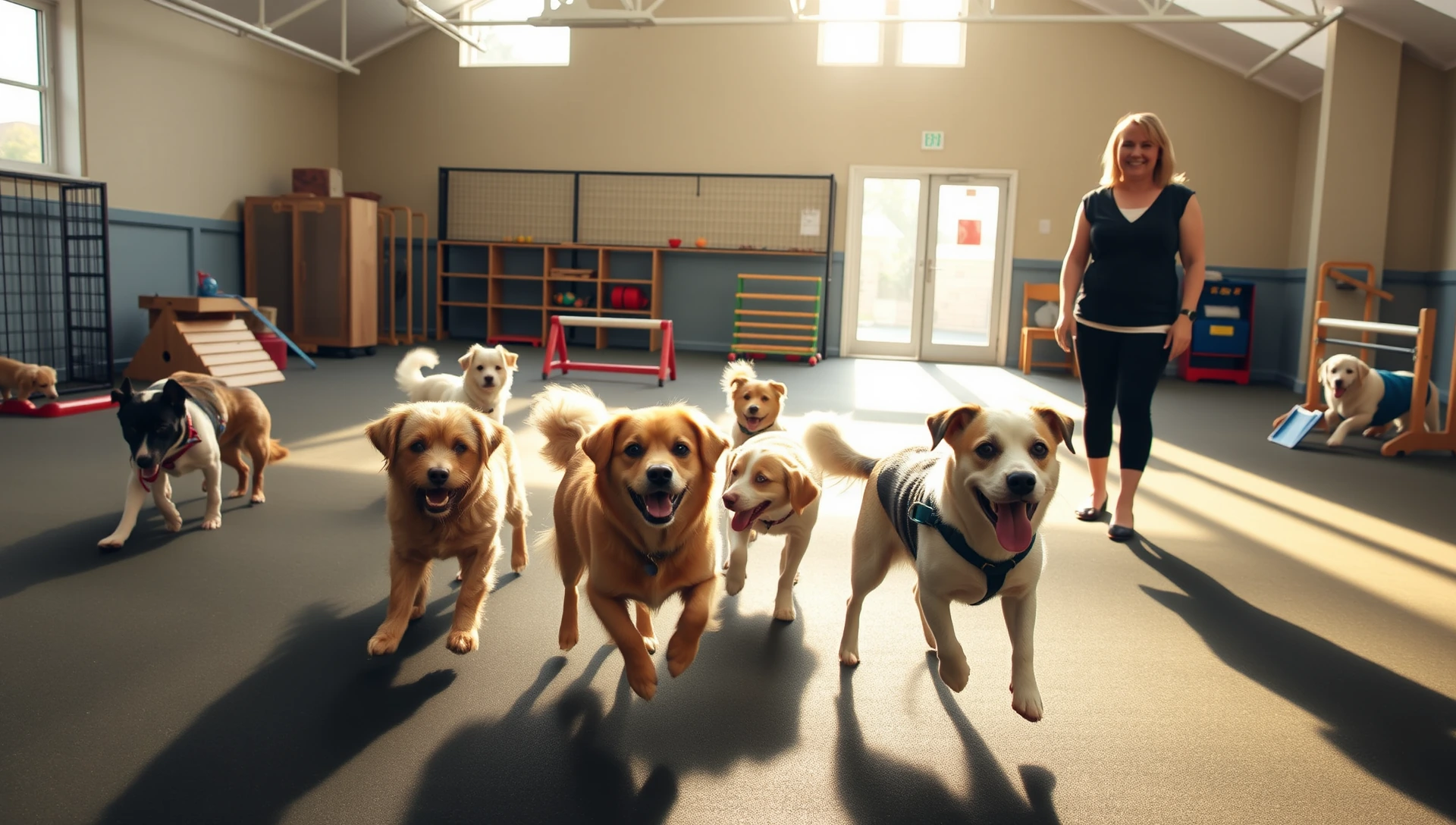
Most "how to start a doggy daycare" posts skip the parts that decide whether you survive year one: how many staff you really need at 4pm on a Friday, what a temperament test that filters out a lawsuit looks like, and why your HVAC quote is about to double. This guide is for the operator who plans to open a real building, hire real handlers, and still be profitable when the morning rush hits 38 dogs.
Considering daycare? Read our guide to Dog Daycare Startup Costs.
The daycare model and the 2026 market context
A doggy daycare is a structured group-play facility where dogs are dropped off, sorted into playgroups by size and temperament, rotated through play and rest cycles, and picked up the same evening. Revenue is concentrated into one building. One well-run room of 30 dogs is more profitable per labor hour than 30 home visits, but a single bite incident, noise complaint, or HVAC failure can wipe out a quarter's margin.
The 2026 context is favorable but no longer easy. National full-day rates have settled at roughly $30 to $60, averaging about $40, with premium urban markets charging $45 to $65 per day, per Dogdrop's 2026 price guide. Return-to-office mandates push owners into recurring weekday daycare, but commercial rent, insurance, and labor have risen faster than rates in most metros. Operators who pick the right location, run a strict intake, and price for 65 to 75 percent peak-day occupancy win. Operators who underprice or under-staff fail inside 18 months.
Daycare vs boarding: which model to start with
Daycare-only and daycare-plus-boarding are different businesses with different licenses, staffing patterns, and capital needs. Daycare-only runs 7am to 7pm, needs no overnight staff, and exits empty each night. Boarding requires overnight coverage, more square footage per dog, and a stricter licensing path in most states. If you are choosing one, start with daycare. It has higher visit frequency (2 to 5 times per week vs 2 to 5 times per year), faster word-of-mouth, and lower regulatory load. Many operators validate daycare in year one, then add boarding in year two using the same building. For the relationship between the two, see our doggy daycare hub and what to expect at doggy daycare.
Market validation: the 7-mile radius test
A doggy daycare is a hyper-local business. Customers drive in, drop off, drive to work, and reverse the trip. The realistic catchment is a 5 to 7 mile radius in suburban markets and 1 to 3 miles in dense urban ones. Run this validation before you sign a lease:
- Map every competitor in your 7-mile radius. Use Google Maps for "doggy daycare," "dog daycare," and "pet resort." Note their full-day rate, package pricing, and online reviews.
- Audit competitor wait lists. Call as a prospective customer. If three of five quote a 2 to 4 week wait for new-dog temperament tests, demand exceeds supply.
- Check median household income. Below roughly $75,000, daycare gets cut first. Above $100,000 with dual-income households, recurring 3-day-a-week packages become normal.
- Drive-time test. Stand in your proposed parking lot at 7:45am on a Tuesday. If you cannot see 20 commuter cars in 15 minutes, the location is wrong.
Legal, licensing, and zoning
There is no federal license for dog daycare. Regulation is state plus city or county, and the model varies, per Wagbar's compliance guide: state-run (a single state agency licenses and inspects, common in PA, NY, NJ, VA, NC, SC, DE), municipal (city or county issues all permits, common in TX, much of the Mountain West), or hybrid (state sets the baseline, locals add permits and inspections). Verify both layers before you sign a lease, because a "perfect" building in the wrong zone is a dead deal.
- Business entity. LLC at minimum. Group dog play does not survive a sole proprietorship.
- State animal facility / commercial kennel license. Some states trigger at 4 dogs, others at 10 or 25. Check your state Department of Agriculture or Public Health.
- City or county zoning. Typically commercial or service-commercial. Many jurisdictions require a special-use permit even in the right zone, especially with any outdoor play area.
- Building permits and certificate of occupancy for any tenant improvement.
- Noise ordinance review. Some residential-adjacent commercial zones cap daytime noise at 60 to 65 dBA, which a barking room can exceed.
- Sales tax and employer registration before your first hire.
For the closely related compliance picture on facility operations once you are open, see our doggy daycare requirements guide.
Insurance: general liability, animal bailee, workers' comp
A daycare needs three distinct policies. Per Animalo's 2026 insurance guide and Pet Care Insurance, expect total premiums between $1,500 and $7,000 per year depending on size.
- General liability: $400 to $1,200 per year for small to mid-size daycares. Standard limits are $1 million per occurrence and $2 million aggregate. Covers slips, falls, third-party bites off-premises, and property damage.
- Animal bailee (care, custody, and control): $129 to $1,080 per year, with most operators paying $300 to $600 for adequate coverage. This is the one general liability will not cover: injury, illness, escape, or death of a dog in your care. Non-negotiable.
- Workers' compensation: required in nearly every state the moment you have a W-2 employee. Pet care has a moderate-to-high modifier because of bite and lifting injuries.
- Commercial property: needed if you own equipment or improvements. Often bundled in a BOP.
- Optional but recommended: employment practices liability (EPLI) once you have 5+ employees, and cyber if you store payment data on premise.
Medium-sized commercial facilities caring for 20 to 50 dogs daily typically pay $3,500 to $7,000 annually for the full stack, per Animalo's 2026 benchmarks.
Facility size and layout
A practical daycare runs in 2,000 to 7,000 square feet of indoor space, with 5,000 to 7,000 being the sweet spot for a 40 to 60 dog peak day. The math comes from a published indoor space standard of 40 square feet for small dogs and 70 square feet for large dogs, plus 20 square feet per dog outdoors, per startup data from Startup Financial Projection. Many jurisdictions require 50 to 75 square feet per dog in group settings indoors, so check yours.
- Reception and intake: 200 to 400 sq ft, separate from play rooms so new dogs are not rushed by a group.
- Two to three play rooms, divided by size and energy. Rotation lets you clean rooms during rest cycles.
- Rest and crate area. Mandatory midday rest of 60 to 90 minutes in individual crates reduces fights and noise.
- Outdoor yard: shaded, double-gated, K9-grade turf or sealed concrete sloped for drainage. Real grass does not survive 30 dogs.
- Isolation room for an ill or off-day dog.
- Bathing and laundry: one industrial washer running 6 to 8 cycles a day.
Equipment, itemized (and why HVAC blows budgets)
Equipment and supplies for a new daycare typically run $5,000 to $25,000, with renovations adding $10,000 to $50,000, per startup cost data. The cost item first-time operators underestimate is HVAC. A 5,000 sq ft daycare with 40 dogs produces more heat, humidity, and odor than a comparable office building, and a standard light-commercial RTU will fail by month four.
- Modular kennels and gates: $3,000 to $10,000. Powder-coated steel, no horizontal bars a paw can hook.
- Flooring: sealed epoxy or K9 turf, $3 to $8 per sq ft installed. Skip vinyl.
- HVAC upgrade: $15,000 to $40,000 sized to 8 to 12 air changes per hour with separate exhaust per play room. Standard offices run 4 to 6 ACH. Skip this and you lose dogs to overheating and clients to smell.
- Acoustic treatment: $2,000 to $8,000 in ceiling tiles, wall panels, and door seals. An untreated 95 dBA barking room is illegal in most residential-adjacent zones.
- Play equipment: $500 to $2,000 in tunnels, platforms, rugged toys. No ropes or squeakers in group settings.
- Surveillance: $1,500 to $5,000 for 8 to 16 IP cameras with cloud recording.
- Software: $50 to $300/month (Gingr, PetExec, Time To Pet).
- Cleaning chemicals: $400 to $800/month at 30 to 40 dogs.
The staff-to-dog ratio that actually works
The single number that decides whether your daycare is safe, insurable, and profitable is the staff-to-dog ratio during active group play. Industry guidance from the International Boarding and Pet Services Association sets 1:10 to 1:15 as the benchmark for active group play, per Wagbar's staffing analysis. Most well-run facilities operate closer to 1:10 during peak energy windows.
- 1:10 during active play, peak energy, or any small-dog room.
- 1:15 as the upper limit for calm, mature, well-known groups in a rest cycle.
- Minimum 2 staff on the floor at all times in any active group play environment. A single handler cannot break up a fight and call for help simultaneously.
Why it matters at scale: a 40-dog peak day needs 4 floor handlers during play windows, plus a front-desk lead, plus a manager who can rotate to the floor. That is a 6-person payroll for one shift. Operators who try to run 40 dogs with 2 handlers are why local news covers a daycare bite story every few months.
The temperament test most operators skip
Every dog gets a structured temperament evaluation before its first paid day. Per industry references including PetExec's temperament-test framework, a real assessment takes 8 to 12 minutes minimum, often longer, and follows a fixed protocol so you can document and defend every decision.
- Paperwork first. Vaccination records (rabies, distemper/parvo, Bordetella, often canine influenza), spay/neuter status (typically required by 7 months), past bite history, and a frank conversation with the owner about prior daycare attempts.
- Owner-present greeting. Watch the dog enter, sniff, sit, and accept handling. Resource-guarding the owner is a red flag.
- Owner separation. Owner leaves the building. The dog stays with a single handler in a neutral room for 5 minutes. Severe separation distress, fence aggression, or fixation is grounds to stop here.
- Auditory, visual, tactile stimuli. Drop a clipboard. Open an umbrella. Touch paws, tail, ears, and collar. Note flinch, growl, or escalation.
- Single-dog introduction. A known, calm, neutral facility dog is brought in on leash, then off. Look for play bows, parallel sniff, and clean disengagement.
- Small group introduction. If single-dog passes, introduce 2 to 4 more matched dogs for 10 to 15 minutes. Watch for healthy play (bounce, role reversal, breaks) vs predatory or bully behavior.
- Decision. Pass, conditional pass (small group only, half days first), or fail. Document the reasoning in the dog's profile so any staff member can read it.
Charge $25 to $50 for the assessment or run it free as a half-day trial. Do not waive it. The dogs you do not test are the dogs who hurt the dogs you did.
Pricing structure
Per the 2026 price data above, anchor your full-day rate to local benchmarks, not a national average. A clean structure looks like this:
- Full day (over 5 hours): $35 to $55 suburban, $45 to $65 urban.
- Half day (under 5 hours): 60 to 70 percent of full-day rate. Dogster, Hepper, and Dogdrop all report half-days at $20 to $35.
- 10-day package: 10 to 15 percent discount.
- 20-day package: 15 to 20 percent discount.
- Unlimited monthly: price at 13 to 15 full days. Sounds generous, but most "unlimited" users average 11 to 13 visits, so margin holds.
- Multi-dog discount: 10 percent off the second dog from the same household. Locks in two-dog families, who churn less.
- Late pickup fee: $1 to $2 per minute after closing. Non-negotiable, because the alternative is unpaid overtime.
For benchmark research on what your local market is actually paying, see how much does doggy daycare cost.
Revenue model: the peak vs off-peak math
Daycare revenue is not a flat line. It peaks Tuesday through Thursday, dips on Mondays and Fridays, and collapses on weekends to roughly 30 to 50 percent of midweek levels. Plan your model around that curve, not against it.
Worked example, 5,000 sq ft suburban facility, $45 full-day rate:
- Capacity: 50 dogs at 75 sq ft per dog of usable indoor play area.
- Tuesday/Wednesday/Thursday: 40 to 45 dogs at 80 to 90 percent occupancy. 42 dogs x $45 = $1,890/day x 3 = $5,670.
- Monday/Friday: 30 dogs average. 30 x $45 = $1,350 x 2 = $2,700.
- Saturday: 15 dogs. 15 x $45 = $675.
- Sunday: closed or boarding-only.
- Weekly gross: roughly $9,045. Monthly gross: about $39,000. Annual: about $470,000 before any boarding, grooming, or retail add-on.
Against that, labor at the recommended 1:10 ratio runs 35 to 45 percent of gross, rent 8 to 15 percent, insurance and software 3 to 5 percent, utilities and supplies 5 to 8 percent. A well-run daycare nets 10 to 18 percent EBITDA in year two and beyond. Year one usually loses money on ramp.
Off-peak strategy separates the survivors. Discounted Monday/Friday packages, half-day "puppy mornings," senior dog mornings at half rate, and training add-ons pull revenue into the soft days without cannibalizing peak. Skip it and you pay full rent and full staff for half the revenue two days a week.
Marketing the first 30 clients
The first 30 paying dogs decide whether you make it to month six. None of them come from paid search.
- Vet partnerships. Visit every clinic in your 7-mile radius, leave temperament-test vouchers. Vets refer high-energy adolescents they cannot help.
- Local groomers and pet stores. Cross-referral. They have your customers already.
- Google Business Profile. Verified, real photos, response to every review within 24 hours. Locally this beats any paid ad.
- Soft-open week. Free or half-price temperament tests for the first 50 dogs fills your Tuesday-through-Thursday calendar.
- Neighborhood door drops. Apartment complexes with pet policies and new-build subdivisions.
- Instagram and TikTok. Short clips of group play (with owner consent). One reel a day for 90 days builds local awareness no paid budget matches.
If you also offer related services or plan to expand, the same client base supports a pet sitting arm and dog walking, both of which have lower capex and can be tested first.
Common failure modes
- Over-booking. One dog over room capacity is how fights start. Enforce hard caps in the booking software.
- Under-staffing the peak. Saving payroll on Tuesday afternoon is the most expensive line item in your P&L when the bite happens.
- Skipping the temperament test. Every viral "dog killed at daycare" story traces back to a rushed assessment.
- Cheap HVAC. Heat exhaustion and ammonia buildup damage every dog in the room. Owners smell it before they see it.
- Noise complaints. Treat the room before opening, not after the first complaint.
- Owner-pleaser pricing. Discounting below labor cost feels good for two months and kills you in month three.
- Hiring on warmth alone. Handlers need to read body language under pressure, lift 60 pounds, and stay calm when a fight starts.