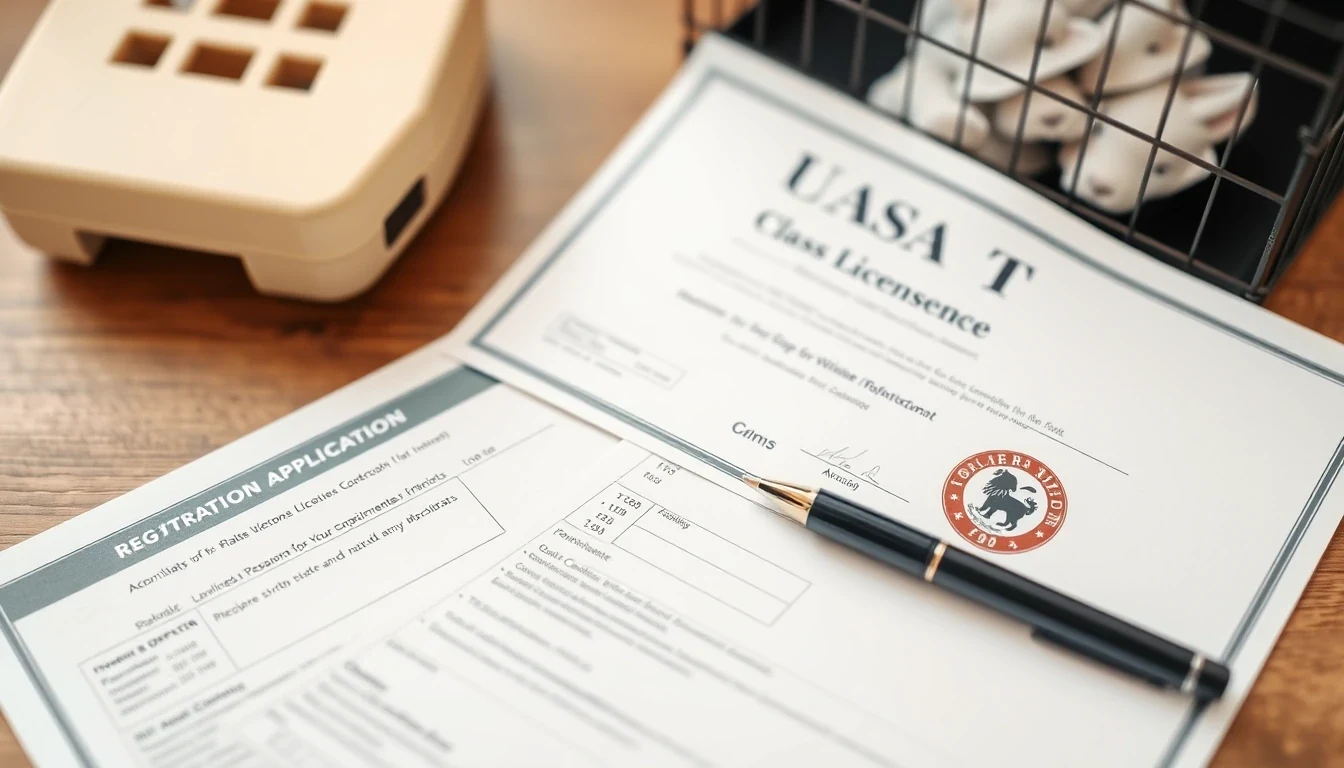
Pet transport license means USDA Class T registration under the Animal Welfare Act (AWA), required for any commercial pet transport across state lines. Application is FREE via the APHIS portal. Process: submit Form 7011 (Class T application) with vehicle and operation details, USDA inspector visits within 60-90 days for initial inspection, vehicle and operation must comply with 9 CFR Part 3 standards (climate control 45F-85F, ventilation, secure crating, food/water access, handler training). Annual renewal required (no fee). Class T number must appear on vehicle and all marketing materials. Operating without it = AWA violation with fines up to $11,000+ per pet per day.
A pet transport license in the US means USDA Class T registration under the Animal Welfare Act, required for any commercial pet transport across state lines. Application is free, takes 60-120 days, and requires vehicle compliance with 9 CFR Part 3 standards. This guide covers the full process: application, inspection, renewal, and the real-cost compliance breakdown.
A license is one step into the field: see pet transport driver jobs and the broader pet transport jobs guide for where it leads.
For a deeper dive, see our guide to how to choose a pet transport company: the vetting checklist and scam red flags (2026).
Comparing providers? See our breakdown of uShip Pet Transport Review.
If you're weighing this decision, our guide on How to Book a Pet Transporter: The Step-by-Step Process walks through the details.
For a closer look at a related situation, see our piece on International Pet Shipping Insurance: What to Know.
We also cover this in more depth in Bonded and Insured Pet Transport: What It Really Means.
Compliance cost breakdown
| Compliance area | Cost range (USD) | Required? | Notes |
|---|---|---|---|
| USDA Class T application | $0 | Yes | Free via APHIS eAuth |
| Business registration (LLC) | $0–$500 | Yes | State-dependent |
| Vehicle 9 CFR Part 3 conversion | $2,000–$10,000 | Yes | Climate, ventilation, anchors |
| Commercial auto insurance | $1,000–$2,500/yr | Yes | Annual |
| Pet bailee insurance | $500–$1,500/yr | Yes | Pet injury/loss coverage |
| Handler training | $0 | Yes | USDA materials free |
| Renewal (annual) | $0 | Yes | Online form |
| Year-1 total compliance | $3,500–$14,500 | , | Mostly vehicle conversion |
Comparing providers? See our breakdown of All Aboard Pet Transport LLC Review.
The application process
- Register business with state (LLC or sole prop) and obtain EIN from IRS.
- Bring vehicle to compliance with 9 CFR Part 3 standards.
- Obtain insurance: commercial auto + pet bailee.
- Document handler training per USDA materials.
- Submit USDA Form 7011 via APHIS eAuthentication portal.
- Pass APHIS inspector site visit within 60-90 days.
Comparing providers? See our breakdown of Pet Express Animal Transport Review.
9 CFR Part 3 compliance, explained

- Temperature: 45F-85F ambient maintained throughout transit. Active climate control with backup.
- Ventilation: fresh-air exchange with operational fans. No engine-only ventilation in cargo area.
- Crating: secure anchors preventing movement during transit. IATA-style crates preferred.
- Space: crate size scaled to pet weight (USDA chart by weight class).
- Food and water: access during transit and at every stop (every 4-6 hours minimum).
- Handler training: per USDA training materials, documented.
- Records: origin, destination, dates, vet records, owner contact info per pet per trip.
What the inspection looks like
USDA APHIS inspector visits your business address. Inspection lasts 1-2 hours. Inspector reviews paperwork (business registration, insurance, training docs), inspects the vehicle (climate, ventilation, crating, food/water systems), verifies record-keeping system, and asks operational questions (how do you handle medical emergencies, lost pets, vehicle breakdown). Inspector issues findings on the spot. Compliant = registration issued within 1-2 weeks. Non-compliant findings require correction and follow-up inspection.
Verifying other operators have a license
The APHIS public registry at aphis.usda.gov lets anyone look up an operator by name or registration number. Reputable operators publish their Class T number on their website and marketing materials. See our USDA certified pet transport guide for the consumer-side verification process.
In-state operators and state licensing
Pet transport that does not cross state lines may not require USDA Class T but typically requires state-level licensing. Examples: California requires state veterinary board commercial animal transporter permits; Texas requires similar; some states (e.g., Florida) have no specific commercial pet transport license but require general business licensing. Check your state Department of Agriculture or Veterinary Board for in-state requirements.

Who actually needs a Class T registration (and who does not)
The line between "needs a federal license" and "does not" trips up more new operators than any other part of the process. USDA Class T registration is required for anyone running a commercial business that moves animals from one location to another for hire across state lines. That sweeps in ground transporters and flight nannies alike. It does not apply to:
- Moving your own personal pets
- Non-commercial or hobby moves with no fee involved
- Purely in-state operations (these fall under state rules instead, covered below)
A useful gut check: if you are being paid to move someone else's animal across a state line, you almost certainly need Class T. The fact that the registration is free is exactly why there is no excuse to skip it, and marketplaces increasingly verify it before letting you bid on interstate loads. Registered transporters also report winning more work, so it functions as a credential as much as a legal requirement.
Where Class T registration is filed: APHIS eFile
The application now runs through the modern APHIS eFile portal rather than a paper-only process. The practical path:
- Create an APHIS eFile account (this replaces the older eAuthentication flow for most applicants).
- Complete the transporter registration application inside eFile, supplying your business, vehicle, and operation details.
- Submit and wait for APHIS to assign an inspector for your pre-registration site visit.
You can verify your own status, and look up any other operator, through the USDA Animal Care public search tool, which is the authoritative registry. Bookmark it: it is how customers and marketplaces confirm you are legitimate, and how you confirm a competitor or subcontractor actually holds the registration they claim.
Annual reporting and staying compliant after approval
Registration is not a one-and-done filing. Class T registrants must keep their registration current each year and remain subject to unannounced inspections at APHIS discretion, where inspectors review your animals, records, and facilities against the Animal Welfare Act. The compliance habits that keep you clean:
- Keep per-trip records of origin, destination, dates, the animal's vet records, and owner contact details, ready to produce on demand.
- Maintain the vehicle to 9 CFR Part 3 standards continuously, not just for the initial inspection. A climate system that fails between inspections is still a violation.
- Renew on schedule. A lapsed registration can force you back through a fresh application rather than a simple renewal.
- Update APHIS if you change vehicles, business address, or scope of operation.
If you have a compliance question, APHIS Animal Care can be reached directly by phone or email, and using that line before an inspection is far cheaper than fixing a citation after one.
State licensing: the layer Class T does not cover
Federal Class T governs interstate commercial transport, but it says nothing about moves that stay inside one state, and it does not override state law layered on top. Several states add their own commercial animal transporter requirements through their Department of Agriculture or state veterinary board. The pattern to plan around:
- Some states require a state-level commercial animal transporter permit even for in-state work.
- Others impose only general business licensing with no pet-specific permit.
- A few have no specific commercial pet transport license at all.
Because the rules vary so widely, the only safe move is to check your own state Department of Agriculture or Veterinary Board before you operate, in addition to securing Class T for interstate work. For the consumer-facing side of verifying any operator's credentials, see our USDA certified pet transport guide, and for where licensing fits in the broader build, our guide to how to start a pet transport business.
Frequently asked questions
Do I need a license to transport pets commercially?
How much does a USDA Class T license cost?
How long does USDA Class T approval take?
What does the USDA inspection involve?
How do I apply for a USDA Class T license?
What is 9 CFR Part 3 compliance?
How do I renew a USDA Class T license?
What happens if I transport pets commercially without a license?
Where do I file for USDA Class T registration?
Does a Class T registration require annual reporting or re-inspection?
Does Class T cover pet transport within a single state?
Process from USDA APHIS Animal Welfare Act resources and 9 CFR Part 3 (May 2026). We refresh annually.
Sources & references
- aphis.usda.gov https://www.aphis.usda.gov/aphis/ourfocus/animalwelfare/animal-welfare-act
- ecfr.gov https://www.ecfr.gov/current/title-9/chapter-I/subchapter-A/part-3
- aphis.usda.gov https://www.aphis.usda.gov/aphis/banner/help/eauth-help