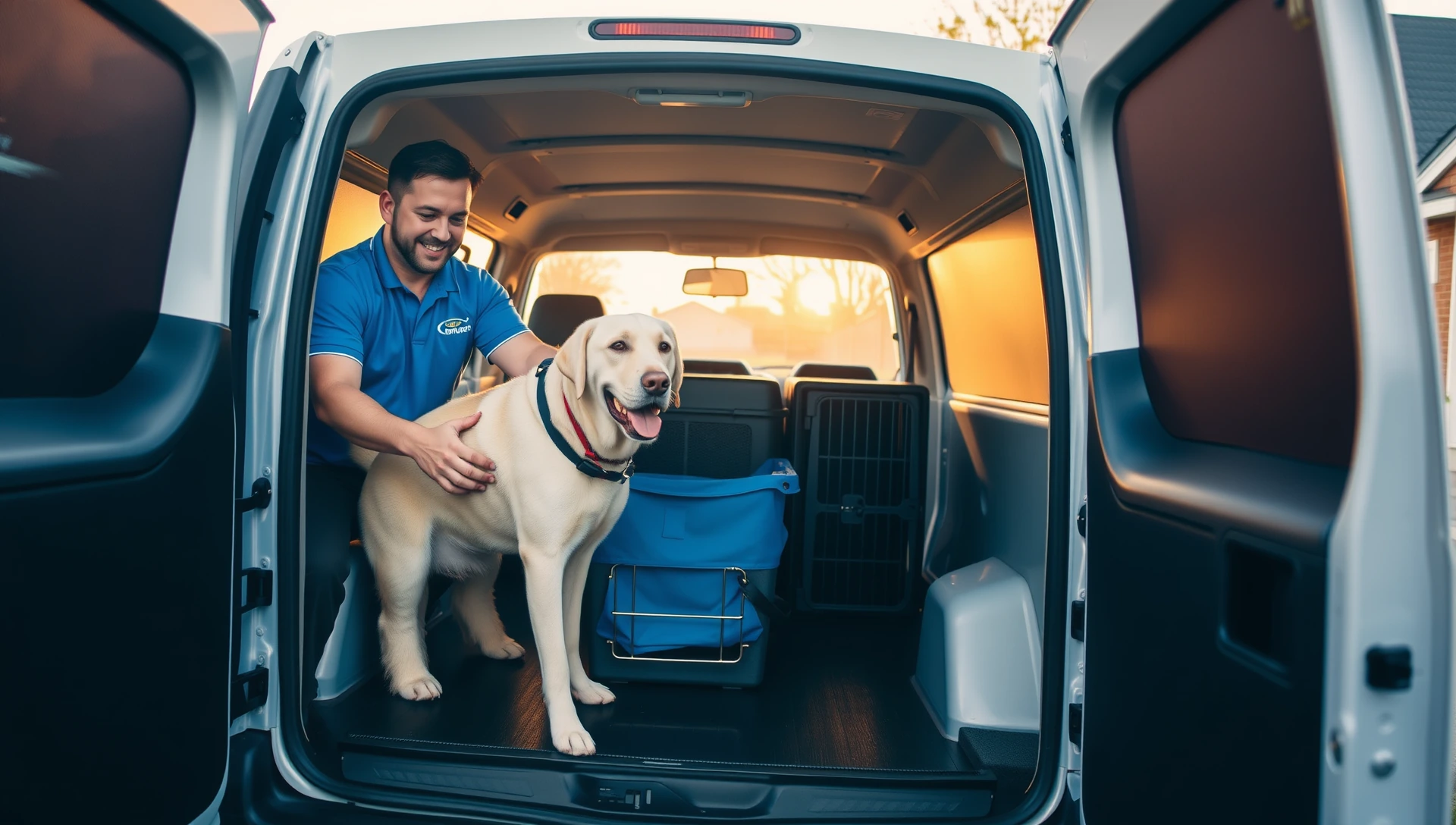
Most "how to start a pet transport business" guides online are surface-level: pick a name, get an LLC, buy a van, done. They skip the parts that actually decide whether you make money or fold inside six months. This guide is written from the operator side. It covers the four real business models, the USDA Class T registration most new transporters do not realize they now need, the insurance stack that separates a real business from a hobby, vehicle build-out costs by tier, and the math that tells you whether to drive for CitizenShipper or build an independent brand.
Quick Take: The pet transport market in the U.S. is growing because demand for ground transport has outstripped airline cargo capacity for brachycephalic and large breeds. A solo operator with a Ford Transit Connect, USDA Class T registration, and pet bailee insurance can realistically gross $6,000 to $10,000 per month within 12 months, with experienced veterans on CitizenShipper clearing $20,000+ monthly. The barriers are not capital, they are paperwork, route discipline, and reputation.
Drafting your customer agreement? Our pet transport contract guide covers the must-have clauses (liability cap, vet care authorization, force majeure, cancellation), state-specific notes, and when to hire a lawyer.
For a deeper dive, see our guide to how to choose a pet transport company: the vetting checklist and scam red flags (2026).
Comparing providers? See our breakdown of All Aboard Pet Transport LLC Review.
Coverage is a core startup cost, so review what insurance a pet transport business needs before you take your first booking.
The pet transport market and why right now is the window
Three structural shifts created the current opening. First, airlines have permanently scaled back in-cabin and cargo pet acceptance after pandemic-era cuts; snub-nosed breed bans pushed thousands of relocations onto the road. Second, remote work normalized long-distance household moves with pets. Third, USDA APHIS formalized commercial transporter oversight, and platforms like CitizenShipper made Class T registration mandatory for drivers as of April 22, 2026 (CitizenShipper, 2026). The market is professionalizing fast, which favors operators who set up properly now.
Comparing providers? See our breakdown of Pet Express Animal Transport Review.
The 4 main business models
Decide which lane you are in before you buy anything. Each model has a different capital requirement, daily routine, and ceiling.
1. Local pet taxi
You ferry pets within a 50-mile metro radius: vet runs, groomer runs, airport pickups, daycare drops. Average ticket $35 to $90. Predictable schedule, high repeat-customer rate, low fuel cost. Capital required is the lowest of the four, you can launch with a clean SUV plus crates. Ceiling is around $4,000 to $6,000 a month solo because you cap out on driveable hours in your service area.
2. Ground long-distance
Multi-day cross-country drives, single-pet private or shared group runs. Average ticket $600 to $2,500. This is where the highest gross sits and where CitizenShipper bids cluster. You will be on the road 15 to 22 days a month. Capital required: a reliable van, full insurance stack, USDA registration. Ceiling is roughly $10,000 to $20,000 monthly solo, higher with a second driver and rotating vehicles.
3. Flight nanny
You fly with a pet as accompanied baggage or checked cargo, typically for breeders, military families, or relocations the owner cannot do themselves. Average ticket $400 to $1,500 plus flight costs reimbursed. Low equipment cost, but you need flexibility, frequent-flyer status helps, and physical stamina for repeat air travel. Closer to a gig than a fleet business. See our breakdown of pet transport driver jobs for what the day-to-day actually looks like.
4. International / specialty
Door-to-door international relocations with customs paperwork, IPATA membership, USDA-accredited vet coordination, often working with corporate relocation accounts. Average ticket $3,500 to $9,000 per pet. Highest barrier to entry: you need years of operational experience, freight-forwarder relationships, and country-specific compliance knowledge. Best entered as a pivot from established ground operations, not as a starting point.
Is it right for you? The lifestyle reality check
Before USDA paperwork, answer four honest questions.
- Can you be away from home 15+ nights a month? Ground long-distance is the only model that scales past $10K solo, and it requires it.
- Are you actually good with dogs, including anxious or aggressive ones? You will handle a 70lb shepherd vomiting in your back seat. Skill matters more than love of animals.
- Can you maintain spotless records? USDA inspections demand transport logs, temperature logs, feeding records. Sloppy operators get deregistered.
- Do you have $15,000 to $40,000 in start-up cash? Vehicle, crates, insurance year-one, LLC, USDA setup, marketing.
USDA Class T registration step by step
Under the Animal Welfare Act, anyone who transports more than four animals per year for compensation is a "commercial transporter" and must be registered with USDA APHIS as a Class T. Registration itself is free, but the compliance bar is real (APHIS, Transporting Animals in Commerce). Detailed walkthrough in our USDA certified pet transport guide.
- Confirm you need it. If you transport 5+ pets a year for any compensation, you are required to register. CitizenShipper now blocks bids from unregistered transporters, with a 90-day grace period for applications in process (CitizenShipper, 2026).
- Download the application. APHIS Form 7003 ("New Registration Application, Transporters"), available at aphis.usda.gov.
- Submit through the Licensing and Registration Assistant. The eFile portal at efile.aphis.usda.gov walks you through entity type, contact info, and operational details.
- Pre-license inspection. An APHIS Animal Care inspector reviews your vehicle, primary enclosures (crates), and recordkeeping templates. Pass on the first try by reading 9 CFR Part 3 Subpart F before they arrive.
- Receive your certificate. Most clean applicants are registered within 60 to 90 days. The number must be displayed on quotes and contracts.
- Annual re-registration. Re-confirm details and pay the annual fee (currently $40 to $400 depending on volume bracket).
State licensing and DOT regulations
USDA covers federal welfare. Two more layers sit on top.
State licensing. Some states (Connecticut, Virginia, Michigan) require a separate state animal transporter license; others piggyback on USDA. Always check your home state and any state you plan to deliver into. Our pet transport license guide tracks this by state.
DOT / FMCSA. Per FMCSA, if your vehicle or combination is under 10,001 lb GVWR you are exempt from Hours-of-Service, ELD, and CDL requirements (FMCSA, Regulations). At 10,001 to 26,000 lb GVWR you do not need a CDL but may need an ELD and a USDOT number for interstate for-hire transport. Above 26,001 lb GVWR you cross into CDL territory. Most pet transport vans (Transit Connect, full-size Transit, Sprinter 144" wheelbase) sit comfortably under 10,001 lb GVWR, which is the simplest place to be regulatorily.
Insurance: the three policies you cannot skip
Your personal auto insurance will not cover a pet in your care being transported for hire. A standard cargo policy also does not cover live animals. You need a layered stack. Full detail in our pet transport insurance guide.
- Commercial auto liability. $1M liability is the floor. Expect $3,000 to $7,000 per year for a single van depending on state and driving record (Insureon, Pet Transportation Insurance).
- General liability. Covers slips, bites, property damage at pickup or drop-off. Usually $400 to $900 a year bundled with a Business Owner's Policy.
- Animal bailee insurance. This is the unique one: covers injury, illness, or death of a pet in your care, custody, or control. Entry-level coverage starts around $139 per year ($5,000 per occurrence / $10,000 aggregate). Mid-tier with a $2,000 single-animal limit and $25,000 overall can be found from $16/year through specialty carriers, while a full $1M / $1M / $3M policy runs up to $4,613 annually (Tivly, Animal Bailee Coverage).
Realistic total insurance budget for a solo ground operator in year one: $4,500 to $8,500.
Vehicle selection: by model and tier
Pick the vehicle that matches the business model, not the one that looks coolest on Instagram. Full breakdown in our best vehicle for a pet transport business guide.
Tier 1: Used minivan or SUV ($8K to $18K)
Honda Odyssey, Toyota Sienna, Chrysler Pacifica, or a used Ford Explorer. Right answer for local pet taxi or a small-group ground operator transporting 2 to 4 pets at a time. Stealth (no commercial wrap), efficient (22 to 28 mpg), cheap to insure. Crates strap to rear seat anchors. This is how most successful CitizenShipper drivers actually start.
Tier 2: Ford Transit Connect or used cargo van ($20K to $35K)
The Ford Transit Connect starts around $35,995 MSRP new (TrueCar); used 2018 to 2022 units sit at $18K to $26K. Step up from a minivan: more vertical room for stacked crates, separate cargo area, more professional look at the door. Build-out (crate tie-downs, rubber flooring, ventilation fan, climate divider) runs $2,500 to $5,000 DIY, $7,000 to $12,000 turnkey.
Tier 3: Mercedes Sprinter or Ford Transit full-size ($45K to $90K+)
A Mercedes Sprinter Passenger Van starts around $59,225 MSRP, with full conversions ranging $50,000 to $150,000+ for premium builds (Paradigm Van Conversions, 2025). Five-year total cost of ownership runs $120,000 to $250,000 on a Sprinter versus $100,000 to $200,000 on an equivalent Transit. The Sprinter justifies the premium only when you are running 6+ pets per trip, premium relocations, or sleeping in the vehicle on multi-day routes. For most new operators, a Transit (lower acquisition, more service availability, smaller maintenance bills) wins on margin even though it lacks the Sprinter's brand cachet.
Crate and equipment investment
USDA-compliant primary enclosures are non-negotiable. Budget for the full kit before your first trip:
- Six IATA / USDA-compliant crates in graduated sizes (100 through 700): $1,200 to $2,400.
- Crate tie-down straps and floor anchors: $200.
- Pet first-aid kit, thermometer, muzzle set, leash backups: $250.
- 12V cooling fans and a cabin temperature monitor that alerts to your phone: $300 to $500.
- Cleaning kit (enzymatic spray, paper towels, biohazard bags, gloves): $150 per restock.
- Dash and cabin cameras (operator protection and proof of welfare): $300 to $600.
- GPS tracker the customer can view (a $99 hardware unit plus $10/mo SaaS) builds trust and pricing power.
Pricing: per-mile, flat-rate, expedited
U.S. ground pet transport runs $0.50 to $1.60 per mile in 2026, with the broader spread reaching $0.50 to $3.00 per mile for premium or expedited service (CitizenShipper, Per Mile Pricing). The pricing rules in practice:
- Short hops (under 100 miles): charge a $150 to $250 minimum so a 60-mile run still pays. Per-mile rates here look like $2 to $4 because of the minimum.
- Mid-range (100 to 500 miles): $1.00 to $1.50 per mile, single pet. Add 20 percent for a second pet, 40 percent for a third.
- Cross-country (1,500 to 3,000 miles): $0.50 to $0.90 per mile because you can stack 3 to 6 pets on a group run. A typical 2,500-mile NYC to LA trip prices at $1,250 to $4,000 depending on solo-vs-group and tier (CitizenShipper, Cross-Country Costs).
- Expedited or solo (no stops, your pet only): $1.50 to $3.00 per mile. This is your highest-margin product.
- Fuel surcharge: when diesel or gas spikes above your baseline, add $0.35 per round-trip mile as a line item rather than re-pricing.
Run the math: a Transit Connect at 23 mpg over a 2,500-mile route at $3.50/gal burns about $380 in fuel. A $0.75/mile group quote on that route grosses $1,875 per pet, four pets equals $7,500. Net after fuel, lodging, tolls, and platform fee is the operator's take-home.
CitizenShipper or uShip vs independent: which is more profitable?
The two platforms book most of the U.S. ground pet transport volume that does not come from breeders or rescues. Detailed reviews: CitizenShipper and uShip.
The platform path. CitizenShipper drivers report $8,000 to $10,000 monthly revenue at 15 to 20 shipments, with $6,000 to $8,000 net after expenses. Experienced veterans clear $20,000 to $30,000 monthly, with some clearing $100K/year net (CitizenShipper, Driver Earnings). Pros: zero customer-acquisition cost, daily bid flow, built-in escrow and reviews. Cons: subscription plus per-bid credits, platform fees, you compete against new drivers willing to undercut, and you do not own the customer relationship.
The independent path. You build a website, run Google Local Service Ads, accept direct bookings, set your own rates, and own every repeat customer. Pros: 20 to 35 percent higher net margin per trip, premium pricing power once you have reviews, you can build a fleet. Cons: 6 to 12 months of slow ramp before bookings cover overhead, you need to invest in marketing (Google, GMB, content), and you absorb chargeback risk.
The realistic answer. Start on CitizenShipper to build review volume and learn route economics. After 18 to 24 months and 150+ positive reviews, layer in direct bookings and let the platform fade to maybe 30 percent of your volume. The hybrid path is the highest-earning pattern in the industry.
Finding your first 5 clients
Cold-start tactics, in priority order:
- List on CitizenShipper Day 1. Bid aggressively (10 to 20 percent below median) on your first 10 jobs to seed reviews. Lose money on the first two if you have to.
- Local breeder outreach. Identify 30 reputable breeders within 200 miles. Email a short intro plus your USDA registration number and bailee insurance policy number. Two or three will need a transporter monthly.
- Vet and groomer flyers. Plain B&W flyers at the front desk outperform glossy ads. Offer a $25 referral fee.
- Rescue partnerships. Local rescues coordinate transports constantly. They will not pay full rate, but they will refer paying clients.
- Google Business Profile + 10 service-area-specific landing pages. Start ranking for "pet taxi your-city" and "pet transport your-city to other cities" terms.
Scaling: drivers, fleet, contracts
Solo operators hit a hard ceiling around $120K to $200K annual gross. To break past, three levers:
- Second driver. 1099 contractor on a revenue share, typically 60/40 to the driver after expenses, or W-2 at $0.45 to $0.60 per loaded mile. You handle dispatch and customer service.
- Second vehicle. A second Transit running parallel routes can double monthly capacity. Capital plus insurance plus USDA amendment, typically $40K to $60K all-in.
- Contract accounts. Breeder networks, corporate relocation firms, university research animal moves, and military PCS contractors all pay recurring monthly volume at lower per-trip margins but vastly more predictable revenue. Apply to pet transport contract opportunities after 24 months of clean operations.
Common failures and how to avoid them
- Skipping bailee insurance. One sick dog in transit can be a $15,000 vet bill. Operators who fold inside year one almost always skipped this.
- Pricing too low for too long. Underbidding to get reviews is fine for 10 jobs, not 100. Raise rates aggressively as your review count crosses 50.
- Vehicle too big, too soon. The $90K Sprinter that nets nothing for six months kills more new operators than slow bookings. Start in a minivan.
- No backup plan for an animal emergency. Know the 24-hour emergency vets along every route. Pre-load addresses into your GPS at trip start.
- Poor records. Failing a USDA inspection because your trip logs are sloppy is a self-inflicted business-ender. Use a single binder or app and update every leg.
- Mixing personal and commercial driving. The day a personal-insurance claim happens during a paid pickup is the day you discover your coverage was void.
The transporters who scale past $250K a year share the same discipline: registered with USDA, fully insured, route-disciplined, review-obsessed. Benchmark against the operators in our pet transport companies directory before setting your own service standard.
Frequently asked questions
How much does it cost to start a pet transport business?
Do I really need USDA Class T registration?
Can I start a pet transport business with just my personal SUV?
Is CitizenShipper or running independent more profitable?
How much can a pet transport business realistically earn in year one?
Reviewed and fact-checked by the Canine Cab Company editorial team, 2026-05-20.