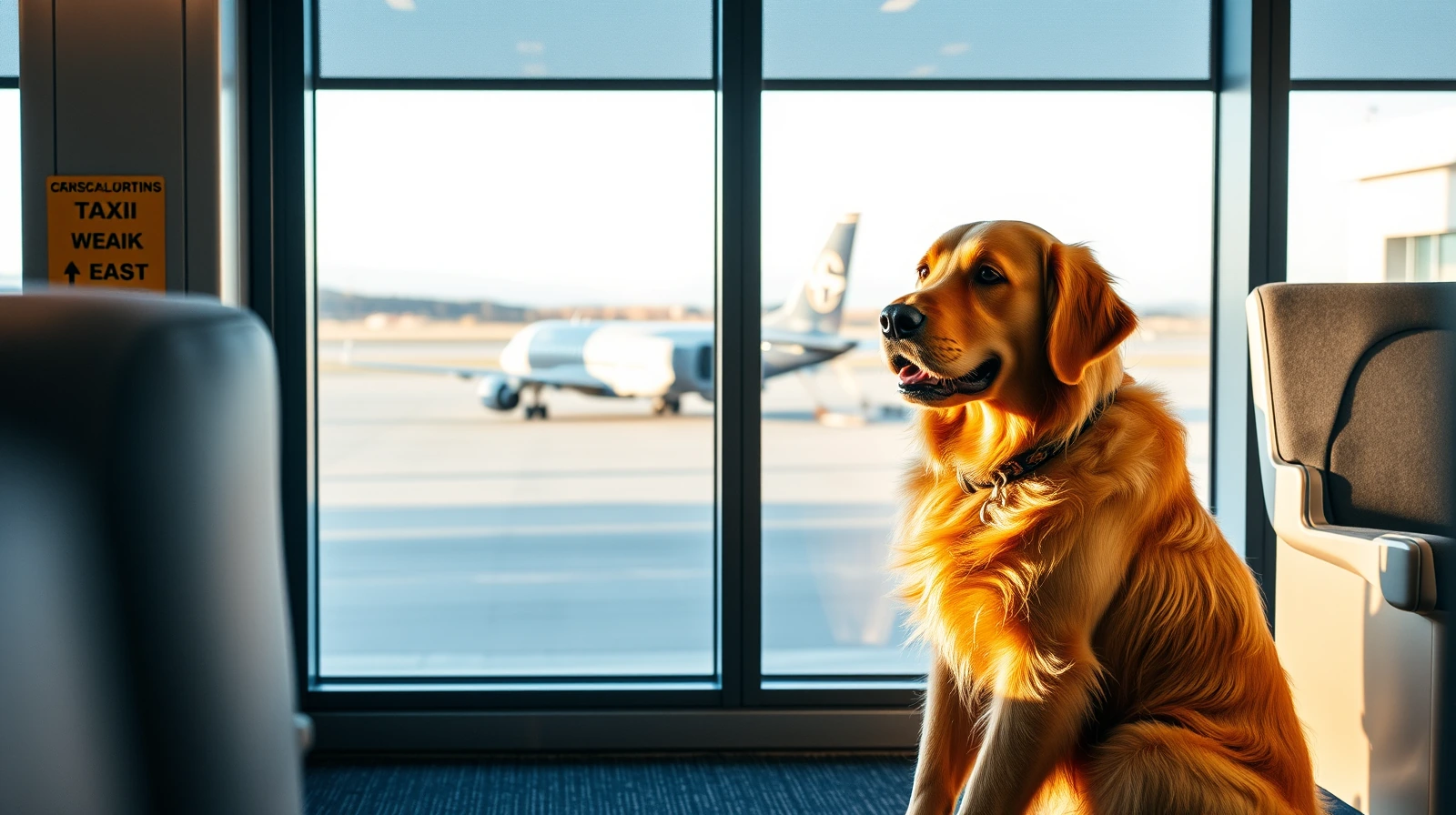
Alaska Airlines lets dogs and cats fly in the cabin for $100 to $200 each way depending on route, and is one of the last major US carriers still moving larger pets in climate-reviewed baggage and as Pet Connect cargo. Pets must be 8 weeks and weaned. Short-nosed breeds are barred from the hold except on Hawaii routes.
Alaska Airlines lets dogs and cats fly in the cabin for roughly $100 to $200 each way depending on the route, and it is one of the last major US carriers still moving larger pets in climate-reviewed checked baggage and as unaccompanied cargo through its Pet Connect program. Pets must be at least 8 weeks old and weaned. Short-nosed breeds are barred from the hold except on Hawaii routes. Fees change with little notice, so confirm the current figure for your route with Alaska before you book.
For a deeper look, see our guide to Going Through Airport Security With a Dog.
Flying a different airline? See our guide to Spirit Airlines Pet Policy.
Rabbit and bird acceptance has moved in both directions recently; see exotic species by airline.
Why Alaska still counts as pet-friendly in 2026
Most legacy US airlines have quietly exited live-animal transport. American and United killed off owner-checked pets and most cargo pet shipping years ago, and Delta ended checked-baggage pets for the general public in 2016. Alaska Airlines is the outlier: it still offers three distinct ways to move an animal. A small dog or cat can ride under the seat in the cabin, a larger pet can travel in the climate-reviewed baggage compartment on the same flight as its owner, and a pet flying without its owner can ship as cargo through Pet Connect, the brand operated by Alaska Air Cargo.
That breadth matters. If your dog is 40 pounds, the only way it boards a passenger flight on most carriers is as freight booked weeks out through a third party. On Alaska, in many cases, it can fly in the belly of the plane you are on. The catch is a thicket of breed bans, temperature embargoes, and route-specific fees that change depending on whether you are flying within Alaska, within Hawaii, transpacific, or across the Lower 48. We break down each path below. For a wider look at how carriers stack up, see our pet airlines guide.
Flying a different airline? See our guide to Allegiant Air Pet Policy.
In-cabin: dogs and cats only, $100 to $200 each way
As of June 5, 2025, Alaska only accepts dogs and cats for new in-cabin bookings. Rabbits and household birds, which the airline used to allow, were grandfathered: only travelers who bought a ticket before that date could still bring them, and that window closes by April 4, 2026. After that, the cabin is dogs and cats, full stop.
The pet rides in a carrier that fits fully under the seat in front of you, and your animal must stay inside it for the whole flight. Hard-sided carriers must not exceed 17 inches by 11 inches by 7.5 inches. Soft-sided carriers, which flex, can be slightly taller at 17 by 11 by 9.5 inches. The combined weight of pet and carrier should let the carrier sit flat under the seat without forcing the animal to be cramped. You are limited to one pet carrier per passenger, and a single carrier can hold up to two animals of the same species if they are small enough to be comfortable.
The fee depends entirely on your route
This is where Alaska gets confusing, and where the Hawaiian Airlines merger reshaped the price list. The base in-cabin fee was $150 each way, and for flights departing on or after January 2, 2026, the standard fee rose to $200 each way per carrier. But several routes carry steep discounts. Travel wholly within the state of Alaska is $100 each way. Interisland Hawaii hops are just $35. Transpacific cabin travel to or from Hawaii settled at $100 after the merger aligned Hawaiian's old $125 fee down to match. So the headline "Alaska charges $100 for a pet" is true only on specific routes; a mainland cross-country flight now runs about $200 each way, or roughly $400 round trip. These are the published figures at the time of writing, so confirm the current fee for your route with Alaska when you book.
You cannot add a pet during online check-in. Alaska caps the number of pets per cabin, so you must call reservations to book the pet onto your flight in advance. Brachycephalic (short-nosed) dogs and cats are allowed in the cabin, where pressurization and temperature are not a concern, even though those same breeds are barred from the baggage hold.
Pet Connect and checked baggage: the climate-reviewed hold
For a pet too big for the cabin, Alaska offers the baggage compartment, a pressurized, temperature-reviewed section of the same aircraft you fly on. Pet Connect is the name of the broader Alaska Air Cargo program; it handles both owner-accompanied checked pets and pets shipped entirely on their own without a passenger. If your dog cannot fit under a seat, this is usually your only same-airline option short of a dedicated ground service.
Checked-baggage pets travel on a per-carrier fee in the same range as the cabin, with the standard fee moving to $200 each way for flights departing on or after January 2, 2026. Unaccompanied Pet Connect cargo is priced differently: Alaska Air Cargo does not publish a flat rate, because the cost is calculated by kennel size, weight, and route, and you must request a quote from the Cargo Call Center. Expect cargo shipments to run meaningfully higher than the checked-baggage fee, often several hundred dollars for a large dog on a long domestic route.
Pet Connect carries dogs, cats, birds, and other animals subject to approval, which is a wider species list than the cabin allows. Every animal needs a kennel that meets airline and IATA standards: the pet must be able to stand, turn around, and lie down naturally. A health certificate and proof of rabies vaccination are required, and animals must be picked up within four hours of arrival. If you are weighing the hold against the cabin for your pet, our breakdown of pet cargo versus in-cabin walks through the trade-offs.
Temperature embargoes can ground your booking
The biggest gotcha with the hold is weather. Alaska reviews the forecast for every city on your pet's itinerary, including connections. Animals are generally accepted only when forecasted temperatures fall between 45 degrees and 85 degrees Fahrenheit at every point on the route. Above 85 degrees, the booking is refused outright. Below 45 degrees, you can still fly if a veterinarian issues a certificate of acclimation within 10 days of travel, confirming the animal can tolerate the cold. In practice this means summer afternoons through hot airports and deep winter cold snaps both trigger embargoes that can block pet travel for days or weeks.
Breed bans: why short-nosed pets cannot fly in the hold
Brachycephalic dogs and cats, the flat-faced breeds, are more vulnerable to breathing problems and heat stress in the cargo environment, so Alaska bars them from the baggage and cargo compartments. The restricted dog list includes Boston Terrier, Boxer, Bulldog (all breeds), Bull Terrier, Brussels Griffon, Chow Chow, English Toy Spaniel, Japanese Chin, Mastiff (all breeds), Pekingese, Pit Bull (all breeds), Pug (all breeds), Shih Tzu, Staffordshire Terrier, and any mix containing these. Restricted cats include the Burmese, Exotic Shorthair, Himalayan, and Persian, plus mixes.
There is one carve-out. These breeds may travel in cargo to, from, or within Hawaii, but they cannot connect on flights departing Hawaii, and they require a kennel one size larger than standard to improve airflow. Everywhere else, a flat-faced dog rides in the cabin or not at all. If your dog is on this list, read our guide to the snub-nosed dog breed flying bans before you book anything, on any airline.
In-cabin vs Pet Connect: the rules side by side
| Factor | In-cabin | Checked baggage / Pet Connect |
|---|---|---|
| Animals allowed | Dogs and cats only (as of June 5, 2025) | Dogs, cats, birds, others by approval |
| Standard fee each way | $200 (from Jan 2, 2026); $100 within AK; $35 interisland HI; $100 transpacific HI | $200 checked baggage (from Jan 2, 2026); cargo quoted by size, weight, route |
| Carrier / kennel | Under-seat, max 17x11x7.5 hard or 17x11x9.5 soft | IATA-compliant kennel, stand and turn around |
| Brachycephalic breeds | Allowed | Barred (except to/from/within Hawaii, larger kennel) |
| Temperature embargo | None (climate-controlled cabin) | 45-85 degrees F at all points; cold cert below 45 |
| Minimum age | 8 weeks, weaned | 8 weeks, weaned |
| Health certificate | Not required for cabin | Required, plus rabies proof |
How Alaska compares to American, United, and Delta
Against the big three, Alaska is the clear winner for anyone with a larger pet. American Airlines and United both accept only small in-cabin dogs and cats on most routes and have largely withdrawn from checked-baggage and cargo pet shipping for general travelers; see our American Airlines pet policy breakdown and the United Airlines pet policy guide for the specifics. Delta also dropped checked-baggage pets in 2016 and now runs a cabin-only program for most customers, as covered in our Delta Airlines pet policy guide.
The practical upshot: if you have a Labrador, a Husky, or any dog over roughly 20 pounds, Alaska is one of the only US passenger airlines that will fly it on your flight at all, weather and breed permitting. Cabin fees across the four carriers cluster around $125 to $200 each way, so Alaska is not cheaper on the small-pet side. Its edge is access, not price. For ground alternatives and a full cost picture, see our guide to how much pet transport costs.
The Hawaiian Airlines merger: what changed for pets
Alaska Air Group acquired Hawaiian Airlines and reached a single operating certificate from the FAA in October 2025, with both carriers moving onto one passenger service system in spring 2026 and all flights eventually carrying the AS code. For pet owners, the merger mostly helped. Pricing converged downward: the interisland Hawaii cabin fee held at $35, and the transpacific cabin fee dropped from Hawaiian's old $125 to $100 to match Alaska's structure. The brands still operate distinctly, with Hawaiian branding kept on Hawaii-focused routes, but the pet rules are now administered as one program.
Hawaii adds its own layer no airline can waive: the state has strict rabies-quarantine and import rules, and only dogs and cats are accepted on Hawaii and international flights. Birds and other species that Pet Connect carries on the mainland are not eligible to or from Hawaii. If the islands are your route, plan the state paperwork first; our Hawaii pet transport guide covers the quarantine program and the documents you need to clear before departure.
Service animals and emotional support animals
Trained service dogs fly free in the cabin under US Department of Transportation rules, and they are not counted against the pet limit. You must submit the DOT Service Animal Air Transportation Form before travel, and the dog must remain under your control and not occupy a seat or block an aisle. Emotional support animals, by contrast, are no longer treated as service animals after the DOT rule change that took effect in 2021. An ESA now flies as a regular pet, which means it pays the in-cabin fee and must meet the same carrier, breed, and age rules as any other animal. Do not assume an old ESA letter buys you a free or unrestricted booking; it does not.
How we sourced this
Fees, breed lists, temperature thresholds, and age rules in this guide come directly from Alaska Airlines' published pet policy pages and the Alaska Air Cargo Pet Connect guidelines and restrictions pages, cross-checked against the airline's merger announcements for the Hawaiian Airlines pricing changes. Airline pet rules and fees change with little notice, especially around the 2026 fee increase and the merger integration, so confirm the current figure for your exact route on alaskaair.com and call the Cargo Call Center for any unaccompanied Pet Connect quote before you book.
How much does it cost to fly a dog on Alaska Airlines?
What pets can fly in the cabin on Alaska Airlines?
Can large dogs fly on Alaska Airlines?
What dog breeds are banned from Alaska cargo?
What is Alaska Pet Connect?
How old does a pet have to be to fly on Alaska?
Does the Hawaiian Airlines merger change Alaska's pet rules?
Do emotional support animals fly free on Alaska?
Sources & references
- alaskaair.com https://www.alaskaair.com/content/travel-info/pets
- alaskaair.com https://www.alaskaair.com/content/travel-info/policies/pets-traveling-with-pets/pets-in-cabin
- alaskacargo.com https://www.alaskacargo.com/petconnect
- alaskacargo.com https://www.alaskacargo.com/petconnect/restrictions
- news.alaskaair.com https://news.alaskaair.com/company/alaska-airlines-and-hawaiian-airlines-reach-major-integration-milestone-a-single-operating-certificate/
- transportation.gov https://www.transportation.gov/individuals/aviation-consumer-protection/service-animals-including-emotional-support-animals
- iata.org https://www.iata.org/en/programs/cargo/live-animals/pets/