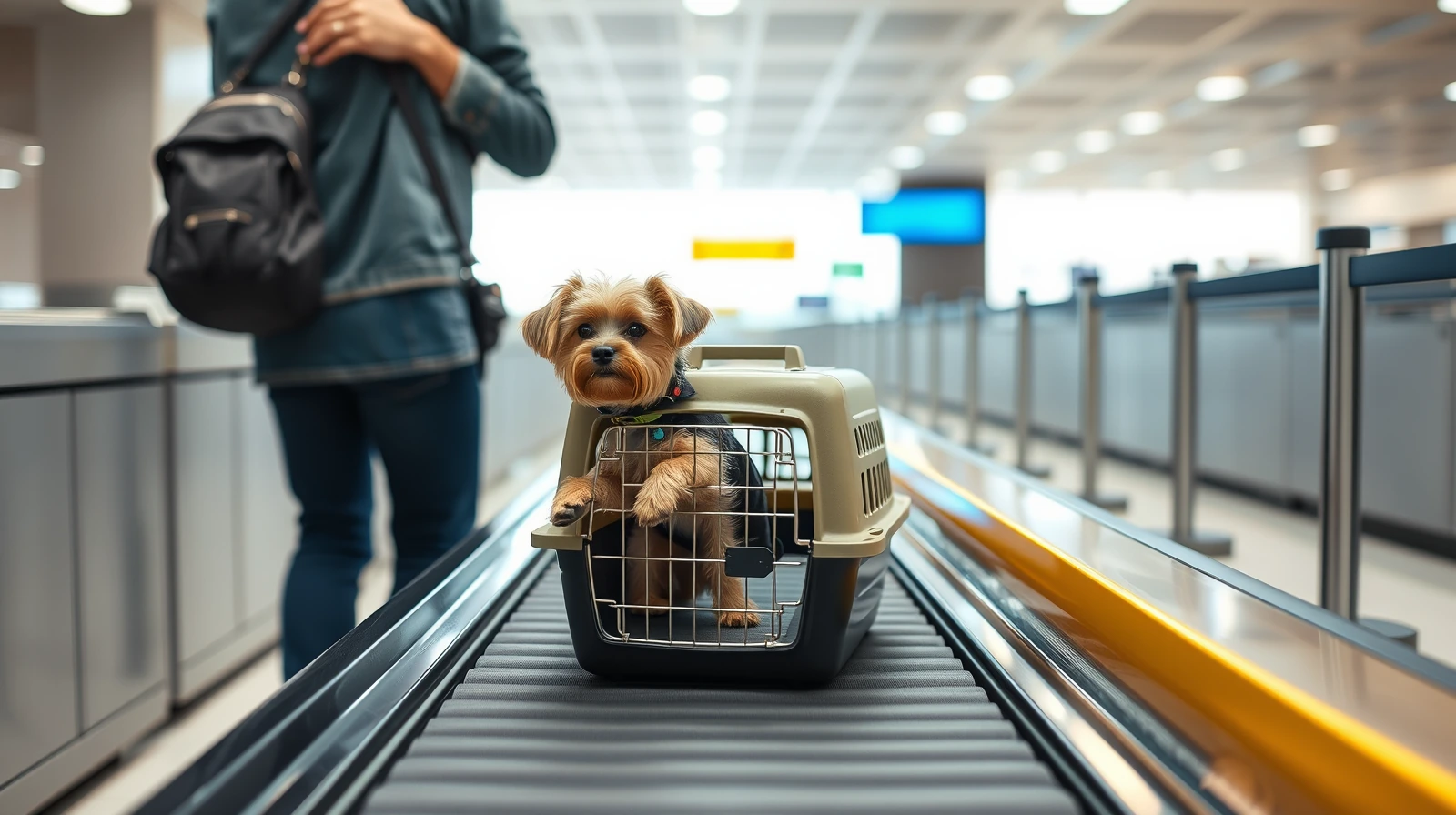
Your dog never goes through the X-ray. You take it out of the carrier, send the empty carrier through the belt, carry or leash the dog through the metal detector, then TSA swabs your hands. Re-secure your dog away from the lanes.
You have done the hard part. The airline approved your dog for the cabin, the carrier fits under the seat, and your boarding pass is in hand. Then you see the security line and a small panic sets in: does the dog go through the scanner? Do you take it out? What if it bolts? The answer is calmer than the worry. The TSA screening process for an in-cabin dog is short, predictable, and the same at every checkpoint in the country. Your dog is never X-rayed. You take it out, send the empty carrier down the belt, walk your dog through the metal detector, and let an officer swab your hands. That is essentially it. This guide decodes the whole sequence so you arrive at the lane already knowing the choreography.
Federal rules also require larger airports to provide a pet relief area in each terminal; see our guide to pet relief areas at airports.
The short version: your dog never goes through the X-ray
The single most important thing to know is the one that scares people most. Your pet does not ride the X-ray belt and does not pass through any imaging equipment. According to TSA guidance on traveling with pets, you remove your animal from its carrier just before screening, send the empty carrier through the X-ray, and carry or walk the pet through the walk-through metal detector with you. The carrier is the only part of your pet's setup that gets imaged. The dog stays in your arms or on its leash the entire time.
That distinction matters because the carrier is the bulky, confusing part. Once you accept that the soft-sided bag goes on the belt empty and your dog comes through with you, the rest of the process is just a person carrying a small dog through a doorway-shaped detector. If you are still selecting a carrier, our guide to the best airline-approved dog carrier covers the soft-sided bags that collapse flat for the X-ray tray, which makes this step far smoother.
The TSA dog screening process, step by step
Here is the exact order of operations at the checkpoint, drawn from TSA's published procedure. Read it once before you fly and the lane will feel familiar.
- Load your other items first. Put your shoes, laptop, liquids bag, and the rest of your belongings into bins and onto the belt while your dog is still secured. You want both hands free for the dog and nothing left to fumble with later.
- Open the carrier and take your dog out. Just before you step up to the detector, unzip the carrier and lift your dog out. Keep a firm grip or a short leash on it the whole time.
- Send the empty carrier through the X-ray. Collapse or place the empty carrier on the belt like any other bag. It rides through the imaging machine without your pet inside.
- Carry or walk your dog through the metal detector. Hold a small dog in your arms or lead a larger one on a leash through the walk-through metal detector. You and the dog go through together.
- Let the officer swab your hands. Because you handled an animal that did not get imaged, a TSA officer will swab your hands for explosive trace detection. This takes seconds and is routine, not a sign of suspicion.
- Move to the recompose area and re-secure your dog. Step well away from the lane to the bench or counter, put your dog back into its carrier, zip it closed, and collect your other items.
If an officer needs to do anything beyond this, such as a closer inspection, they will explain it. The baseline process above is what the overwhelming majority of pet owners experience. TSA's broader special procedures page confirms that screening is meant to be completed without separating you from your animal.
Leash and harness control in a crowded checkpoint
The checkpoint is the riskiest moment for an escape because it is loud, packed, and full of strangers, and it is the one place your dog is briefly out of its carrier. Control is everything. Put a well-fitted harness and a short leash on your dog before you reach the line, even if it travels in the carrier, so you have a handle the instant the zipper opens. A harness is safer than a collar alone here because a startled dog can back out of a collar, and you do not want anything slipping over the head at the wrong second.
Keep the leash short, looped around your wrist, and gathered in your hand so there is no slack for the dog to dart into. Never set the dog on the floor near the lanes. Carry small dogs; keep larger leashed dogs tight against your leg. The goal is that from the moment the carrier opens to the moment it zips shut again, your dog is either in your arms or on a taut leash with no daylight in between.
Remove the collar and any metal first
Metal sets off the walk-through detector, and a dog wearing a chunky metal-buckle collar, tags, or a metal-clasp harness can trigger an alarm that means a re-scan. Before you reach the front of the line, swap a metal collar for the harness and leash you are using for control, or remove jingling tags and tuck them in your bag. A cloth or plastic-buckle harness with the leash clipped on is the cleanest setup. Keep the ID tags accessible in your carry-on so you can clip them back on after the checkpoint, since you still want your dog identifiable for the rest of the trip.
Before, at, and after the checkpoint: a quick reference
| Stage | Do this |
|---|---|
| Before the line | Put harness and short leash on the dog, remove metal collar and tags, take a bathroom walk, confirm carrier zips easily. |
| Loading the belt | Send shoes, laptop, liquids, and bags through first. Keep both hands free for the dog. |
| At the detector | Take the dog out, put the empty carrier on the belt, carry or walk the dog through the metal detector, allow the hand swab. |
| After (recompose) | Step away from the lanes, re-secure the dog in the carrier, clip tags back on, collect your items, breathe. |
What to do if your dog will not stay calm
Some dogs handle the noise fine. Others tremble, whine, or squirm. A few practical moves reduce the odds of a meltdown. Tire the dog out with a long walk before you get to the airport, and use the airport's pet relief area right before security so it is not anxious about needing to go. Bring a familiar item with its scent, such as a worn shirt, in the carrier. Speak in a low, steady voice and avoid mirroring the dog's panic with your own tension, since dogs read your stress.
If your dog genuinely will not settle, tell the officer. They handle nervous animals constantly and can give you a moment to gather the dog before you step through. Do not sedate your dog for the flight without a veterinarian's explicit sign-off, because sedatives can be dangerous at altitude. The better long-term fix is desensitization at home: practice taking the dog in and out of the carrier, walking it on a leash through busy places, and getting it used to being held in crowds well before the trip. Our broader guide to flying with a dog in cabin covers the pre-flight conditioning that pays off at the checkpoint.
Travel with two people if you can
A second adult turns the hardest part of the trip into a relay. One person manages the dog and the leash while the other loads bins, pushes the carry-ons down the belt, and grabs everything on the far side. You hold the dog and walk through; your companion handles the logistics. If you are traveling solo, you can still do everything above, just slow down, load your belongings completely before you touch the carrier, and ask the officer for a beat if you need both hands. There is no rush prize at security, and officers would rather you take ten extra seconds than drop a dog.
TSA Cares: free help before you fly
If you have a disability, a medical condition, or simply want a smoother run through the checkpoint, TSA Cares is a free help line that can arrange a Passenger Support Specialist to meet you and guide you through screening. You can request assistance through the TSA Cares passenger support program, ideally at least 72 hours before your flight. This is especially useful for travelers managing a service dog, a mobility device, and luggage all at once. Even for a routine in-cabin pet, knowing the option exists takes the pressure off if anything feels overwhelming on the day.
Encountering a TSA working dog: give it space
You may see TSA's own explosives-detection dogs working the floor or sniffing along queues. These are working animals, not greeters. Keep your dog away from them, do not let your pet approach, and do not try to interact with the working dog or its handler beyond following instructions. If a working dog is screening the line you are in, simply walk at a normal pace and keep your dog under tight control at your side. Two dogs meeting in a security line helps no one, and a calm, distanced pass-through is exactly what the handler wants from you.
Water, food, and the liquid rules for pets
Standard pet water and treats in solid form are easy: dry food and treats can go in your carry-on without issue, and an empty bottle or collapsible bowl sails through so you can fill up past security. Liquids are where the 3-1-1 rule applies, but there is meaningful flexibility for an animal's needs. TSA treats certain pet liquids similarly to medically necessary liquids, which are exempt from the standard limits when declared. Per TSA's guidance on medically necessary and exempt liquids, you can bring reasonable quantities above 3.4 ounces if you declare them at the start of screening, and they will be inspected separately. The simplest approach is to carry an empty bottle through the checkpoint, fill it at a fountain, and keep wet food to a declared, reasonable amount.
Service dogs: a different lane in one respect
A service dog is screened differently from a pet in one key way: it stays leashed and goes through the process attached to its handler rather than being placed in a carrier. The handler and the service dog walk through the metal detector together, and the officer may screen them as a unit, with an additional pat-down or swab if the alarm sounds. Service dogs are protected under U.S. Department of Transportation rules for air travel, which the DOT explains in its overview of service animals on flights. The everyday in-cabin pet rules in this guide are for pets, not trained service animals, though the underlying checkpoint physics (no X-ray for the animal, swab for the handler) are the same.
Timing: arrive early and give yourself room
Everything above goes better with a time cushion. Arrive earlier than you would for a solo trip, because the dog adds steps at check-in, at the relief area, and at the checkpoint itself. A good rule is to give yourself an extra 30 to 45 minutes over your normal airport buffer. Use that time to walk the dog, visit the pet relief area, and reach security without being rushed by a boarding clock. A calm handler makes a calm dog, and the surest way to stay calm is to not be sprinting. If you are weighing whether to fly at all versus other options, our overview of how to transport a pet and our guide to pet-friendly airlines can help you plan the trip end to end. Cat owners will find the same checkpoint logic in our guide to flying with a cat in cabin.
Frequently asked questions
Does my dog go through the X-ray machine at airport security?
Why does TSA swab my hands after I carry my dog through?
Do I have to take my dog out of the carrier?
Should I take off my dog's collar before security?
Can I bring water and food for my dog through security?
What is TSA Cares and should I use it?
What do I do if there is a TSA working dog at the checkpoint?
How early should I arrive at the airport when flying with a dog?
Sources & references
- tsa.gov https://www.tsa.gov/travel/special-procedures/traveling-pets
- tsa.gov https://www.tsa.gov/travel/special-procedures
- tsa.gov https://www.tsa.gov/travel/security-screening/whatcanibring/items/breast-milk-formula-and-juice
- tsa.gov https://www.tsa.gov/travel/passenger-support
- transportation.gov https://www.transportation.gov/individuals/aviation-consumer-protection/service-animals
- tsa.gov https://www.tsa.gov/travel/frequently-asked-questions