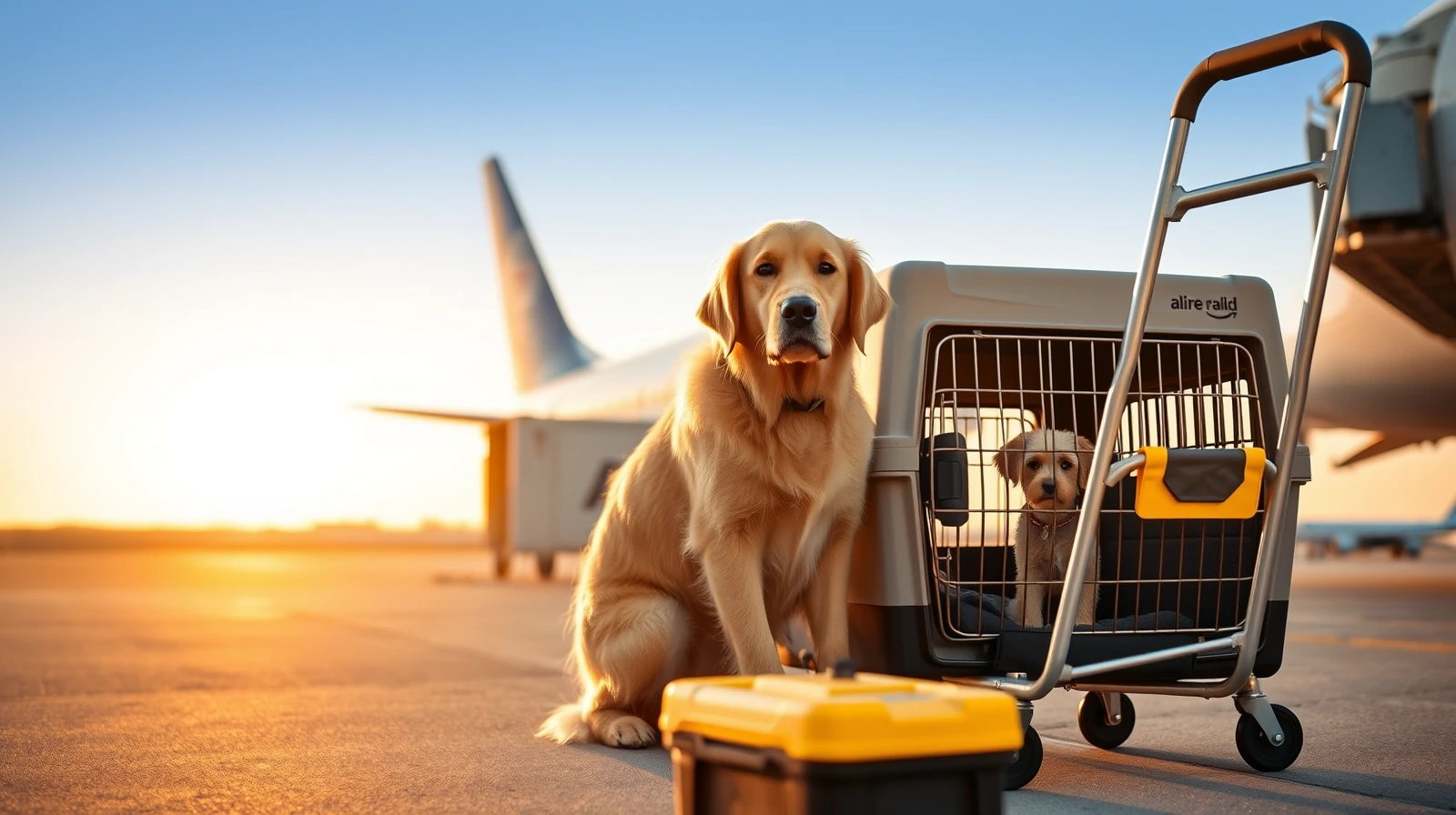
In-cabin is safest and cheapest for dogs under ~20 lb with carrier, at $99 to $150 each way. For larger dogs, manifest air cargo (professional, climate-controlled, pressurized) is safest. Checked baggage, the old middle tier, is now closed to civilian pets on most US airlines.
In-cabin is safest and cheapest for dogs small enough to fit under a seat (roughly 20 lb with carrier), at roughly $99 to $150 each way depending on the airline and route. For larger dogs, manifest air cargo, the professional climate-controlled, pressurized service usually booked through a pet shipper, is generally the safest option. Checked baggage, the old middle tier, is now closed to civilian pets on most US airlines. Confirm the current fee with your carrier at booking, since fees vary by airline and route.
The confusion around "cargo versus in-cabin" comes from collapsing three very different things into two words. There are actually three ways a dog flies, and they are not on the same risk or price ladder. Below we separate them cleanly, give the current 2026 numbers, and end with a plain "use X when Y" framework so you can match your dog to the right method in under a minute.
Flying a different carrier? Our guide to Hawaiian Airlines Pet Policy breaks down that airline's pet fees and rules.
Flying a different carrier? Our guide to Air Canada pet policy breaks down that airline's pet fees and rules.
Flying a different carrier? Our guide to British Airways Pet Policy breaks down that airline's pet fees and rules.
Flying a different carrier? Our guide to Emirates Pet Policy breaks down that airline's pet fees and rules.
See also Can You Sedate a Dog for Travel? A Safety-First Guide.
Flying a different airline? See our guide to Southwest Airlines Pet Policy in 2026.
Once you know cabin from cargo, the next question is how much it costs to fly a dog on each option.
If your pet flies in the hold, read up on live animal cargo insurance and how airline liability is capped.
When neither cabin nor cargo will work, our guide to transporting a dog that cannot fly lays out the ground alternatives.
Bird carriers should be smaller than the home cage, not larger, as flying with a bird sets out.
Alaska requires a health certificate even when the airline does not, as pet transport to Alaska explains.
For the cat-specific version of the cargo decision, including crate ventilation and brachycephalic restrictions, see our guide to flying with a cat in cargo.
Flying to Latin America? The Copa Airlines pet policy allows dogs and cats in the cabin up to 10 kg with the carrier and sends larger pets through its cargo service.
The three ways a dog flies, decoded
People say "in the cabin" or "in cargo" as if those are the only two choices. In reality there are three distinct services, each with its own booking channel, price, and safety profile. Getting these straight is the whole game.
Flying a different airline? See our guide to JetBlue Pet Policy and JetPaws in 2026.
1. In-cabin (small dogs, under the seat)
Your dog rides with you, zipped into a soft carrier that slides under the seat in front. This is reserved for small dogs and cats where the pet plus carrier stays under the airline's weight ceiling (about 20 lb in practice) and the carrier fits the under-seat envelope, usually around 18 to 19 inches long. You keep eyes on your dog the entire flight. It is the cheapest channel and, for an animal that genuinely fits, the lowest-stress one.
Flying a different airline? See our guide to Frontier Airlines Pet Policy.
2. Checked baggage (accompanied, being phased out)
Historically, a medium or large dog could fly in the hold on the same ticket as the owner, processed at the baggage counter. This is the tier that is disappearing. As of 2026, Delta no longer accepts pets as checked baggage at all, and American Airlines only accepts checked pets for active-duty US military and State Department Foreign Service personnel on official orders. For most travelers with a large dog on a major US carrier, this option no longer exists. A handful of carriers (notably Alaska Airlines) still offer it on select routes, so it is not extinct, just rare.
3. Manifest air cargo (professional, climate-controlled)
Your dog flies as a tracked air-cargo shipment, usually arranged through a pet shipper or relocation company, often on a separate flight or routing from you. The animal is booked on the aircraft manifest as live cargo, handled by staff trained in live-animal transport, and travels in the same pressurized, temperature-controlled hold used for the checked-baggage tier. The difference is the level of care, documentation, and oversight around it. This is the channel that has largely replaced checked baggage for big dogs, and despite the scary-sounding word "cargo," it is widely considered the safest hold option.
In-cabin vs checked baggage vs manifest cargo: the comparison
Here is the three-way breakdown across the factors that actually decide the call: cost, the size of dog each one fits, the safety profile, and who each method is genuinely best for.
| Factor | In-cabin | Checked baggage | Manifest air cargo |
|---|---|---|---|
| Typical cost (US, each way) | $99 to $150 | $125 to $200 (where still offered) | $300 to $1,000+ domestic; $1,000 to $5,000+ international (shipper included) |
| Dog size it fits | Small, pet + carrier under ~20 lb | Medium to large | Any size, large and giant breeds |
| Where the dog rides | Under-seat with you | Pressurized hold, your flight | Pressurized hold, often a separate routing |
| Who handles the dog | You | General baggage handlers | Trained live-animal cargo staff |
| Availability in 2026 | Widely available | Mostly military only on Delta and American | Widely available via shippers |
| Safety profile | Lowest stress for a dog that fits | Adequate, least oversight of the three | Most regulated and monitored hold option |
| Best for | Small dogs, short and long haul | Edge cases on the few carriers that still allow it | Large dogs, long-haul, international relocations |
The pattern is clear: in-cabin wins on price and stress but is capped by size. Manifest cargo costs far more, but it is the only channel built specifically around the welfare of a large animal, and it is the one with professional oversight at every handoff. Checked baggage used to be the affordable middle ground, and its near-disappearance from major US carriers is the single biggest change pet owners need to internalize. For a deeper dollar-by-dollar look across methods, see our breakdown of the cheapest way to transport a pet and our full pet transport cost guide.
Is cargo safe for dogs? What the numbers say
The fear around the cargo hold is mostly outdated. On modern passenger aircraft, the live-animal compartment in the belly of the plane is pressurized and temperature-controlled to the same conditions as the cabin above it. Your dog is not in an unheated luggage bin.
The statistics back this up. The US Department of Transportation requires airlines to report every animal death, injury, and loss. According to the DOT Air Travel Consumer Report for calendar year 2024, airlines transported 161,335 animals and reported 13 incidents total (10 deaths, 3 injuries, zero lost), a rate of about 0.81 incidents per 10,000 animals. That is well under one in ten thousand. Air travel carries real risk for a dog, and that risk is not zero, but the data does not support the idea that the hold is inherently unsafe.
Within the hold options, manifest cargo is generally considered safer than checked baggage. The reason is handling, not air. Cargo pets are processed by staff specifically trained in live-animal transport and are tracked on the manifest as a priority shipment, while a checked pet moves through the general baggage system. The cabin and hold environments are similar; the human attention around the animal is not. For the official welfare standards behind air transport, see USDA APHIS guidance on pets on planes and the global rulebook airlines follow, the IATA Live Animals Regulations.
The real risk factors, ranked
- Breed: snub-nosed (brachycephalic) dogs are the most vulnerable group and are banned from the hold by most airlines.
- Heat: summer ground temperatures trigger embargoes and account for a large share of incidents.
- Layovers: every connection is a tarmac handoff and a stretch of exposure; direct routings are safer.
- Crate fit: a crate that is too small, poorly ventilated, or not secured raises stress and injury risk.
- Sedation: the AVMA advises against it, because sedatives raise the risk of breathing and heart problems at altitude.
Cabin noise and stress: the in-cabin trade-off
In-cabin is not automatically the calmest ride. Your dog stays zipped inside a soft carrier under the seat for the entire flight, in a loud, crowded, brightly lit environment, often unable to stand fully or turn around. For a small dog that is bonded to you and comfortable in its carrier, your presence is reassuring and this is the gentlest option available. For an anxious dog, the cabin's noise, engine vibration, and the inability to move can be genuinely stressful, sometimes more so than a quiet hold compartment would be.
The single best thing you can do for either channel is acclimate the dog to its carrier or crate weeks ahead. The AVMA recommends leaving the carrier open at home with a familiar blanket or chew toy inside so the dog chooses to spend time in it before travel day. We cover this in detail in our guide to crate training a dog for travel. The AVMA also recommends against sedation for flights; see its guidance on traveling with your animal.
Temperature embargoes: when no dog flies in the hold
Both checked baggage and manifest cargo are subject to temperature embargoes, and they catch a lot of owners off guard in summer. As a general standard, airlines will not transport warm-blooded animals in the hold when ground temperatures at the origin, any connection, or the destination are above 85°F or below roughly 20°F to 45°F, depending on the carrier and breed. These limits apply to the actual tarmac temperature, not the forecast high, and a single hot connection can ground an otherwise fine itinerary.
Practical consequences: a July flight from Phoenix or Dallas may be un-bookable for a hold pet during daytime hours, pushing you to early-morning or red-eye departures. This is the main reason large-dog summer relocations are scheduled around the weather rather than your calendar. In-cabin travel is exempt from these embargoes because the cabin climate is always controlled and the dog is never left on a hot tarmac, which is one more reason small dogs have it easier. For carrier-specific summer rules, see American Airlines Cargo summer safety measures.
Breed limits: why some dogs cannot fly in the hold at all
Snub-nosed, or brachycephalic, breeds are restricted or outright banned from hold travel by nearly every airline. Bulldogs, French bulldogs, pugs, boxers, Boston terriers, Pekingese, and similar breeds have compressed airways that make it hard to regulate body temperature and breathe under heat and stress, the exact conditions of air transport. They are over-represented in cargo incident reports, which is why the bans exist.
If you own one of these breeds, your realistic options are in-cabin (if the dog is small enough to qualify) or ground transport. A 60 lb English bulldog cannot fly in-cabin and cannot go in the hold, which leaves a professional ground mover. We keep a full list of affected breeds and the airline-by-airline rules in our guide to snub-nosed dog breeds and the flying ban.
IATA crate rules for hold travel
Any dog flying in the hold, checked or manifest cargo, must travel in an IATA-compliant crate. These rules are the international standard and airlines enforce them strictly; a non-compliant crate is the most common reason a hold booking gets refused at the counter. The essentials:
- Construction: rigid plastic, fiberglass, metal, or solid wood. No collapsible or wire crates.
- Size: the dog must be able to stand, turn around, and lie down naturally inside.
- Ventilation: openings on at least three sides for domestic travel, often all four sides for international.
- Door and fixings: a secure spring-locked door and bolted, not clipped, hardware.
- Extras: food and water dishes accessible from outside, absorbent bedding, and "Live Animal" labeling.
The IATA Traveler's Pet Corner publishes the full container requirements. A reputable pet shipper will size and supply a compliant crate as part of a manifest-cargo booking, which removes a common point of failure.
Use X when Y: a quick decision framework
Match your situation to one of these and you have your answer:
- Use in-cabin when your dog plus carrier is under about 20 lb, fits the under-seat carrier, and is not a banned snub-nosed breed. Cheapest, lowest-stress, exempt from heat embargoes.
- Use manifest air cargo when your dog is too big for the cabin, especially for long-haul or international moves, or when you want professional handling and tracking. Most expensive but the safest hold option for a large dog.
- Consider checked baggage only if you are flying a carrier that still offers it (rare in 2026) and want to save money over manifest cargo, accepting less oversight.
- Skip air travel entirely when your dog is a large snub-nosed breed, when summer embargoes block your route, or when your dog has a health condition that makes flying risky. Ground transport is the answer.
For carrier-specific fees, carrier dimensions, and breed rules, see our airline guides for American Airlines, United Airlines, and Delta Air Lines, all anchored to our pet airlines hub.
How we sourced this
Fees and policy details are pulled from the major US carriers' own published pet pages as of June 2026 and cross-checked against current airline pet-policy reporting. Safety figures come from the US Department of Transportation Air Travel Consumer Report for full-year 2024. Crate, temperature, and welfare standards are drawn from the IATA Live Animals Regulations, USDA APHIS, and the American Veterinary Medical Association. Airline pet policies change frequently, so confirm the exact fee and breed rules on your specific carrier's site before you book.
Is cargo safe for dogs?
What is the difference between checked baggage and manifest cargo?
What is the safest way to fly a dog?
How much does it cost to fly a dog in-cabin versus cargo?
Can large dogs fly in-cabin?
Why is checked baggage for pets being phased out?
When will airlines refuse to fly my dog in the hold?
Should I sedate my dog for a flight?
Sources & references
- iata.org https://www.iata.org/en/publications/manuals/live-animals-regulations/
- iata.org https://www.iata.org/en/programs/cargo/live-animals/pets/
- aphis.usda.gov https://www.aphis.usda.gov/pet-travel/pets-on-planes/care-handling-air-travel
- avma.org https://www.avma.org/resources-tools/pet-owners/petcare/traveling-your-animal
- aacargo.com https://www.aacargo.com/learn/summertime_safety_measures.html