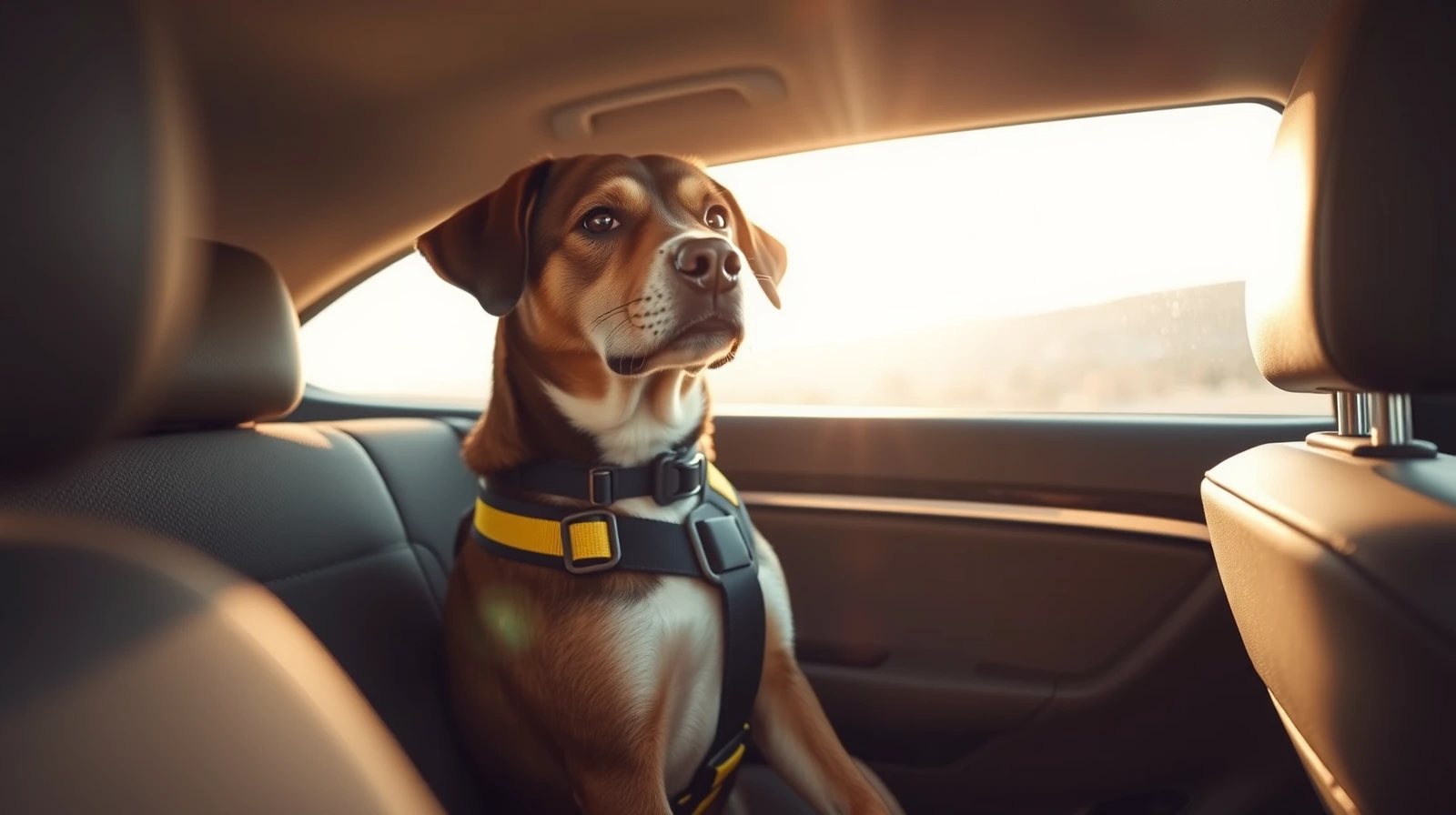
No federal law requires pets to be restrained in a car. As of 2026, only a few states (such as Rhode Island, New Jersey, and Hawaii) have explicit pet restraint rules, while many more can cite you under distracted-driving or animal-cruelty statutes. Always confirm your current state law before you travel.
If you have ever let your dog ride shotgun with their head out the window, you have probably wondered whether that is actually legal. The honest answer is that it depends on where you live, and the rules are patchier than most owners expect. There is no national requirement to buckle up your pet, only a thin patchwork of state rules, plus a much larger set of distracted-driving and animal-cruelty laws that can land you a ticket even where no pet-specific statute exists. Here is how the law actually breaks down, what the penalties tend to look like, and how to keep your dog safe regardless of what your state requires.
There is no federal dog seatbelt law
Start with the big picture: there is no federal law in the United States that requires pets to be restrained inside a moving vehicle. Unlike child car seats, which are governed by federal safety standards, pet restraint is left entirely to the states. That means the rules change the moment you cross a state line, and a setup that is perfectly legal at home may draw a citation a few hours down the highway.
It also means most enforcement happens indirectly. Even in states with no pet-specific law on the books, an officer who sees a dog climbing across your lap can often write a ticket under a broader distracted-driving statute. So the question is rarely "is there a dog seatbelt law?" It is closer to "could an unrestrained dog get me cited under some law in this state?" In a lot of places, the answer is yes. For the mechanics of safely securing a dog on any trip, see our guide on how to transport a dog in a car.
States with an explicit pet restraint law
As of 2026, only a small number of states have laws that specifically address restraining a pet in a passenger vehicle, and even those tend to be narrowly worded. Rhode Island, New Jersey, and Hawaii are the states most consistently cited by legal and pet-travel resources as having explicit pet restraint or lap-animal rules. The reported penalties below are drawn from those secondary summaries and should be treated as approximate. Statutes and fine schedules change, so always confirm the current text with the state legislature or DMV before you rely on it.
- Rhode Island. Reported to require that a pet be under the physical control of someone other than the driver, or be restrained by a crate, harness, or seat belt. Summaries describe fines that can reach roughly $200 for violations. Confirm current law.
- New Jersey. An unrestrained animal can reportedly be treated as cruelty under the state's animal-protection statutes, with penalties commonly described in the range of roughly $250 to $1,000. Confirm current law.
- Hawaii. Reported to prohibit a driver from holding an animal in their lap or otherwise letting a pet interfere with control of the vehicle. Secondary sources describe fines in the neighborhood of $97 for a lap animal and around $57 for a loose pet, though figures vary by source. Confirm current law.
Notice that none of these is a clean "your dog must wear a seatbelt" mandate. They are mostly aimed at the dog being loose in the front, in your lap, or interfering with driving. That distinction matters: a properly secured dog in the back seat is what each of these rules is effectively steering you toward.
States that can ticket you indirectly
This is the larger and more important group for most drivers. A number of states have no pet-specific restraint statute, yet maintain distracted-driving or animal-cruelty laws broad enough that an unsecured dog can trigger a citation, especially if the animal is on your lap, blocking your view, or you are involved in a stop or crash.
Resources that track these rules commonly point to states including Arizona, Connecticut, Maine, Massachusetts, Washington, Wisconsin, South Carolina, and the District of Columbia as places where distracted-driving language has been applied to drivers with loose pets. Separately, several states restrict carrying an unrestrained animal in an open truck bed, including Connecticut, Maine, Massachusetts, Minnesota, New Hampshire, Oregon, and Washington. Because these are general statutes rather than pet-specific ones, how aggressively they are enforced varies widely by jurisdiction and officer discretion. Treat these lists as a prompt to check, not as the final legal word.
State-by-state grouping at a glance
The table below groups the situation into three tiers. It is a planning aid, not legal advice, and it reflects how widely cited pet-travel and legal resources characterized the landscape as of 2026. Laws in every tier can change, and "no specific law" never means "anything goes," because the distracted-driving and cruelty rules still apply.
| Tier | How the law works | Examples commonly cited (as of 2026) |
|---|---|---|
| 1. Explicit pet restraint or lap-animal law | A statute specifically addresses restraining a pet or bans a lap animal that interferes with driving. | Rhode Island, New Jersey, Hawaii |
| 2. Distracted-driving or animal-cruelty (indirect) | No pet-specific rule, but a loose or lap-riding dog can draw a citation under broader statutes. Some also ban unsecured animals in open truck beds. | Arizona, Connecticut, Maine, Massachusetts, Washington, Wisconsin, South Carolina, District of Columbia (truck-bed rules also reported in Minnesota, New Hampshire, Oregon) |
| 3. No pet-specific law | No statute squarely on point. General distracted-driving and cruelty laws can still apply, especially after a crash. | Most remaining states. Confirm with your state DMV or legislature. |
If your state is not named in tiers one or two, do not assume you are exempt. The safer reading is that you fall into tier three, where enforcement is discretionary and a serious incident can still expose you to liability. When in doubt, restrain the dog.
Why restraint matters even where it is not required
Laws aside, the physics make a strong case on their own. In a crash, an unrestrained dog becomes a projectile. Safety analysts frequently cite the estimate that a 10-pound dog in a 50 mph collision can generate roughly 500 pounds of force, and a 60-pound dog can translate into something on the order of 3,000 pounds of force. That is enough to seriously injure or kill the dog and to hurt the people sitting in front of it.
There are three distinct risks worth separating:
- Injury to your dog. A loose pet can be thrown into the dashboard, a seatback, or through a window, and can also bolt from a damaged car into traffic after a collision.
- Injury to people. A dog launched forward in a crash can strike and injure the driver or passengers, and can obstruct first responders trying to reach an injured person.
- Driver distraction. Industry and AAA-linked surveys have found that a large share of drivers admit to being distracted by their pets, whether petting them, restraining them by hand, or letting them move around the cabin. Distraction is a crash cause in its own right, before any impact occurs.
In other words, restraint protects everyone in the car and on the road, not just the dog. That is the same reasoning behind every responsible road trip with a dog checklist.
Best-practice restraint options
If you want to satisfy the strictest interpretation of these laws and actually protect your dog, focus on equipment that has been independently crash-tested rather than products that simply look sturdy. The Center for Pet Safety has tested many harnesses over the years and found that a large number failed, with the dog at risk of choking, breaking free, or becoming a projectile when the hardware gave way. Only a short list of products has earned their crash-test certification, so a marketing claim of "crash tested" is not the same as a verified pass.
Three approaches are generally considered sound:
- A crash-tested harness clipped to the seatbelt. Best for dogs that ride calmly in the back seat. Look for independently verified results, not just the words on the box. See our roundup of the best crash-tested dog car harness options.
- A secured, appropriately sized crate. A strong crate that is anchored so it cannot slide or tumble gives many dogs a protected space and keeps them out of the front entirely.
- A back-seat barrier. A barrier will not restrain the dog in a crash the way a harness or crate can, but it keeps the dog out of the driver's space and reduces distraction. Compare options in our best dog car barrier guide, and protect your upholstery with a dog car seat cover.
Whatever you choose, the dog should ride in the back. Front airbags are designed for adult humans and can injure or kill a dog, which is part of why the lap-animal laws exist in the first place.
How to confirm your own state's law
Because pet restraint rules sit at the intersection of traffic codes, animal-cruelty statutes, and local ordinances, the most reliable way to know your obligations is to go to the primary source. Search your state legislature's website for "animal" plus "vehicle" or "distracted driving," and cross-check with your state DMV's traffic-rule pages. National roundups such as GoPetFriendly's state-by-state guide and the Animal Legal and Historical Center are useful starting points, but they can lag behind new legislation, so treat them as a map rather than the territory.
One more practical reminder: hot weather is a separate and serious legal and safety issue. Many states have specific laws about leaving animals in parked vehicles, which is a different topic from restraint while moving. If you are planning summer travel, read how hot is too hot for a dog in a car before you go.
Disclaimer: This article is general information, not legal advice, and the figures and statutes described here reflect widely cited secondary sources as of 2026. Laws and fines change frequently and vary by locality. Confirm the current requirements with your state DMV, legislature, or a licensed attorney before you rely on anything here.
Frequently asked questions
Is there a federal law requiring dogs to be restrained in cars?
Which states have explicit pet restraint laws?
Can I get a ticket for an unrestrained dog if my state has no pet law?
How much are the fines for an unrestrained pet?
Is it illegal to drive with a dog in my lap?
What is the safest way to restrain my dog in the car?
Are there laws about dogs riding in open truck beds?
Do these restraint laws apply when crossing state lines?
Sources & references
- gopetfriendly.com https://www.gopetfriendly.com/blog/state-laws-require-pets-to-be-restrained-in-vehicles/
- animallaw.info https://www.animallaw.info/topic/table-state-laws-protect-animals-left-parked-vehicles
- magazine.northeast.aaa.com https://magazine.northeast.aaa.com/daily/life/cars-trucks/dog-car-restraints/
- centerforpetsafety.org https://www.centerforpetsafety.org/test-results/harnesses/