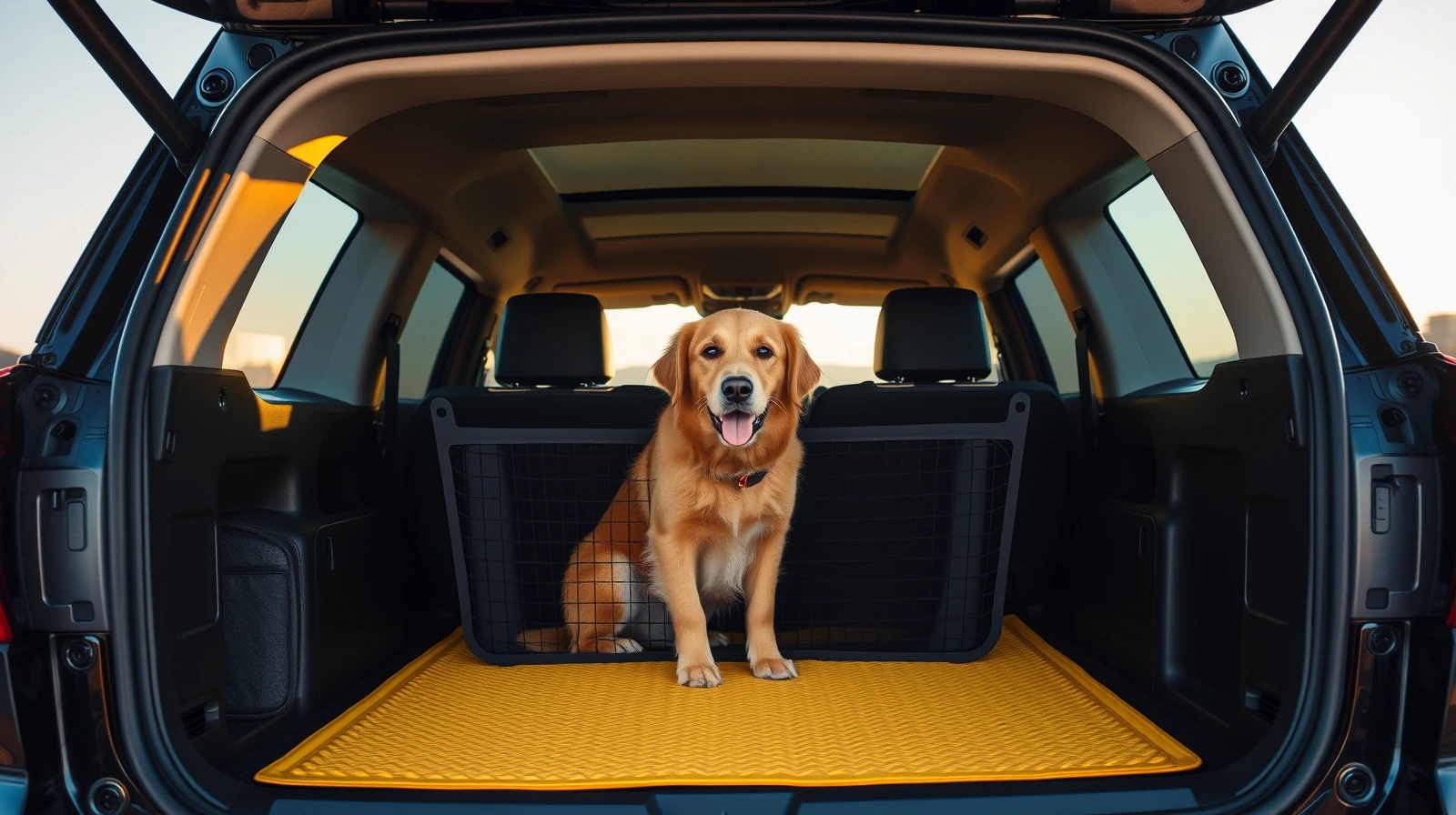
The best dog car barrier for most SUVs is the Kurgo Backseat Dog Barrier for sedans and crossovers needing a backseat-to-front block, or a steel universal cargo divider for SUVs needing a behind-seat barrier. Expect roughly $30 to $200 by type. A barrier contains a dog but is not a crash restraint.
The best dog car barrier for most SUVs is the Kurgo Backseat Dog Barrier for sedans and crossovers that need a backseat-to-front block, or a steel universal cargo divider (Zookeeper-style) for SUVs and wagons that need to keep a dog behind the rear seats. Expect to pay roughly $30 to $200 depending on type. A barrier contains a dog and keeps it out of the front, but it is not a crash restraint.
That last point matters more than any product pick, so we will say it twice. A barrier solves a behavior problem (a loose dog climbing into your lap, blocking your mirrors, or distracting you), not a physics problem. In a sudden stop or collision, an unrestrained dog behind a mesh barrier can still be thrown hard. For crash protection you pair the barrier with a crash-tested harness or a properly secured crate. We get into how below, with picks for backseat barriers, behind-seat cargo dividers, and the trade-offs between mesh and steel.
For a deeper look, see our guide to Best Cat Litter Mat.
Related reading: Best Pet Water Fountain.
Gearing up for your pet? Compare our pick for the Best Dog Brush for Shedding.
Two kinds of barrier: backseat block vs cargo divider
Before you buy anything, decide which of two jobs you actually need done. They use different products and they fit different vehicles.
Gearing up for your pet? Compare our pick for the Best Dog Winter Coat.
Backseat barrier (keeps the dog out of the front)
A backseat barrier stretches across the cabin between the front seats and the back seats, so the dog rides on the rear bench and cannot climb forward into the driver's space. These are usually fabric and mesh panels that hook to the front-seat headrests and anchor to the seat-belt buckles or floor. They install in minutes, fold away, and fit almost any sedan, crossover, or SUV. They do nothing for cargo-area dogs, and a determined chewer can work at the mesh over time.
Gearing up for your pet? Compare our pick for the Best Dog Training Treats.
Cargo divider (keeps the dog behind the rear seats)
A cargo divider, sometimes called a pet barrier or a dog gate, walls off the rear cargo area of an SUV, wagon, or hatchback so the dog rides in the back and cannot get into the passenger seats. These range from tension-mounted fabric-and-pole kits to heavy steel grids that bolt or pressure-fit between the rear seatbacks and the headliner. Steel versions are the most chew-resistant and the most likely to be vehicle-specific for a tight fit. Universal versions trade some fit precision for broad compatibility.
If your dog is large and rides in the way-back of an SUV, you want a cargo divider. If your dog is small to medium and you want it kept out of the front of a car or crossover, a backseat barrier is simpler and cheaper. Some owners run both. For a fuller walk-through of safe in-car setups, see our guide on how to transport a dog in a car.
Comparison table: 6 dog car barriers at a glance
Prices below are approximate ranges drawn from maker listings and major retailers in 2026. Barrier prices move with sales and bundles, so confirm the current figure on the maker or retailer page before you buy.
| Barrier | Type | Material | Fit | Approx. price |
|---|---|---|---|---|
| Kurgo Backseat Dog Barrier | Backseat block | Mesh + nylon, padded frame | Universal, most sedans/SUVs | $45-$70 |
| Petsfit Dog Car Barrier | Backseat block | Oxford cloth + mesh, adjustable straps | Universal, cars/SUVs/trucks | $30-$50 |
| Petboda Dog Car Barrier | Backseat block | Fabric + mesh, slide-rail frame, foldable | Universal, up to ~62 in wide | $30-$55 |
| Zookeeper-style metal cargo divider | Cargo divider | Powder-coated steel | Universal, behind rear seats | $60-$130 |
| Steel-grid + transparent-net barrier | Cargo divider | Steel frame + chew-resistant net panel | Universal SUV/wagon, wide coverage | $70-$150 |
| WeatherTech Pet Barrier | Cargo divider | Molded thermoplastic, vehicle-specific | Made to fit specific models | $150-$230 |
The picks, with honest pros and cons
1. Kurgo Backseat Dog Barrier - best overall backseat block
The Kurgo Backseat Dog Barrier is the one we point most owners to first. It is a padded mesh-and-nylon panel that hooks over the front headrests and anchors down low, creating a wall between the front and back seats. It goes in and out in under a minute, folds flat for storage, and fits the widest range of sedans, crossovers, and SUVs. Kurgo backs it with a lifetime warranty, which tells you something about how the company expects it to hold up.
Pros: fast install, broad fit, padded frame, lifetime warranty, lets you still use the back seat for passengers when removed. Cons: it is mesh, so a dedicated chewer can eventually fray it; tall or very pushy large dogs may lean over the top; it does nothing for cargo-area riders.
2. Petsfit Dog Car Barrier - best value backseat block
The Petsfit uses oxford cloth plus mesh on adjustable straps, and it is built to span cars, SUVs, and trucks. It is typically cheaper than the Kurgo and adapts to odd cabin widths thanks to the strap system. Owners who want a no-fuss, low-cost block that keeps a medium dog out of the front seats tend to be happy with it. The trade-off is that the lighter strap-tensioned build can sag or shift more than a rigid-framed barrier, and the fabric panel is again not chew-proof.
Pros: affordable, adjustable for many cabin sizes, lightweight. Cons: can sag without a rigid frame, fabric is chewable, less premium feel.
3. Petboda Dog Car Barrier - best foldable universal block
The Petboda uses a slide-rail frame that extends to roughly 62 inches wide, so it covers wider cabins, and it folds down for storage when you need the back seat for people. It sits between the lightweight strap barriers and the rigid steel dividers: more structure than a pure fabric panel, less than a metal grid. It is a good middle choice for owners who swap between hauling a dog and hauling passengers and want the barrier to disappear quickly.
Pros: wide adjustable coverage, foldable, more rigid than strap-only barriers. Cons: slide-rail fit varies by vehicle, mesh panel is not chew-resistant, bulkier than fabric-only options when stowed.
4. Zookeeper-style metal cargo divider - best universal steel divider
If you want a dog kept in the cargo bay of an SUV and you want it to hold up to a strong, persistent dog, a powder-coated steel divider is the category to shop. Zookeeper-type universal dividers pressure-fit or anchor between the rear seatbacks and the roof, putting a rigid steel wall behind the back seats. Steel is the most chew-resistant material here and shrugs off scratching and pawing that would fray mesh. The downside is fit: universal steel dividers need careful measuring against your cargo height and width, and a loose fit defeats the purpose.
Pros: chew-resistant, rigid, contains large dogs, reusable across moves. Cons: install is fiddlier, fit must be measured carefully, heavier, can rattle if not snug.
5. Steel-grid plus transparent-net barrier - best wide coverage and chew resistance
Some dividers pair a steel frame and lower grid with an upper transparent net panel, giving you a rigid chew-resistant base where the dog pushes hardest plus a wide net that closes off the gap to the headliner. The net keeps a clambering dog from going over the top while preserving rear visibility better than a solid wall. This style suits tall SUV cargo areas and dogs that try to jump the divider. Expect more straps and more measuring than a simple backseat block.
Pros: wide coverage to the roofline, chew-resistant lower section, decent rear visibility through the net. Cons: more involved install, net is less rugged than full steel up top, universal fit needs verification against your model.
6. WeatherTech Pet Barrier - best premium vehicle-specific divider
WeatherTech makes a molded Pet Barrier built to a specific vehicle's dimensions, the same made-to-fit philosophy as its floor liners. When it is offered for your exact make, model, and year, the fit is tight with no gaps, and the molded thermoplastic is clean and rigid. The catch is availability and price: it is only made for selected vehicles, it costs noticeably more than universal options, and it will not transfer to a different vehicle the way a universal divider can. Check WeatherTech's fitment lookup for your specific model before counting on it.
Pros: precise vehicle-specific fit, premium rigid build, no measuring guesswork. Cons: expensive, limited to supported vehicles, not transferable across cars.
Important: a barrier contains, it does not crash-protect
This is the single most important thing on this page. A car barrier solves a containment and distraction problem. It keeps the dog out of the front, stops it from blocking your view or pawing the pedals, and gives it a defined space. It is not a crash restraint and should not be sold to you as one.
The Center for Pet Safety, an independent nonprofit that crash-tests pet travel products, draws a clear line between products that merely contain a pet and products that are crash-tested to restrain one in a collision. In a hard stop, a loose dog behind a mesh barrier can still be thrown forward into the barrier or the seatbacks with significant force, and a barrier that is not anchored for crash loads can deform or detach. Treat the barrier as the daily-driving behavior fix, and add a real restraint for crash protection.
For crash protection, pair the barrier with one of these:
- A crash-tested harness clipped to the seat-belt system. See our roundup of the best crash-tested dog car harness options and what "crash-tested" actually means.
- A secured, appropriately sized crate that is anchored so it cannot become a projectile. See choosing a pet transport crate for sizing and tie-down basics.
In short: barrier plus harness, or anchored crate. The barrier alone manages behavior. The harness or secured crate is what you rely on if something goes wrong. The American Veterinary Medical Association likewise advises that pets be properly restrained in a vehicle rather than left loose, both to protect the pet and to avoid distracting the driver.
How to choose: a quick decision framework
Match the type to your vehicle and your dog
- Sedan or crossover, want the dog off the front seat: backseat barrier (Kurgo, Petsfit, Petboda).
- SUV, wagon, or hatchback, want the dog in the cargo bay: cargo divider (Zookeeper-style steel, steel-grid + net, or WeatherTech if your model is supported).
- Large or strong dog that pushes and chews: lean steel, not mesh.
- You swap between dog-hauling and passengers often: a foldable or quick-remove design (Petboda, Kurgo) over a bolt-in unit.
Measure for fit before you buy
Universal dividers are only universal within a range. For a cargo divider, measure the width between the rear seatbacks and the height from the seatback top to the headliner, then check those against the product's adjustment range. For a backseat barrier, confirm your front seats have headrests to hook over and an accessible lower anchor point. A poorly fitted barrier rattles, sags, and gives a determined dog a gap to exploit.
Mesh vs steel
Mesh and fabric barriers are lighter, cheaper, faster to install and remove, and gentler on your interior, but they are chewable and they flex. Steel dividers are rigid, chew-resistant, and best for big dogs, but they are heavier, fiddlier to fit, and can rattle if not snug. Pick based on your dog's size and chewing habits more than on price.
Visibility and install
You still need to see out the back. Open-mesh and transparent-net panels preserve rear visibility better than solid walls. On install, favor designs that anchor at multiple points (headrests plus a lower tether, or seatback plus roof) over a single tension point, which is easier for a dog to dislodge.
SUV cargo-area setup tips
- Fold the rear seats up, not flat, when running a cargo divider so the divider has a solid seatback to brace against and the dog cannot slide under.
- Lay down a liner or seat cover to protect the cargo floor from nails, fur, and accidents. Our dog car seat cover guide covers cargo-area liners too.
- Add traction. A non-slip mat keeps a dog from sliding around corners and reduces the bracing it has to do, which means less stress and fewer scratches on your interior.
- Mind temperature and airflow. The cargo area can run hotter or stuffier than the cabin; make sure vents reach the back and never leave a dog in a parked vehicle.
- Help older or short-legged dogs in and out. A high SUV liftover is hard on joints; a ramp protects both the dog and your back. See the best dog ramp for car options.
How we sourced this
Our picks are based on published manufacturer specifications, maker product information, and aggregated owner reviews across major retailers, weighted toward fit range, build material, install method, and chew resistance. We did not independently crash-test these barriers, and we do not present any of them as crash restraints. For the restraint-versus-containment distinction we rely on the Center for Pet Safety, an independent nonprofit that crash-tests pet travel products. Prices are approximate 2026 ranges and move with sales and bundles, so confirm the current figure and the exact fitment for your vehicle on the maker or retailer page before buying. You can find the rest of our hands-on gear and operator coverage in our reviews hub.
Is a dog car barrier the same as a crash restraint?
Do I need a backseat barrier or a cargo divider for my SUV?
Are steel barriers worth it over mesh?
Will a universal cargo divider fit my vehicle?
Can a dog chew through a car barrier?
Does a barrier block my rear visibility?
How much does a good dog car barrier cost?
Can I use a barrier and a harness at the same time?
Sources & references
- centerforpetsafety.org https://www.centerforpetsafety.org
- avma.org https://www.avma.org/resources-tools/pet-owners/petcare/traveling-your-pet
- kurgo.com https://www.kurgo.com
- weathertech.com https://www.weathertech.com