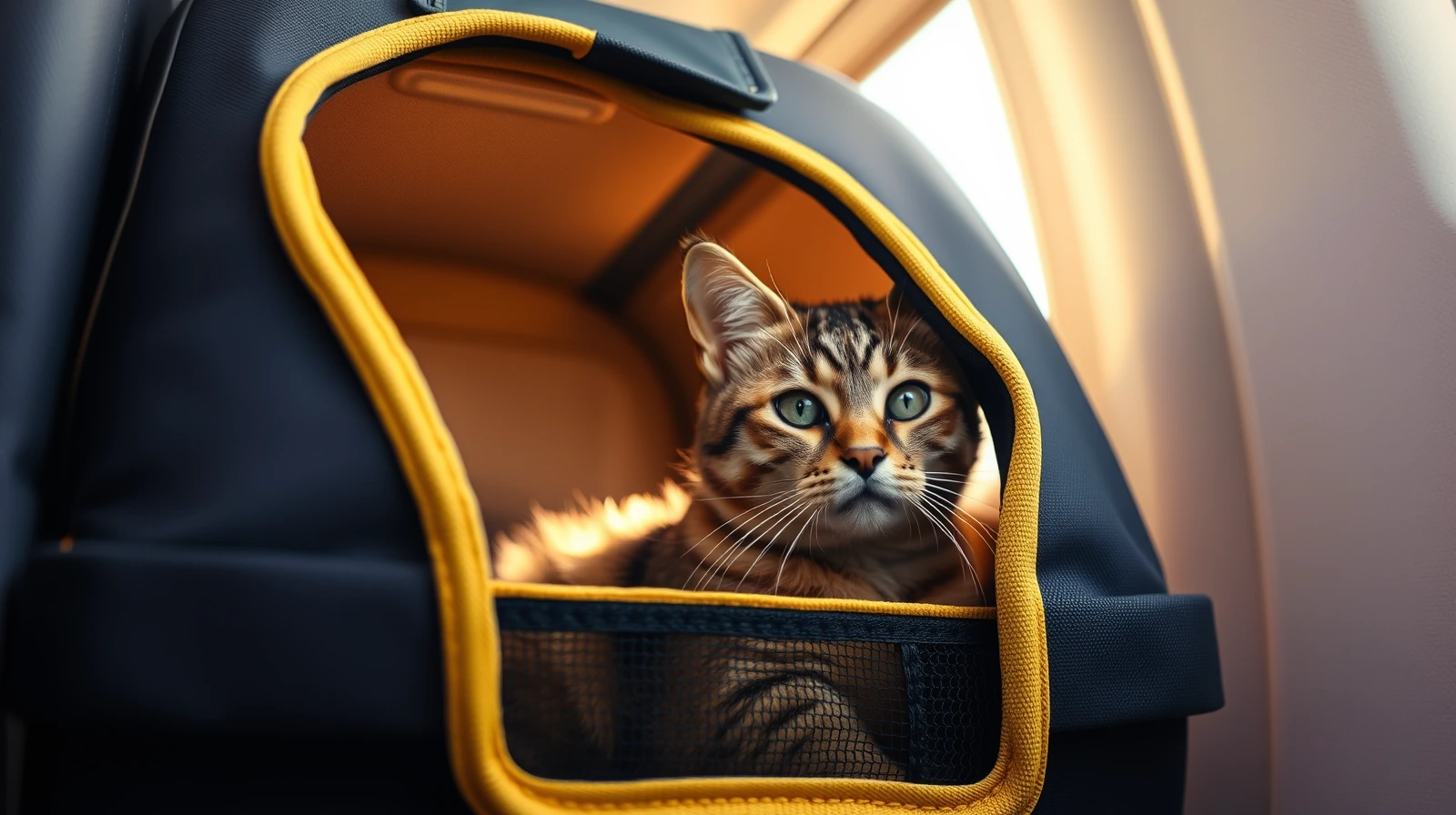
Flying with a cat in the cabin means booking an in-cabin pet slot early (airlines cap them), buying an airline-approved carrier that fits under the seat (roughly 18 x 11 x 11 inches), getting a vet health certificate within 10 to 28 days, acclimating your cat to the carrier for weeks, and keeping it under the seat the whole flight. Plan on a $95 to $150 each-way fee.
Flying with a cat in the cabin means booking an in-cabin pet slot early (airlines cap them per flight), buying an airline-approved carrier that fits under the seat (roughly 18 x 11 x 11 inches), getting a vet health certificate within 10 to 28 days, acclimating your cat to the carrier for weeks beforehand, and keeping it under the seat the whole flight. Plan on a $95 to $150 each-way fee.
This is a do-it-yourself guide to flying with your own cat in the passenger cabin, where the carrier slides under the seat in front of you and your cat travels at your feet. It is a different decision from hiring a professional long-distance cat transporter to ship your cat without you, and from driving your cat yourself in a car. If your cat fits the size limit and you can fly direct, in-cabin air travel is usually the calmest and most affordable option. Here is the full sequence, with the numbers and the official rules.
For more on this, read Moving With a Cat.
Cabin flights mean extended time in the bag, so it helps to know how long a cat can stay in a carrier safely and when to offer water.
Not every cat should fly. If yours stays home, book a cat sitter well ahead so a trusted sitter is locked in for your dates.
First: confirm your cat is actually eligible for the cabin
Cabin travel is not automatic. Three things have to be true before you book.
- Your cat plus carrier fits under the seat. Most U.S. airlines require the cat to stand up and turn around inside a carrier that fits beneath the seat in front of you. Combined weight limits, where they exist, are usually around 15 to 20 pounds including the carrier. An oversized cat may have to fly as checked baggage or cargo instead, which is a different and more stressful proposition.
- Your cat meets the minimum age. United, for example, requires cats to be at least 2 months old for domestic flights and 4 months old for international travel, according to its traveling with pets page. Other carriers set 8 weeks as a common floor.
- The flight has an open in-cabin pet slot. Airlines cap the number of pets allowed in the cabin per flight, often around four to six total. Once those slots fill, you cannot add your cat even if you have a seat. This is the single most common reason people get turned away, so book the pet reservation the moment you book your own ticket.
If your cat is over the size limit or you are crossing an ocean, read our guide to airlines and their pet policies first, then weigh whether a professional shipper makes more sense for your route.
Book the pet reservation early and pay the in-cabin fee
Once you confirm eligibility, reserve the pet slot right away. Most airlines require you to phone reservations or add the pet during booking rather than at the gate. The fee is charged each way (so a round trip is double), and it is separate from your own fare.
Published in-cabin cat fees on major U.S. carriers cluster around $95 to $150 per direction. United, for instance, lists a flat in-cabin pet fee of $125 each way. Fees change, so confirm the current figure with your specific airline before you count on it. A few low-cost and international carriers do not allow cats in the cabin at all, which is another reason to check policy before you buy a ticket.
| Airline | Typical in-cabin fee (each way) | Max soft carrier (approx.) |
|---|---|---|
| United | ~$125 | 18 x 11 x 11 in |
| American | ~$125 | 18 x 11 x 11 in |
| Delta | ~$95 | fits under seat |
| JetBlue | ~$125 | 17 x 12.5 x 8.5 in |
| Southwest | ~$125 | 18.5 x 13.5 x 8.5 in |
Southwest in particular has its own quirks on routing and fees, so if you are flying it, see our Southwest pet transport breakdown for the details.
Choose a carrier that meets the size limit
The carrier is the one piece of gear that can make or break the trip. It must be airline-approved, soft-sided enough to flex slightly under the seat, well-ventilated on at least two sides, and leak-resistant on the bottom. Hard-sided carriers are allowed too but have tighter dimensions because they do not compress.
Common maximum soft-carrier dimensions run about 18 x 11 x 11 inches (United and American), 17 x 12.5 x 8.5 inches (JetBlue), and 18.5 x 13.5 x 8.5 inches (Southwest). The safest move is to buy a carrier rated for the specific airline you are flying, then measure your under-seat space if you can. For a deeper comparison of models, features, and what to look for, see our best cat carriers for travel roundup.
One practical tip: a carrier with a top opening as well as a front opening makes the security checkpoint far easier, because you can lift your cat straight up and out rather than dragging it through a front door at a busy checkpoint.
Get the health certificate and update vaccines
Most airlines require a health certificate (a veterinary certificate of inspection) signed by your vet within a set window before departure. United, for example, asks for one issued within 28 days of travel; some airlines tighten that to 10 days, so confirm your carrier's exact window. The certificate states that your cat is healthy and fit to fly and that its vaccinations are current.
For domestic flights between U.S. states, the rules come from the destination state, not the airline alone. As the USDA APHIS interstate pet travel page explains, APHIS does not regulate owners moving pets between states; the receiving state sets the animal-health requirements, which can include a health certificate and current rabies vaccination. Contact the destination state veterinarian's office, or simply ask your vet, who usually knows the common interstate requirements.
For international trips the bar is much higher: the USDA-endorsed APHIS health certificate, microchipping, rabies titers, and country-specific timelines that can take months. The USDA APHIS Pet Travel hub is the authoritative starting point, and the VCA guide to flying with your cat is a good plain-English overview of the vet side.
Acclimate your cat to the carrier weeks ahead
This is the step most people skip, and it is the one that matters most for a calm flight. A cat that only sees the carrier on vet days associates it with fear. Start two to four weeks out.
- Leave the carrier open in a room your cat already likes, with a familiar blanket or a worn t-shirt inside so it smells like home.
- Feed treats or meals near it, then inside it, so the carrier becomes a good place rather than a trap.
- Once your cat rests inside willingly, zip it up for a few minutes, then build to short car rides so motion is not a brand-new shock on flight day.
- Consider a feline pheromone spray (a synthetic version of the calming facial pheromone cats use to mark safe spaces) on the bedding a few minutes before zipping up. The peer-reviewed literature on feline stress during air travel supports gradual habituation and pheromone support over chemical sedation.
The same carrier-acclimation logic helps in other situations too. If you ever board your cat, the prep overlaps closely with our notes on preparing a cat for boarding.
The day of the flight
Small choices on travel day prevent the two things every cat owner dreads: a soiled carrier and a panicked cat.
- Withhold breakfast, keep water. Feed a light meal the night before and skip the morning meal so a queasy or stressed stomach has less to bring up. Offer small sips of water up to departure.
- Line the carrier with an absorbent potty pad. Bring two or three spares plus a zip bag and wipes in case you need to swap one in a restroom mid-trip.
- Try to get a direct flight. Every connection adds another security line, another boarding, and more hours in the carrier. A nonstop is worth paying a bit more for.
- Arrive early. Pet check-in and the security screening both take longer than you expect.
- Skip food and water bowls in the carrier. They spill. A frozen treat or a few licks of water at the gate is plenty for most flights.
Getting through TSA security with your cat
This is the part that surprises first-time flyers: your cat cannot stay in the carrier through the X-ray. According to the TSA small-pets guidance, you remove your cat from the carrier, send the empty carrier through the X-ray machine, and carry your cat through the walk-through metal detector in your arms (or on a harness and leash). Never put a pet through the X-ray tunnel.
Because a startled cat can bolt in a loud, open checkpoint, take two precautions. First, put a well-fitted harness and leash on your cat before you reach the front of the line so you have a hold if it squirms. Second, if your cat is skittish, ask the TSA officer for a private screening room: they will escort you, cat still in carrier, to an enclosed space where there is no risk of a runaway. After screening, a TSA officer may swab your hands for explosive trace detection, then you return your cat to the carrier in the re-composure area past the checkpoint, not at the belt.
In-flight: what to expect once you board
The Federal Aviation Administration requires pets in the cabin to stay inside the carrier for the entire flight, stowed under the seat in front of you during taxi, takeoff, and landing. You cannot put the cat on your lap or let it out to roam.
- Once you are seated, slide the carrier under the seat and drape a light cloth over part of it. A partly covered carrier feels den-like and cuts visual stimulation.
- Speak softly and rest a hand near the mesh during takeoff so your cat hears you. Most cats settle and sleep once the engine noise becomes a steady drone.
- Keep an eye on temperature near the floor and the cabin air vents; do not aim a cold vent directly at the carrier.
- If your cat soils the pad and you can manage it, a discreet swap in the lavatory with the door locked is safer than opening the carrier at your seat.
Do not sedate your cat for the flight
This is the one hard safety rule. The American Veterinary Medical Association advises against sedating or tranquilizing pets for air travel unless a veterinarian determines it is medically necessary, because sedation raises the risk of heart and respiratory problems and impairs the animal's ability to balance and regulate body temperature at altitude. The International Air Transport Association, which sets global live-animal standards, gives the same warning: sedatives reduce an animal's ability to respond to stress during the trip.
The risk is sharper for flat-faced (brachycephalic) cats such as Persians and Himalayans, whose airways are already compromised. Most airlines will refuse a cat that has been sedated or appears sedated. The safer path is the gradual carrier acclimation above plus a pheromone spray. If your cat is genuinely unmanageable when traveling, talk to your vet well in advance: there are non-sedating anti-nausea or anxiety options that some vets prescribe, but that is a medical decision, not a default. See the AVMA traveling-with-your-pet brochure for the full guidance, and confirm carrier-by-carrier rules on your airline's pet page, such as American Airlines' pet travel page.
Pre-flight timeline and what to pack
Use this timeline as a working checklist. Pull the dates forward for international travel, which can require months of lead time.
| When | Do this |
|---|---|
| 4+ weeks out | Book your ticket and the in-cabin pet slot the same day. Buy an airline-approved carrier. Start carrier acclimation at home. |
| 2-3 weeks out | Confirm your destination state's (or country's) entry rules. Schedule the vet visit. Continue carrier training with short car rides. |
| Within 10-28 days | Vet visit: health certificate signed, rabies and core vaccines confirmed current, microchip checked. |
| 2-3 days out | Trim your cat's nails. Pack the travel bag (see below). Re-confirm the pet reservation by phone. |
| Night before | Light dinner, then withhold the morning meal. Spray pheromone on the carrier bedding. |
| Flight day | Harness and leash on before security. Arrive early. Carrier under the seat for the whole flight. |
Pack a carrier-day kit: 3 to 4 absorbent potty pads, a zip bag for soiled pads, pet wipes, a small water container, a familiar-smelling blanket, the printed health certificate and vaccine records, a copy of your pet reservation, and a recent photo of your cat in case it gets loose.
How we sourced this
Carrier dimensions, fees, age minimums, and health-certificate windows are drawn from the published pet pages of major U.S. airlines (United, American, Delta, JetBlue, Southwest) as of 2026; airlines change these, so we present fees as approximate ranges and tell you to confirm the current figure before booking. The security procedure comes from the TSA small-pets guidance, the interstate and international rules from USDA APHIS, the sedation warning from the AVMA and IATA, and the veterinary overview from VCA and the peer-reviewed feline-travel-stress literature. Where sources differed on a number, we used the more conservative figure.
How much does it cost to fly with a cat in the cabin?
What size carrier do I need to fly with a cat in the cabin?
Do I need a health certificate to fly with my cat?
Can I sedate my cat for a flight?
Does my cat have to come out of the carrier at airport security?
Should I feed my cat before a flight?
How early should I book the pet reservation?
Is flying in the cabin or driving better for my cat?
Sources & references
- vcahospitals.com https://vcahospitals.com/know-your-pet/flying-with-your-cat
- aphis.usda.gov https://www.aphis.usda.gov/pet-travel
- aphis.usda.gov https://www.aphis.usda.gov/pet-travel/state-to-state
- tsa.gov https://www.tsa.gov/travel/security-screening/whatcanibring/items/small-pets
- ebusiness.avma.org https://ebusiness.avma.org/files/ProductDownloads/mcm-client-brochures-travel-with-pet-2023.pdf
- united.com https://www.united.com/en/us/fly/travel/traveling-with-pets.html
- aa.com https://www.aa.com/i18n/travel-info/special-assistance/pets.jsp
- pmc.ncbi.nlm.nih.gov https://pmc.ncbi.nlm.nih.gov/articles/PMC10812047/