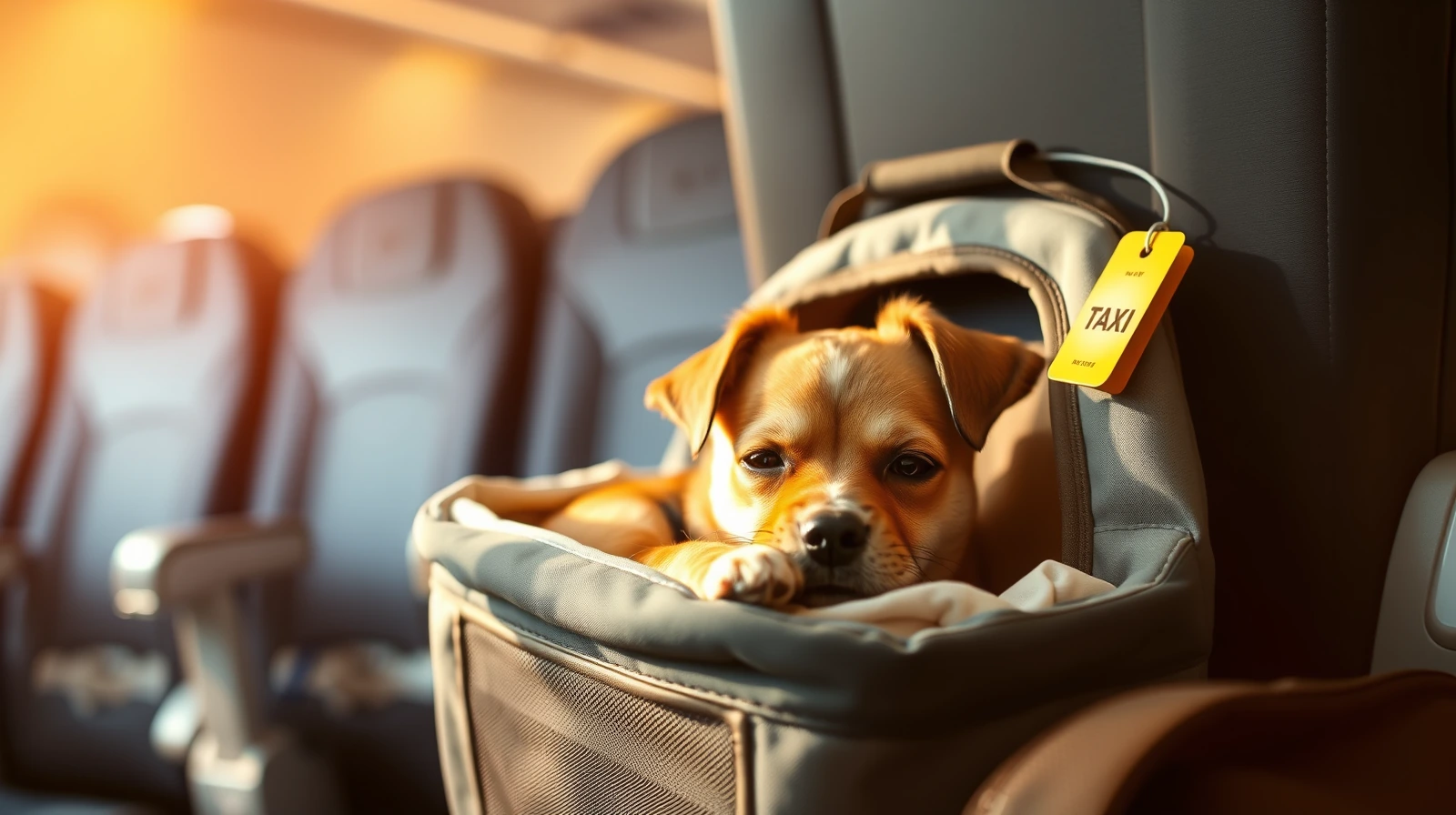
Flying with a dog in cabin means a small dog rides under the seat in a soft carrier that fits the under-seat space. Expect a $95 to $150 fee each way, capped pet slots per flight, and breed and age limits. Book the pet spot early and confirm carrier dimensions with your airline.
Flying with a dog in cabin is the cheapest, lowest-stress way to fly a small dog, because your pet rides in a soft carrier under the seat in front of you rather than in the cargo hold. The catch is that every US airline caps the number of pets per flight, charges a fee each way, and enforces a strict carrier-fit rule. This guide decodes the 2026 rules, airline by airline, so you can book the right flight and pack the right carrier the first time.
Flying a different airline? See our guide to Southwest Airlines Pet Policy in 2026.
Some breeds fit under the seat far more easily than others, as the best dog breeds for travel explains.
Before you fly, the pet reservation itself is a separate step from booking your own ticket; see our guide to how to book a pet on a flight.
A task-trained service dog flies under a separate, more protective federal rule than an ordinary pet in the cabin; see our flying with a service dog guide for the DOT form and documentation rules.
What "in cabin" actually means in 2026
An in-cabin dog travels inside a ventilated carrier that stays stowed under the seat for the entire flight. Your dog must be able to stand up, turn around, and lie down in a natural position inside the carrier, and the carrier must fit fully under the seat in front of you. The old shorthand "dogs under 25 pounds fly in cabin" is being quietly retired across the industry. The real test is not a number on a scale, it is whether the dog and carrier fit the under-seat space comfortably. A lean 22-pound beagle may not fit a soft carrier that slides under a seat, while an 18-pound dog with a slimmer build might.
Most carriers also count as your one personal item or carry-on, so you typically cannot bring a pet carrier plus a full-size carry-on plus a personal item. Check your fare's baggage allowance before you book. For a deeper comparison of riding up front versus shipping a pet below deck, see our breakdown of pet cargo vs in-cabin travel.
Flying a different airline? See our guide to JetBlue Pet Policy and JetPaws in 2026.
Which US airlines allow dogs in the cabin
Most major US carriers allow small dogs in the cabin on domestic flights, with the notable exception of certain ultra-low-cost carriers and most long-haul international routes. The table below summarizes the published in-cabin rules for six major US airlines. Fees and exact dimensions change frequently, so treat this as a starting point and confirm the current numbers on the airline's own pet page before you book. All figures are as of 2026.
| Airline | Max soft carrier size (approx.) | In-cabin fee (each way) |
|---|---|---|
| United | 18 x 11 x 11 in (hard) / 18 x 11 x 11 in soft | $125 |
| Delta | Must fit under seat; varies by aircraft | $95 to $150 |
| American | 19 x 13 x 9 in soft | $150 |
| Alaska | 17 x 11 x 9.5 in soft | $100 to $150 |
| Southwest | 18.5 x 8.5 x 13.5 in | $125 |
| JetBlue | 17 x 12.5 x 8.5 in | $125 |
Verify each policy directly: United, Delta, American, Alaska, Southwest, and JetBlue. For a wider directory of which carriers fly pets and how, see our guide to pet airlines, and our detailed United Airlines pet transport walkthrough.
Flying a different airline? See our guide to Frontier Airlines Pet Policy.
The under-seat fit rule, decoded
The single most important rule is the under-seat fit. Airlines publish maximum carrier dimensions, but those numbers are guidance, not a guarantee. The under-seat space varies by aircraft type and even by seat row. Bulkhead rows and some window seats have less usable floor space, so a gate agent can refuse a carrier that technically met the published dimensions.
Soft-sided carriers are the safe choice because they flex into a tighter space than rigid carriers, and most airlines allow them to be slightly compressed during stowage. Measure the carrier with your dog inside, not empty, and choose one with a low profile rather than maximum length. A carrier your dog can comfortably stand and turn in, but that still slides flat under the seat, is the goal. For specific models that pass these checks, see our roundup of the best airline approved dog carriers.
Fees, and why you book the pet slot early
In-cabin pet fees for US airlines generally run $95 to $150 each way as of 2026. That fee is per direction, so a round trip can mean paying twice. The fee is separate from your ticket and is not usually refundable once the pet reservation is confirmed.
The bigger constraint is capacity. Airlines limit the number of pets allowed in the cabin on each flight, often somewhere between two and six animals total depending on the carrier and aircraft. Those slots are first come, first served. On popular routes and around holidays they fill fast, so you cannot assume a spot will be open when you book your own seat. The practical rule:
- Reserve the pet spot at the same time you book your ticket, by phone or through the airline's pet booking flow.
- Get a confirmation number or note on your reservation specific to the pet.
- If you are connecting through a hub, confirm the pet is allowed on every leg, since aircraft and limits can differ.
- Arrive at the airport earlier than usual, because pet check-in is done in person at the counter, not at a kiosk.
Breed and age restrictions
Two restrictions catch travelers off guard: brachycephalic (snub-nosed) breeds and minimum age.
Snub-nosed breeds
Snub-nosed dogs such as English and French bulldogs, pugs, boxers, and many mastiffs have compressed airways that make air travel riskier, especially in cargo. Many airlines restrict or ban these breeds even in the cabin during hot months or on certain routes. If you own a flat-faced breed, confirm eligibility before you build a trip around flying. Our guide to the snub-nosed dog breeds flying ban lists the breeds airlines most often restrict and the seasonal embargoes to watch for.
Minimum age and health
Most airlines set a minimum age for in-cabin puppies, commonly 8 weeks, though some require puppies to be older, in the 10 to 16 week range, and to be weaned. A health certificate or proof of vaccination may be required depending on the airline and destination, particularly for international travel. Older dogs and dogs with respiratory or heart conditions should be cleared by a veterinarian before flying. If your dog does not qualify for the cabin, weigh the alternatives in our overview of how to transport a pet.
Service dogs versus emotional support animals
This is the area where the rules changed most. Under the US Department of Transportation rule that took effect in 2021, airlines are only required to treat trained service dogs as service animals. Emotional support animals (ESAs) are no longer guaranteed free cabin access and are now treated as pets, which means they pay the standard in-cabin fee and must meet carrier and capacity rules like any other dog. Trained service dogs continue to fly in the cabin at no charge, but the traveler must complete the DOT service animal form. The authoritative reference is the US DOT service animal guidance under the Air Carrier Access Act. If your dog is a pet rather than a trained service animal, plan to pay the fee and book a pet slot.
What to pack for an in-cabin dog
Pack light but cover the essentials. Everything except the carrier goes in your personal item or carry-on.
- Airline-approved soft carrier, measured with the dog inside.
- Absorbent pad lining the carrier floor, plus a spare.
- Collapsible water bowl and a small amount of water for layovers.
- Leash and collar with ID tag, kept accessible for security screening.
- A few familiar treats and one comfort item that smells like home.
- Health certificate or vaccination records if your airline or destination requires them.
- Waste bags and unscented wipes for accidents.
The at-airport flow
Pet check-in happens in person. Go to the airline counter first to confirm the pet, pay the fee if you have not already, and get any required paperwork stamped. At the security checkpoint, you take the dog out of the carrier, carry or walk it through the metal detector on a leash, and send the empty carrier through the X-ray belt. Use a pet relief area before boarding, since you will not be able to take the dog out during the flight. Many airports have post-security relief areas; locate yours before you head to the gate.
In-flight tips
Once on board, the carrier stays under the seat in front of you for taxi, takeoff, and landing, and ideally for the whole flight. You may not place the carrier on your lap or in an empty seat. Keep these in mind:
- Do not sedate your dog without veterinary guidance, since sedatives can interfere with breathing and temperature regulation at altitude.
- Skip a heavy meal in the hours before the flight to reduce nausea, but keep your dog hydrated.
- A quiet, dark carrier helps an anxious dog settle. A light cover that does not block ventilation can reduce overstimulation.
- Speak calmly and avoid opening the carrier mid-flight unless a crew member directs you to.
If you also travel with a feline companion, the rules are close but not identical. See our companion guide to flying with a cat in cabin for the differences in carrier fit and check-in.
Frequently asked questions
How much does it cost to fly with a dog in the cabin in 2026?
Is there still a 25-pound weight limit for in-cabin dogs?
How early should I book my dog's spot?
Can snub-nosed breeds like French bulldogs fly in the cabin?
What is the minimum age for a puppy to fly in cabin?
Do emotional support animals still fly free?
What carrier should I use for an in-cabin dog?
Can my dog come out of the carrier during the flight?
Sources & references
- united.com https://www.united.com/en/us/fly/travel/traveling-with-pets.html
- delta.com https://www.delta.com/us/en/pet-travel/overview
- aa.com https://www.aa.com/i18n/travel-info/special-assistance/pets.jsp
- alaskaair.com https://www.alaskaair.com/content/travel-info/policies/pets-traveling-with-pets
- southwest.com https://www.southwest.com/help/traveling-with-animals
- jetblue.com https://www.jetblue.com/traveling-together/traveling-with-pets
- transportation.gov https://www.transportation.gov/airconsumer/service-animals