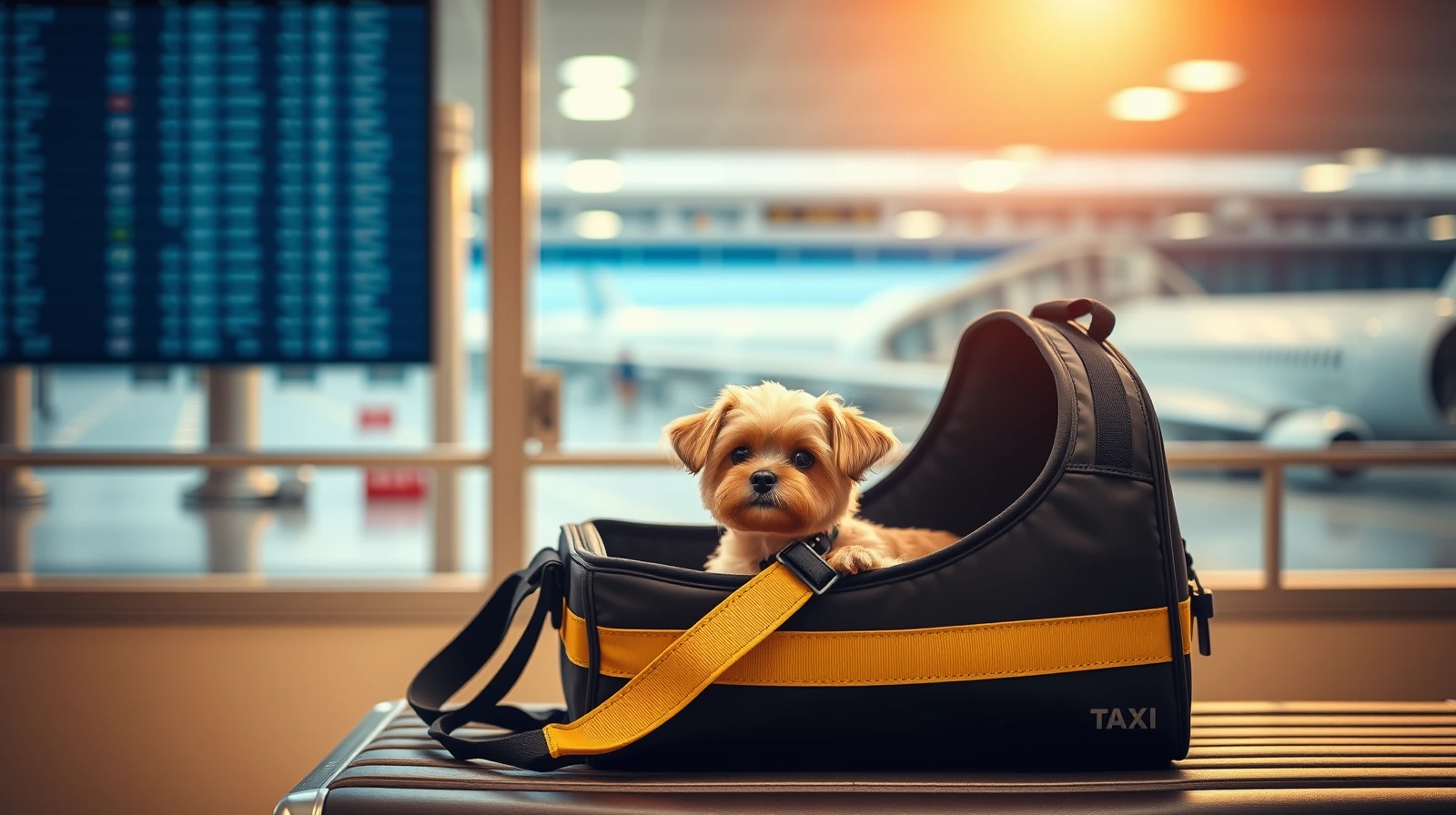
The best airline-approved dog carrier is a soft-sided bag that fits your airline's under-seat space, roughly 18 x 11 x 11 inches but as little as 9 inches tall on regional jets. Top picks: Sherpa Original Deluxe, Sleepypod Air, and Mr. Peanut's Gold Series. Approved is not a certification; it means it fits.
The best airline-approved dog carrier is a soft-sided bag that fits your airline's under-seat space, roughly 18 x 11 x 11 inches on mainline jets but as little as 9 inches tall on regional aircraft. Our top picks are the Sherpa Original Deluxe (guaranteed-on-board sizing), the Sleepypod Air (safety-tested), and the Mr. Peanut's Gold Series (broad compliance, lower price). "Approved" is not a certification; it just means it fits.
Still comparing gear? Our roundup of the Best Dog Car Barriers and Cargo Dividers for SUVs covers the current top picks.
Still comparing gear? Our roundup of the Best Orthopedic Dog Beds for Large and Senior Dogs covers the current top picks.
You may also want our guide to Best Pet Camera.
Gearing up for your pet? Compare our pick for the Best Dog Cooling Mat.
"Airline approved" is a marketing phrase, not a certification
Before you spend a dollar, understand the single most important truth about in-cabin carriers: there is no government body or airline that "approves" a specific bag. When a product says "airline approved" on the box, it means the manufacturer designed it to fit the under-seat dimensions that most major U.S. airlines publish. The final decision always rests with the gate agent and the aircraft you are actually flying.
The underlying rule comes from the FAA. Under cabin baggage regulations (14 CFR 121.589), a pet container has to fit completely under the seat in front of you without blocking anyone's path to the aisle, and your pet must stay inside the closed carrier for the whole flight. The FAA does not publish a carrier size. It leaves the exact dimensions to each airline, which is why two "airline approved" bags can be wildly different shapes. You can read the agency's own summary on the FAA Cabin Safety Pets FAQ.
This guide covers soft-sided carriers for small pets riding in the cabin with you. It is deliberately separate from a hard IATA flight kennel used for cargo or checked travel. If your dog is too big for the cabin and has to fly as cargo, you need a rigid crate instead: see our guides to the best pet transport crate and how to choose a pet transport crate. For the bigger decision of cabin versus cargo, read pet cargo vs in-cabin. Soft carriers like the ones below are for in-cabin small pets only and are not safe or legal substitutes for a cargo crate.
Gearing up for your pet? Compare our pick for the Best Elevated Dog Bowl.
Under-seat dimensions vary by airline and aircraft
The most common "safe" recommendation you will see is 18 x 11 x 11 inches, because that fits most mainline narrow-body jets. But the published limits differ, and regional jets are the trap. According to current airline policy pages, here is roughly where the major carriers land. Confirm the exact figure on your airline's site before buying, since policies change and depend on the aircraft assigned to your flight.
| Airline | Soft carrier max (approx.) | Notes |
|---|---|---|
| Delta | 18 x 11 x 11 in (recommended) | No universal size published; regional jets can drop to roughly 9-10 in tall |
| United | 18 x 11 x 11 in (soft) | Hard carriers limited to 18 x 14 x 8 in |
| Southwest | 18.5 x 13.5 x 8.5 in | Wider but shorter than the 18 x 11 x 11 norm |
| American | ~18 x 11 x 11 in | Soft-sided preferred; confirm by aircraft |
Notice that Southwest allows a wider, shorter bag (8.5 inches tall) than Delta or United. A carrier that is perfect for United can be too tall for a Southwest under-seat space. If you fly more than one airline, buy for the smallest opening you expect. Airline-specific rules are spelled out in our Southwest Airlines pet transport and JetBlue Airlines pet transport guides. The primary sources are the Delta pet travel overview and Southwest's pet policy page.
Gearing up for your pet? Compare our pick for the Best Dog Nail Grinder.
How we sourced this
We cross-checked carrier dimensions and weight limits against each manufacturer's official product pages (Sherpa, Sleepypod, Mr. Peanut's, Diggs), then mapped those against the published under-seat limits from Delta, United, Southwest, and the FAA's cabin baggage rule. Prices below are approximate June 2026 figures and fluctuate by color, size, and retailer, so treat them as a starting point and confirm the live price before you check out. We do not accept payment for placement; picks are based on fit, build quality, and independent safety testing where it exists.
The 7 best airline-approved soft-sided carriers
1. Sherpa Original Deluxe - best all-around (guaranteed on board)
Who it's for: Most first-time flyers with a dog up to about 16 pounds. Max pet size: roughly 16 in long, 10 in tall, 16 lb (Medium). Approx price: $45-$75 depending on size.
The Sherpa Original Deluxe is the carrier most often referenced when people say "airline approved." Its patented spring-wire frame lets you push the back end down so it conforms to a tight under-seat space, which is the whole trick on regional jets. The Small (15 x 10 x 8.5 in) and Medium (17 x 11 x 10.5 in) qualify for Sherpa's Guaranteed On Board program, meaning the brand backs their fit on participating airlines. The Large (19 x 11.75 x 11.5 in) is too big for some carriers, so size down if you fly mixed fleets. Specs are on the official Sherpa product page.
2. Sleepypod Air - best for safety
Who it's for: Owners who want crash-tested gear and a flexible, contouring shape. Max pet size: up to 18 lb. Approx price: $190-$220.
The Sleepypod Air is the premium pick. Its body is 16 to 22 inches long and 10.5 inches wide and tall, but the ends fold in so you can compress it to fit a smaller under-seat space, then expand it for your pet's comfort once seated. It is certified by the Center for Pet Safety for pets 18 pounds and under, which most soft carriers cannot claim. At around $200 it is roughly three to four times the price of a basic bag, so it suits frequent flyers or anyone who also wants car-safety performance. See the official Sleepypod Air page.
3. Mr. Peanut's Gold Series - best value with broad compliance
Who it's for: Travelers who fly several airlines and want one bag that fits all of them. Max pet size: pets up to about 16 in long (Standard). Approx price: $100-$120.
Mr. Peanut's lists its Gold Series Standard (18 x 10 x 11 in) as compliant with Delta, Southwest, JetBlue, American, United, Alaska, Frontier, and Allegiant, which is one of the broadest compliance claims on the market. The 600D nylon shell is more rigid than a budget bag while still flexing under the seat, and a Mini size (16 x 10 x 10 in) suits smaller dogs and short regional jets. At roughly $109 it undercuts the carriers Petco and PetSmart stock. Compliance details are on the Mr. Peanut's airline size guide.
4. Diggs Passenger - best modern design
Who it's for: Owners who want safety testing plus thoughtful extras. Max pet size: up to 18 lb. Approx price: $125-$150.
The Diggs Passenger (external 20 x 10.8 x 11.5 in, internal 18 x 10 x 10.75 in) holds a five-star rating from the Center for Pet Safety and adds genuinely useful touches: a collar tether so your pet cannot bolt when the bag is open, a key clip, and a side panel that lets you swap a pee pad without disturbing your dog on long layovers. At 4.5 pounds it is light, and the structured-but-flexible build threads the line between soft and rigid. Specs are on the official Diggs Passenger page.
5. Away The Pet Carrier - best for design-minded frequent travelers
Who it's for: Owners already in the Away luggage ecosystem who want a matching, durable bag. Max pet size: pets up to about 18 lb. Approx price: $195-$225.
Away's pet carrier is built from the same water-resistant nylon as its suitcases, with a luggage-strap pass-through so it rides on top of a rolling bag through the terminal. It is sized to fit under most standard airline seats, with a removable, washable base and mesh ventilation. It sits at the premium end on price without the published crash-test certification of Sleepypod or Diggs, so you are paying for materials and design. As with every carrier here, confirm the current dimensions and price on Away's official site before buying, and check them against your specific airline.
6. Amazon Basics Soft-Sided Carrier - best budget pick
Who it's for: Occasional flyers and tight budgets. Max pet size: up to 22 lb (Large size), but measure carefully. Approx price: $25-$40.
The Amazon Basics soft-sided carrier is the no-frills option. The smallest is about 13.8 x 8.9 x 8.9 in and the airline-marketed mesh version runs 16.5 x 10.6 x 11 in for pets up to 16 pounds. It has a washable fleece pad, top and front zippers, and mesh on multiple sides. The trade-off versus the Sherpa is a less rigid frame, so it can sag and the height may exceed a short regional under-seat space if you overstuff it. For one or two flights a year with a small dog, it is hard to beat on price.
7. Henkelion Soft-Sided Carrier - best ultra-budget backup
Who it's for: A spare bag or a very small dog or cat. Max pet size: up to 15 lb. Approx price: $20-$35.
The Henkelion (17 x 11 x 11 in) is a popular entry-level carrier sized for pets up to about 15 pounds and roughly 15 x 9 x 9 inches lying down. It collapses flat for storage, has dual loop handles and a shoulder strap, and is genuinely cheap. Build quality is basic, so treat it as a backup or a low-mileage option rather than a daily-driver for a nervous chewer. Always verify it fits your airline's height limit, because at 11 inches tall it will not clear Southwest's 8.5-inch under-seat space without compressing.
Comparison table at a glance
| Carrier | Max pet size | Dimensions (approx.) | Approx price | Best for |
|---|---|---|---|---|
| Sherpa Original Deluxe | Up to 16 lb | 17 x 11 x 10.5 in (M) | $45-$75 | All-around, guaranteed on board |
| Sleepypod Air | Up to 18 lb | 16-22 x 10.5 x 10.5 in | $190-$220 | Safety, frequent flyers |
| Mr. Peanut's Gold Series | ~16 in pet | 18 x 10 x 11 in | $100-$120 | Broad multi-airline compliance |
| Diggs Passenger | Up to 18 lb | 20 x 10.8 x 11.5 in | $125-$150 | Modern design plus safety testing |
| Away The Pet Carrier | Up to ~18 lb | Standard under-seat | $195-$225 | Design-minded travelers |
| Amazon Basics | Up to 16-22 lb | 16.5 x 10.6 x 11 in | $25-$40 | Budget, occasional flyer |
| Henkelion | Up to 15 lb | 17 x 11 x 11 in | $20-$35 | Ultra-budget backup |
Measure your pet, then check your airline
The carrier has to do two jobs at once: hold your dog comfortably and fit your airline's under-seat space. Get both right with three measurements before you buy.
- Measure your dog standing. Length from chest to base of tail, and height from the floor to the top of the head or ears, whichever is taller. Your pet should be able to stand up, turn around, and lie down inside the carrier per the FAA rule.
- Add a buffer. Pick a carrier whose interior length is at least 1-2 inches longer than your dog and whose interior height clears the top of the head. Too tight is stressful and may get you turned away at the gate.
- Check your airline and aircraft. Find the published under-seat dimensions for the airline you are flying, then look up the seat map for your specific aircraft. Regional jets (Bombardier CRJ, Embraer E-jets) often have only 9 to 10 inches of height.
- Buy for the smallest opening. If you fly multiple airlines, size to the tightest one you expect to use, usually a shorter height like Southwest's 8.5 inches.
- Confirm the weight cap. Most airlines require the pet plus carrier to fit and the pet to be able to move; some cap combined weight. Verify before travel.
One more practical step: get the carrier weeks early and let your dog sleep and eat in it at home. A bag your dog already trusts makes for a calmer flight. Our guide to crate training a dog for travel walks through the acclimation routine. For the full picture of in-cabin operators, fees, and rules across the industry, start at our pet transport reviews hub.
Soft features that actually matter on a plane
- A flexible or collapsible frame. This is the single most useful feature. The Sherpa's spring-wire and the Sleepypod's fold-in ends let you squeeze into a tight space without crushing your pet.
- Ventilation on multiple sides. Mesh on three to five panels keeps airflow up, which matters during long taxi-and-hold delays on a warm tarmac.
- A washable, leak-resistant base. Accidents happen. A removable pad and a water-resistant bottom save you a miserable cleanup.
- A safety tether. A clip inside (Diggs has one) stops a frightened dog from bolting when you open the bag at security.
- A luggage pass-through strap. Lets the carrier ride on your rolling bag, freeing your hands at the gate.
Does "airline approved" mean a carrier is guaranteed to be allowed?
What is the safest under-seat carrier size to buy?
Can a soft carrier be used for cargo or checked travel?
How big a dog can fly in the cabin?
Is the Sherpa or the Sleepypod better?
Does my pet count as a carry-on bag?
How do I measure my dog for a carrier?
Are prices in this guide current?
Sources & references
- faa.gov https://www.faa.gov/about/initiatives/cabin_safety/pets_faq
- delta.com https://www.delta.com/us/en/pet-travel/overview
- support.southwest.com https://support.southwest.com/helpcenter/s/article/pet-policy
- sherpapet.com https://sherpapet.com/products/sherpa-original-deluxe-travel-bag-pet-carrier
- sleepypod.com https://sleepypod.com/products/sleepypod-air
- mrpeanutspetcarriers.com https://mrpeanutspetcarriers.com/pages/airline-approved-pet-carrier-size-guide-2026
- diggs.pet https://www.diggs.pet/products/passenger-travel-carrier