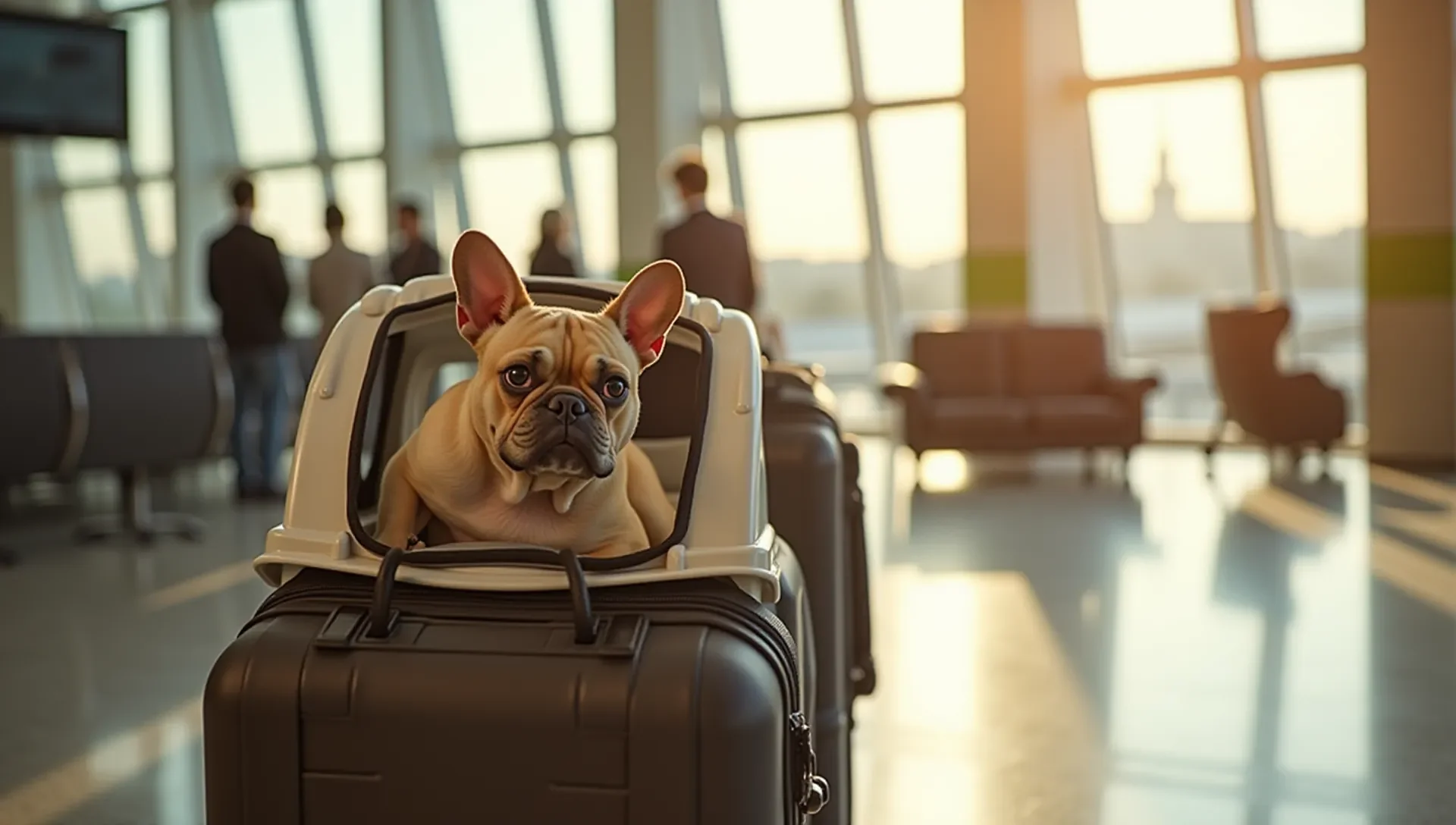
Moving a pet to France from the US requires an EU Health Certificate, ISO microchip, current rabies vaccination (30 days+ before travel), and accredited USDA vet endorsement. Banned breeds (Pit Bull, Tosa, Boerboel, American Staffordshire) cannot enter. Plan 30-45 days lead time.
Every year, US owners land at Charles de Gaulle with a Pit Bull in a crate and walk out without their dog. French border police at CDG do not negotiate. If your dog is on the Category 1 banned list, French law (Loi du 6 janvier 1999, still in force in 2026) gives the inspector authority to refuse entry, seize the animal, and in some cases euthanize it. There is no permit, no waiver, and no "but my dog is friendly" exception. This is the first thing every US owner needs to know before booking a flight.
The US does not issue an EU pet passport, so see our guide to the pet passport to understand what document actually replaces it for a US-origin move.
The banned breeds are: American Pit Bull Terrier, Boerboel, Tosa Inu, and any dog "resembling" the American Staffordshire Terrier without official LOF pedigree papers. Rottweilers and other Category 2 dogs can enter France, but require a formal declaration at the town hall (mairie) within eight days of arrival, plus a behavioral evaluation and owner permit. We will cover all of this. After the breed question, the process is mostly paperwork: an ISO-compliant microchip, a rabies vaccine administered after the chip with a 30-day wait, an EU Health Certificate endorsed by a USDA-accredited veterinarian within 10 days of travel, and a cargo booking with an airline that flies live animals into CDG. Plan 30 to 45 days end to end. Rush jobs fail at the vet endorsement stage.
Before you start, see our pet transport cost guide for a baseline on what international moves actually run, and our USDA certified pet transport explainer for how the vet endorsement chain works.
Heading from France to Italy with your pet? Free movement applies once you have the EU pet passport. See our Italy guide for intra-EU rules and Italian destination logistics.
Routing through to Ireland? See our Ireland pet import guide for the DUB entry rules, ISO microchip and rabies requirements, and realistic $1,800-$4,500 costs.
For a deeper look, see our guide to Amtrak Pet Policy.
For a deeper dive, see our guide to pet transport to puerto rico in 2026: requirements, cost, and how-to.
Related reading: pet transport to the netherlands from the us: dog and cat import requirements (2026 guide).
If you are weighing your options, our guide to how to find pet-friendly hotels (and book the right one for your dog) goes further.
Banned breeds you must know about FIRST
France classifies dogs of certain breeds or appearances as chiens dangereux (dangerous dogs) under two categories. Category 1 dogs cannot enter France at all. Category 2 dogs can enter but trigger strict registration, muzzling in public, and a mandatory permit.
Category 1 (chiens d'attaque) - BANNED from entry:
- American Pit Bull Terrier and any dog of pit-bull-type appearance without LOF (Livre des Origines Français) registration. Since the US does not issue LOF pedigrees, every American Pit Bull is treated as Category 1.
- Boerboel (South African Mastiff) without LOF papers.
- Tosa Inu without LOF papers.
- Dogs resembling the American Staffordshire Terrier ("Amstaff") without an LOF pedigree. AKC papers do not count.
Category 2 (chiens de garde et de défense) - allowed with declaration:
- American Staffordshire Terrier WITH LOF pedigree (rare for US dogs).
- Rottweiler, with or without pedigree.
- Tosa Inu WITH LOF pedigree.
- Dogs of Rottweiler-type appearance without pedigree.
If your dog is Category 2, you must visit the local mairie within eight days of arrival with: rabies vaccination proof, third-party liability insurance (assurance responsabilité civile), a veterinary behavioral evaluation (évaluation comportementale), and an owner training certificate (attestation d'aptitude). Public muzzling is mandatory. Skipping these steps is a €750 fine and possible seizure.
One detail most guides skip: the behavioral evaluation itself has a minimum-age rule. French law requires it to be carried out by an approved veterinarian only after the dog turns eight months old, and the resulting paperwork feeds directly into the permis de detention application, filed on CERFA form no. 13996*01 at the local mairie. A Category 2 dog younger than eight months cannot complete this step yet, which matters if you are planning a move around a dog's age.
A practical note: French customs inspectors at CDG and Orly judge by appearance, not by paperwork. A muscular short-haired dog with a blocky head will be assessed as a pit-bull-type regardless of what your AKC papers say. If your dog could plausibly be classified Category 1, do not fly it to France. Period. Consider moving to Spain or Germany instead, both of which have far less restrictive breed laws.
The 4 documents you need
The EU's pet import framework is set by Regulation (EU) No 576/2013, which standardized non-commercial pet movement across member states. For commercial movement (more than 5 pets, or movement intended for sale or transfer of ownership) you fall under Regulation 1/2005 and additional rules apply. Most US owners relocating one or two pets fall under the non-commercial framework, but the documentation is the same either way.
| Document | Where to get it | Lead time | Cost |
|---|---|---|---|
| ISO 11784/11785 microchip | Any vet. Must be implanted BEFORE the rabies shot. If your pet has a US-only AVID or HomeAgain chip, you need a new ISO chip or a universal scanner letter. | Same day | $40 to $75 |
| Rabies vaccination certificate | USDA-accredited vet. Must be given AFTER the ISO microchip. 30-day wait between shot and travel is mandatory. | 30 days minimum before flight | $25 to $60 |
| USDA APHIS vet endorsement | Your USDA-accredited vet completes the EU Health Certificate, then submits it to the USDA APHIS Veterinary Services Endorsement Office (most submissions go through VEHCS, the online portal). | 2 to 10 business days | $38 federal fee + $50 to $200 vet fee |
| EU Health Certificate (Annex IV) | Form issued by USDA APHIS, completed by your accredited vet, then endorsed by USDA. Valid 10 days from endorsement for entry into the EU, then 4 months for onward movement within the EU. | Issue within 10 days of departure | Included in vet endorsement |
The critical ordering is microchip first, rabies second. If the rabies shot was administered before the microchip, France will not accept the certificate even if the dog is fully vaccinated. You must revaccinate after the chip and wait 30 days. This is the single most common reason DIY moves fail.
Cats follow the same rules. There is no breed restriction on cats entering France.
The 30-day timeline
Working backwards from your flight date, here is the minimum viable schedule.
- Day -45 to -35: Confirm your dog is not Category 1. Microchip if not already ISO-compliant. Book USDA-accredited vet appointments.
- Day -35: Rabies vaccination administered (after microchip). Start the 30-day clock.
- Day -30 to -10: Book cargo space with Air France, Lufthansa, or KLM. International pet cargo to CDG fills up; do not assume same-week availability.
- Day -10 to -5: Vet completes the EU Health Certificate (Annex IV). Submit to USDA APHIS via VEHCS for endorsement. Most endorsements return within 2 to 3 business days.
- Day -5 to -1: Receive endorsed certificate. Confirm IATA-compliant crate. Print all paperwork in duplicate.
- Day 0: Fly. Carry the original endorsed certificate, rabies certificate, microchip implantation record, and a copy of your passport with the pet.
The EU Health Certificate is valid for 10 days from the date of USDA endorsement for entry into the EU. Miss that window and you must redo the endorsement. Once inside the EU, the same certificate covers onward movement for four months.
Which Paris airport accepts pets in cargo
Paris has three airports. They are not interchangeable for live animal cargo.
- Paris-Charles de Gaulle (CDG) - Primary entry point. CDG has a dedicated animal reception facility (Centre d'Hébergement Animalier) at the cargo terminal, operated under the Service d'Inspection Vétérinaire et Phytosanitaire aux Frontières (SIVEP). Almost all transatlantic pet cargo from the US arrives here.
- Paris-Orly (ORY) - Limited. ORY handles some intra-European pet cargo, but is not a typical transatlantic entry point. If your pet is routed via ORY (rare), confirm in writing that the SIVEP border post is open for your arrival window.
- Paris-Beauvais (BVA) - No. BVA is a low-cost carrier airport with no live animal cargo facility. Ryanair and Wizz Air, the dominant carriers there, do not accept pets in cargo at all.
If you are not flying to Paris, the alternative entry points are Lyon-Saint-Exupéry (LYS), Marseille-Provence (MRS), and Nice-Côte d'Azur (NCE). All three have SIVEP border posts and accept commercial pet cargo. LYS is often cheaper than CDG and has shorter wait times at the animal facility.
Air cargo cost ranges from major US hubs
Pricing for international pet cargo is driven by crate size, weight, and routing. The figures below are for a medium-sized dog (40 to 60 lbs) in an IATA 400-series crate, one-way to CDG, sourced from operator quotes and airline cargo tariffs collected in early 2026.
| US Hub | CDG cargo cost (medium dog) | Typical transit time | Airline options |
|---|---|---|---|
| New York (JFK) | $1,400 to $2,400 | 7 to 9 hours nonstop | Air France, Delta Cargo (partner with Air France), Lufthansa via FRA |
| Miami (MIA) | $1,800 to $2,900 | 9 to 11 hours direct | Air France, American Airlines Cargo, KLM via AMS |
| Los Angeles (LAX) | $2,200 to $3,800 | 11 to 13 hours nonstop | Air France, Lufthansa via FRA, KLM via AMS |
| Chicago (ORD) | $1,700 to $2,800 | 8 to 10 hours nonstop | Air France, Lufthansa via FRA, United Cargo via partner |
| Atlanta (ATL) | $1,600 to $2,700 | 9 hours nonstop | Air France, Delta Cargo, KLM via AMS |
Large and giant breeds (70 lbs+ in IATA 500 or 700 crates) typically run 1.5x to 2x these figures because cargo is priced by chargeable weight (the greater of actual weight or volumetric weight). A Great Dane in a 700-series crate can hit $5,000+ from LAX. Brachycephalic breeds (Bulldogs, French Bulldogs, Pugs, Boxers) face additional restrictions; Air France and KLM have temporary embargoes on snub-nosed breeds during warm months, and Lufthansa requires a veterinary fitness-to-fly letter year-round.
Quotes from full-service pet relocation companies (door-to-door, including the export endorsement, crate, and customs clearance at CDG) typically add $1,500 to $3,000 on top of the raw airline cargo cost. Whether that is worth it depends on how much time you have and how much paperwork tolerance you have.
Once you arrive: declaring at customs
At CDG, pet cargo is processed at the SIVEP border post inside the cargo zone (not the passenger terminal). Your pet will not come out at baggage claim. You or your customs broker must collect the pet from the cargo facility, which is open Monday to Friday during business hours and limited weekend hours. After-hours arrivals mean your pet waits in the animal reception kennel until SIVEP opens.
The SIVEP inspector checks four things: that the microchip number matches the certificate, that the rabies vaccination is current and was administered after the microchip, that the EU Health Certificate is original (not a photocopy) and within its 10-day validity window, and that the dog is not a Category 1 banned breed. The inspection is visual and document-based; there is no quarantine for compliant pets.
If everything checks out, the pet is released within 1 to 3 hours of arrival. Inspection fees are typically €30 to €60, payable on the spot or billed through your customs broker. Most pet relocation companies build this into their quote.
Ground onward travel within France and the EU
Once your pet is inside the EU on a valid Health Certificate, the same certificate covers onward movement within the EU for four months. You can drive from Paris to Berlin, Barcelona, or Rome without further paperwork. French train operator SNCF allows small pets in carriers (under 6 kg) for €7 per journey and larger dogs on a leash and muzzle for half the second-class fare. TGV and Intercités services accept pets; check Eurostar separately if you plan to continue to the UK.
The UK is now separate post-Brexit. The EU Health Certificate does not cover entry to Great Britain. You need a UK-specific Animal Health Certificate or a GB pet passport, plus tapeworm treatment for dogs administered 1 to 5 days before entry. See our full pet transport to UK guide for the post-Brexit process. The Republic of Ireland is in the EU and accepts the same certificate as France.
Common rejection reasons at CDG
SIVEP inspectors are not flexible. The most common reasons US-origin pets get held, refused, or sent back:
- Rabies given before microchip. Roughly 40% of DIY failures. The vaccination is treated as invalid; the pet enters quarantine or is returned to origin.
- Non-ISO microchip. US-only chips (some older AVID or HomeAgain models) cannot be read by French scanners without a manufacturer's letter or a co-implanted ISO chip.
- Health Certificate older than 10 days. If your flight is delayed past the 10-day window from USDA endorsement, the certificate is dead. Some owners have had to fly home, re-endorse, and fly back.
- Photocopied certificate. SIVEP requires the original USDA endorsement with the embossed seal. Print copies and digital versions are not accepted.
- Category 1 breed. The pet is refused and either returned to the US (at owner expense) or seized.
- Weekend arrival without arrangement. SIVEP weekend hours are limited. Arriving Saturday afternoon with no pre-cleared customs broker means your pet may sit in the kennel until Monday morning.