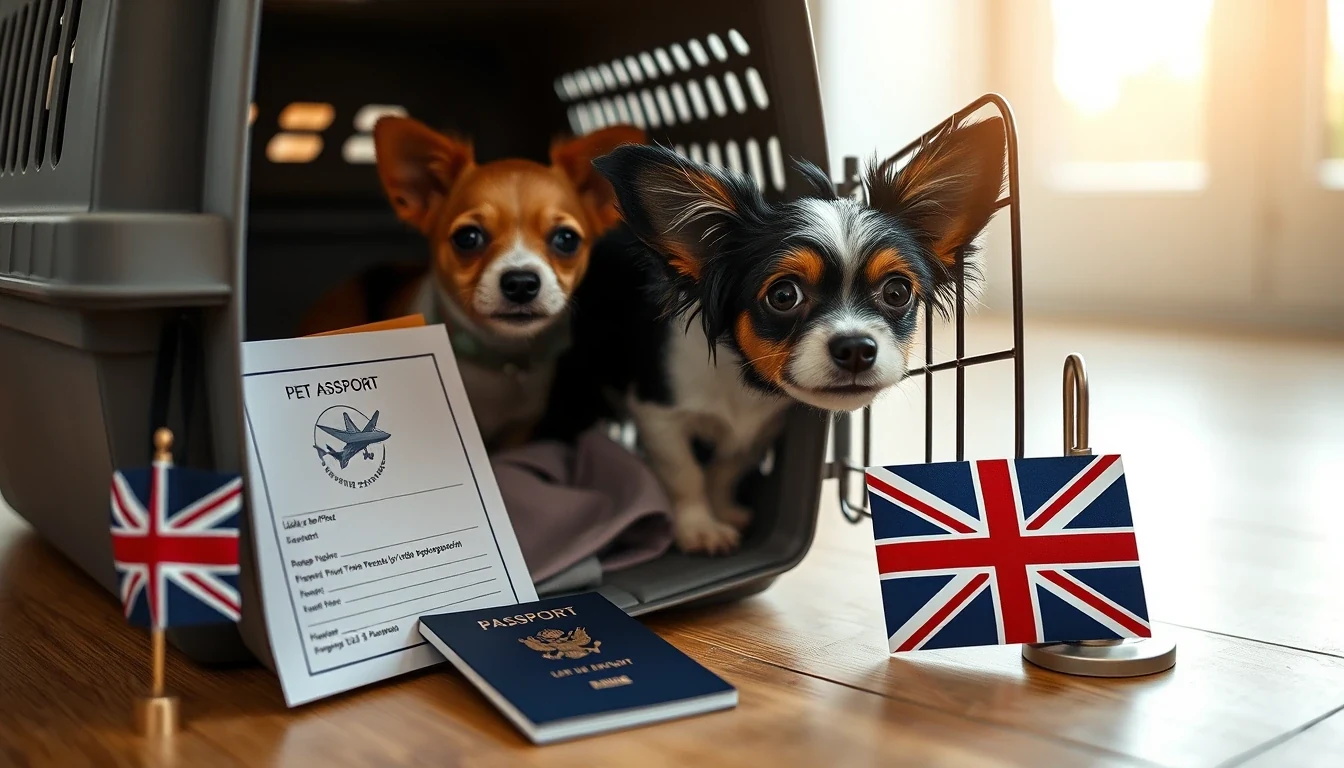
Moving a pet from the USA to the UK costs $1,800 to $3,500 for a small in-cabin pet and $3,000 to $6,000 for a larger pet in cargo. Required paperwork: an Animal Health Certificate (AHC, replaces the EU Pet Passport for US-issued docs post-Brexit), USDA APHIS endorsement, current rabies vaccine, ISO microchip, and a rabies titer test done 30+ days before travel. Approved direct routes: British Airways and Virgin Atlantic carry pets in cargo; KLM and Lufthansa offer routes via Amsterdam or Frankfurt.
Pet transport to the UK from the USA requires an Animal Health Certificate (AHC), USDA APHIS endorsement, ISO microchip, current rabies vaccine, a rabies titer test waited out 30 days after vaccination, and tapeworm treatment for dogs 24 to 120 hours before arrival. Total cost ranges $1,800 to $6,000. Plan 4+ months from start to UK arrival if your pet is starting fresh with vaccination.
Moving to mainland Europe rather than the UK? Our Germany pet transport guide covers the EU 576/2013 process which applies broadly across the EU.
Planning a bigger move? Our pet relocation hub covers routes, destinations, and every transport method.
Moving onward to continental Europe? Our pet transport to France guide covers the EU Health Certificate process, banned breeds (Pit Bull, Tosa, Boerboel), and CDG cargo logistics.
Ireland instead of the UK? Our pet transport to Ireland guide covers the mandatory tapeworm treatment window (24-120 hours pre-arrival), EU Annex IV health cert, and which airlines actually fly pets into Dublin.
Moving somewhere specific? See our guide to Pet Transport to the Philippines for that route's import requirements.
Moving somewhere specific? See our guide to Pet Transport to South Korea for that route's import requirements.
Related reading: Pet Health Certificate for Travel.
For a deeper dive, see our guide to pet transport to costa rica from the us: dog and cat import requirements (2026 guide).
Related reading: dog car anxiety: how to calm your dog and stop carsickness.
If you are weighing your options, our guide to traveling with a dog in an rv: a safety and planning guide goes further.
Americans often search for a pet passport they cannot actually get, so it is worth understanding what a pet passport really is first.
Moving the other way? Our guide to pet transport from the UK to the US explains why direct flights take pets as cargo only, and the via-Europe workaround for small pets.
Post-Brexit reality: the AHC replaces the EU Pet Passport
Before Brexit (January 2021), US-resident pets could enter the UK on an EU Pet Passport issued by a US vet. That option is gone. US-resident pets now require an Animal Health Certificate (AHC), a 4-page paper document issued by a USDA-accredited veterinarian, signed within 10 days of UK arrival, and endorsed by USDA APHIS as the federal validation. The AHC is single-use; a new one is needed for each entry.
EU Pet Passports remain valid for pets that originally entered the EU on one before Brexit and have continuously maintained the passport with current rabies vaccinations. For new arrivals from the US, the AHC pathway is the only option.
Required documents: what each one covers
| Document | Issuer | Validity | Cost (USD) | Notes |
|---|---|---|---|---|
| ISO 11784/11785 microchip | USDA-accredited vet | Permanent | $25–$80 | UK rejects non-ISO chips |
| Rabies vaccination | USDA-accredited vet | 1–3 yr | $20–$60 | After microchip; min 21 days before travel |
| Rabies titer test (FAVN/RNATT) | USDA-approved lab | 2 yr (per UK) | $80–$150 | Min 30 days after vaccine; results 2-4 wk |
| Animal Health Certificate (AHC) | USDA-accredited vet | 10 days from issue | $50–$200 issuance | 4-page certificate; mailed to USDA |
| USDA APHIS endorsement | USDA APHIS VS office | 10 days from endorsement | $38–$173 | Federal stamp on AHC |
| Tapeworm treatment (dogs only) | USDA-accredited vet | 24–120 hr window | $30–$60 | Praziquantel; on AHC |
Approved airlines US to UK
| Airline | Route | Cabin? | Cargo fee | Weight limit |
|---|---|---|---|---|
| British Airways | Direct US-UK cargo (IAG Cargo) | No | $300–$1,500 | Up to 45 kg total |
| Virgin Atlantic | Direct US-UK cargo (Virgin Cargo) | No | $300–$1,500 | Up to 45 kg total |
| KLM | US-AMS-UK connection cargo | Small dogs only | $400–$1,200 | Up to 75 kg cargo |
| Lufthansa | US-FRA-UK connection cargo | Small dogs only | $350–$1,500 | Up to 75 kg cargo |
| American Airlines | Via European hubs in cargo | No (intl) | $500–$1,800 | Cargo only |
British Airways and Virgin Atlantic offer the cleanest single-flight options. For brachycephalic breeds or pets needing in-cabin, route via Schengen on KLM or Lufthansa and use Eurostar or short ground transfer to UK from Amsterdam or Frankfurt. See our American Airlines pet transport guide for US-side details.
Timeline: when to start each step
- 4 months before move: Microchip + first rabies vaccination if pet is starting fresh. Wait 30 days.
- 3 months before move: Rabies titer blood draw. Lab results take 2 to 4 weeks. Then wait 3 months from titer date.
- 2 weeks before move: USDA-accredited vet exam + AHC issuance.
- 1 week before move: Submit AHC to USDA APHIS for endorsement.
- 24 to 120 hours before arrival: Tapeworm treatment (dogs).
- Travel day: Check in with documents. Pet meets you at destination airport pet check-in or designated cargo pickup point.
Quarantine cost if you mess up paperwork
UK quarantine for non-compliant pets is the worst outcome. Pets that fail compliance at border checks are quarantined for 4 months at approved DEFRA facilities (Heathrow Animal Reception Centre, Manchester Animal Reception Centre, others). Cost: 1,500 to 5,000 GBP entry fee plus daily care (50 to 100 GBP per day). Total non-compliance cost can exceed 12,000 GBP. Most common reasons for quarantine: rabies titer timing mistake, missing tapeworm treatment, microchip is not ISO standard, expired AHC.
The 5-day rule: commercial vs non-commercial entry
One rule decides which paperwork track you fall into, and most owners do not know it exists. If you are moving your own dog or cat and travel within 5 days of your pet, you usually qualify for the simpler non-commercial path. If your pet arrives in Great Britain more than 5 days before or after you, the move is treated as commercial, which means heavier documentation, customs declarations, and often a registered exporter.
Practical implications:
- Coordinate your flight and your pet's flight so the arrivals fall inside the 5-day window.
- If you are flying your pet ahead with a flight nanny or operator while you arrive weeks later, plan for the commercial path from the start.
- The non-commercial path also caps you at 5 pets per traveler; above that is automatically commercial.
Approved routes and authorised carriers
Great Britain does not let you fly a pet in on any flight you like. Pets must enter on an approved route using an authorised transport company, and the approved-routes list should be checked before you book a single ticket. Booking the wrong carrier or routing can mean the pet is refused at the border or sent to quarantine.
- The UK does not allow pets to travel as accompanied checked baggage the way some destinations do; entry is via approved cargo (manifest cargo) or an approved in-cabin route.
- Pets typically clear at a designated Animal Reception Centre (the Heathrow Animal Reception Centre is the busiest), where officials verify the GB health certificate, microchip, rabies status, and tapeworm record.
- Confirm your operator is on the authorised-carrier list, not just any pet shipper. This is non-negotiable for GB.
For mainland Europe, where the approved-route system works differently, see our pet transport to France guide, and for pet transport to Ireland the tapeworm window applies just like GB.
Tapeworm: a dog-only rule (cats are exempt)
A frequent and expensive misreading: the mandatory tapeworm treatment applies to dogs only. Cats and ferrets entering Great Britain do not need it.
- Dogs must be treated with a praziquantel-based wormer by a vet between 24 and 120 hours before arrival into GB, recorded on the health certificate.
- Cats skip the tapeworm step entirely but still need the ISO microchip, rabies vaccination, titer where required, and a GB health certificate.
- All animals must be microchipped before the rabies vaccination or any tapeworm treatment is given, and must be at least 12 weeks old before the rabies shot.
Missing the dog tapeworm window, or doing it too early or too late, is one of the top reasons dogs are held at the border, so confirm the exact treatment time against the flight schedule.
Crate rules and the no-sedation policy
Getting the documents right is only half the job; the physical setup matters at the border too.
- Pets travel in an IATA-compliant crate with secure latches and adequate ventilation, sized so the animal can stand, turn, and lie down.
- Do not sedate. Authorities and airlines discourage sedatives because they raise the risk of respiratory and cardiovascular problems at altitude, and a visibly sedated animal can be refused.
- Label the crate with your contact details and attach travel paperwork in a pouch on the outside.
- Freeze a small water dish so it does not spill during loading but melts to drinkable water in transit.
For broader budgeting across methods, our pet transport cost per mile guide puts the UK move in context.
Frequently asked questions
Can I bring my dog to the UK from the USA?
How much does it cost to move a pet from US to UK?
Does the UK still accept the EU Pet Passport from US-issued?
How long does the UK pet rabies titer process take?
Which US airlines fly pets to the UK?
Is there UK pet quarantine if I bring my dog correctly?
What is an Animal Health Certificate (AHC)?
Can I take my pet to the UK in-cabin?
What is the 5-day rule for bringing a pet to the UK?
Do cats need tapeworm treatment to enter Great Britain?
Can I bring a pet to the UK as checked baggage like in the US?
UK import requirements sourced from DEFRA UK pet travel, USDA APHIS UK guidance, BA Cargo, Virgin Cargo, KLM Cargo, Lufthansa Cargo published rate cards (May 2026). We refresh annually after DEFRA fee updates.
Sources & references
- gov.uk https://www.gov.uk/take-pet-abroad
- aphis.usda.gov https://www.aphis.usda.gov/pet-travel/countries/uk
- britishairways.com https://www.britishairways.com/cargo/petsaway
- virgincargo.com https://www.virgincargo.com/pets
- klmcargo.com https://www.klmcargo.com/livestock