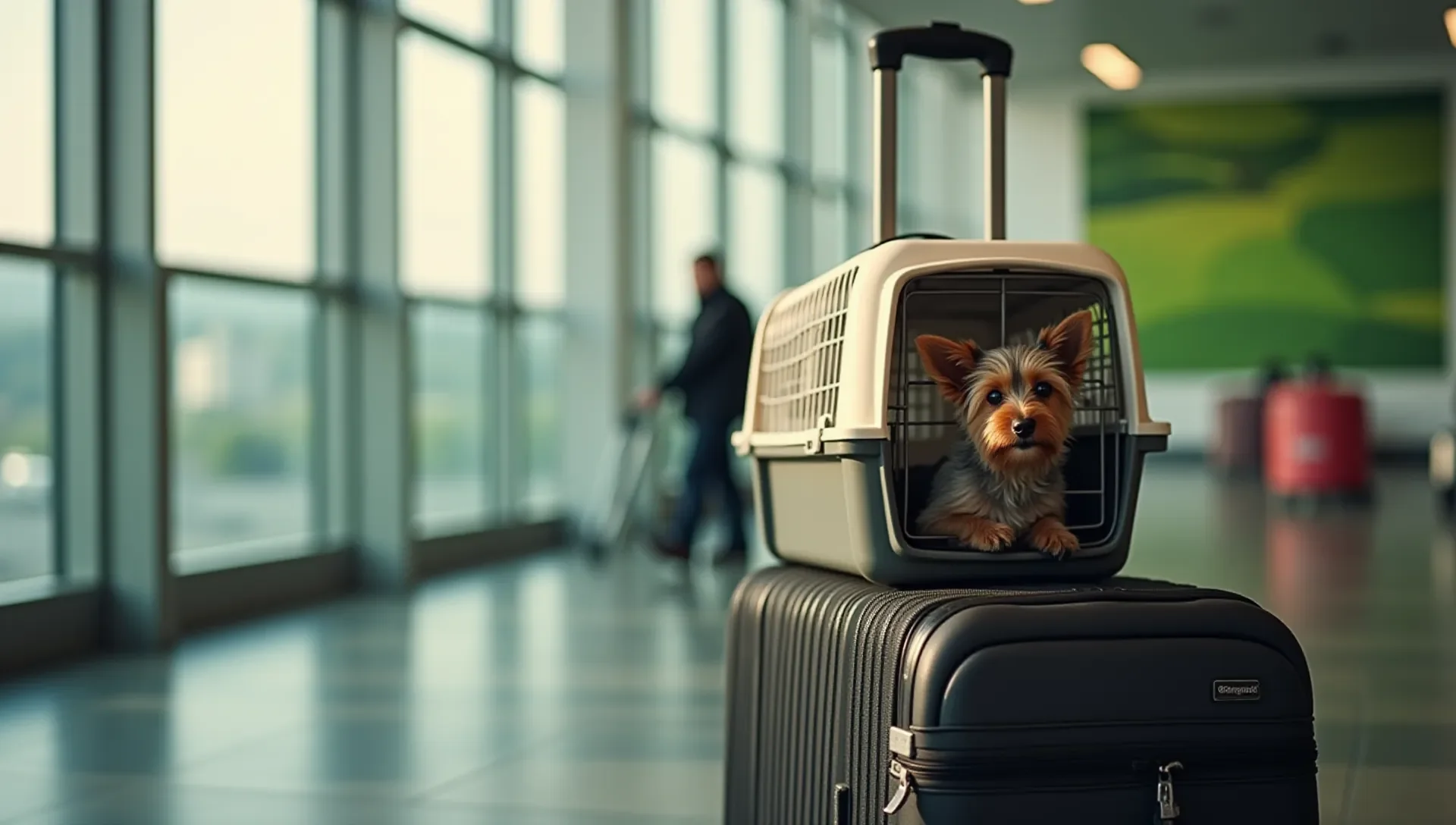
Transporting a pet to Ireland from the US requires an ISO microchip, a rabies vaccine given after the chip with a 21-day wait, an EU Annex IV health certificate, and a USDA APHIS endorsement. Ireland also mandates a tapeworm treatment given 24-120 hours before arrival, strictly enforced. Aer Lingus does not carry pets as cargo, so most fly via a European hub on Lufthansa or KLM. Expect $1,800-$4,500.
Ireland is one of the few EU countries that adds its own non-negotiable rule on top of the standard EU pet-import rules: a tapeworm treatment administered by a vet 24 to 120 hours before your pet arrives, recorded in the official paperwork. Miss that window and your dog can be refused entry or held at the border. Combine that with the fact that Ireland's national carrier, Aer Lingus, does not fly pets as cargo, and a move that looks simple on paper becomes a logistics puzzle. This guide decodes every requirement, the airline routing, the real costs ($1,800-$4,500), and how Ireland's rules differ from the UK's.
If you are comparing entry rules across multiple destinations, our pet quarantine rules by country guide breaks down how Ireland's no-quarantine-if-compliant approach compares to stricter island nations.
See also Dog Seatbelt Laws by State.
For a deeper dive, see our guide to pet transport to canada from the us in 2026: requirements, cost, and how-to.
Related reading: pet transport to dubai and the uae from the us: 2026 dog and cat import guide.
If you are weighing your options, our guide to pet health certificate for travel: how to get one (us guide) goes further.
Ireland follows EU rules, plus its own
Ireland is part of the European Union, so it applies the EU's pet-travel framework. But it is also one of a small group (with the UK, Finland, Malta, and Norway) that requires an extra tapeworm (Echinococcus) treatment for dogs because these regions are historically free of the parasite and want to keep it that way.
So a US pet entering Ireland must satisfy two layers:
- The standard EU import requirements for a non-listed third country
- Ireland's additional tapeworm rule for dogs
The Irish Department of Agriculture, Food and the Marine (DAFM) is the authority, and its requirements are enforced strictly at Dublin Airport.
The core requirements, step by step
Follow these in order, because the sequence matters.
1. ISO microchip first
Your pet must have an ISO 11784/11785-compliant 15-digit microchip implanted before anything else. If the chip is implanted after the rabies vaccine, the vaccine does not count and must be redone. If your pet's chip is not ISO-standard, bring your own scanner or have an ISO chip implanted.
2. Rabies vaccination after the chip
The rabies vaccine must be given after the microchip is in place. There is then a mandatory 21-day waiting period from the date of vaccination before the pet can travel. A vaccine given before the chip, or travel inside the 21 days, invalidates the trip.
3. EU Annex IV health certificate (non-listed third country)
The US is a non-listed third country for EU pet travel, which means your pet travels on the EU Annex IV health certificate rather than an EU pet passport. A USDA-accredited veterinarian completes it, confirming the microchip, rabies vaccination, and dates. The certificate is valid for entry within 10 days of issue and for onward EU travel for four months.
4. USDA APHIS endorsement
After your accredited vet completes the Annex IV certificate, it must be endorsed by USDA APHIS (the Animal and Plant Health Inspection Service) before departure. This is typically done through APHIS's VEHCS online system at the nearest endorsement office. Build in time: endorsement is not instant, and the certificate's validity clock is short. The USDA APHIS pet travel pages detail the Ireland-specific paperwork.
5. Tapeworm treatment, 24-120 hours before arrival (dogs)
This is Ireland's signature rule. A vet must treat your dog for tapeworm with an approved product containing praziquantel, and the treatment must be administered and recorded not less than 24 hours and not more than 120 hours (1 to 5 days) before arrival in Ireland. The treating vet logs the date, time, and product in the health certificate. Cats are exempt from the tapeworm requirement; only dogs need it.
Because the window is tight and tied to your exact arrival time, this treatment usually happens in the country you are departing from or transiting, timed precisely against the flight. A transport specialist coordinates this so it lands inside the legal window.
Dublin Airport entry and quarantine
If every requirement is met, there is no quarantine. Pets enter through Dublin Airport (DUB), which is the main approved point of entry for animals from outside the EU. The paperwork is checked on arrival, the microchip is scanned, and a compliant pet is released to its owner or agent.
Dublin is not the only option. DAFM also designates Cork Airport, Shannon Airport, Dublin Port, the Port of Cork at Ringaskiddy, and Rosslare Europort as approved points of entry for pets from outside the EU, according to official DAFM pet travel guidance. Cork requires advance arrangement, generally at least 48 hours ahead, through the DAFM Southern Regional Office. Shannon has its own dedicated portal inspector line for owners who need to coordinate or cancel an inspection. Choosing a non-Dublin entry point can simplify routing for an owner flying into a regional airport or taking the ferry from Wales, but the same compliance check and advance-notice rule apply everywhere.
If any requirement fails (chip not detected, missing endorsement, tapeworm treatment outside the window, or incomplete paperwork) the pet can be refused, held, or in some cases returned to the country of origin at the owner's expense. The strictness is the point: there is little discretion at the border, so compliance must be exact before the pet boards.
Airlines and routing: the Aer Lingus problem
Here is the routing wrinkle that catches most owners: Aer Lingus, Ireland's national carrier, does not transport pets as cargo or accompanied baggage. Small cabin-eligible pets have limited options, and large dogs cannot fly Aer Lingus at all.
Practical routes from the US:
- Lufthansa via Frankfurt or Munich, then onward to Dublin
- KLM via Amsterdam, then onward to Dublin
- A dedicated pet transport specialist managing the full door-to-door route, often the simplest option for large dogs
Because most routes involve a European hub connection, the EU Annex IV certificate must remain valid for the full journey, and the tapeworm treatment window must be timed against the final Dublin arrival, not the first leg. This is precisely why owners moving large dogs usually hire a specialist rather than booking it themselves. IATA's Live Animals Regulations govern the cargo and crate standards on these carriers.
What pet transport to Ireland costs
Total cost depends on pet size, route, and how much you delegate.
| Cost component | Typical range |
|---|---|
| Airline cargo / cabin fee | $200-$1,200 |
| IATA-compliant crate | $50-$500 |
| Vet visits, vaccines, tapeworm treatment | $150-$500 |
| USDA APHIS endorsement | $38-$173 per certificate |
| Full-service transport specialist | $1,000-$3,000+ |
| All-in total | $1,800-$4,500 |
A DIY move with a small cabin-eligible pet sits at the low end. A large dog requiring cargo, a specialist, and hub routing pushes toward the top. The endorsement fee alone is set by APHIS and varies by the number of animals and certificate complexity.
Top operators for Ireland moves
Three categories of specialist handle Ireland relocations:
- Global pet relocation firms (full IATA-member specialists) that manage paperwork, the tapeworm-treatment timing, crate sourcing, hub routing, and Dublin clearance end to end. Best for large dogs and complex routes.
- Door-to-door pet transport companies that coordinate the flight booking and ground legs on both sides.
- Marketplace and consolidator services for owners who want help with logistics but a lower price point.
Whichever you choose, confirm the operator is an IATA-accredited or recognized pet shipper, has handled Ireland specifically (the tapeworm timing is where amateurs fail), and provides a written checklist of every date and document.
Ireland versus the UK: the key differences
The UK and Ireland share the tapeworm requirement, but the destinations differ in important ways.
- Both require ISO microchip, rabies vaccine with the post-chip wait, and the praziquantel tapeworm treatment in the 24-120 hour window for dogs.
- The UK is no longer in the EU, so it has its own GB pet-import scheme and Animal Health Certificate rules rather than the EU Annex IV certificate.
- Ireland, as an EU member, uses the EU Annex IV certificate for entry from the US.
- Routing differs: UK-bound pets often route via approved carriers into Heathrow, while Ireland-bound pets typically route via a continental EU hub because Aer Lingus does not carry pets.
If you are weighing both islands or moving onward, see our detailed pet transport to the UK guide. For other EU destinations with the standard (non-tapeworm) rules, compare pet transport to France, pet transport to Spain, and pet transport to Germany.
A realistic timeline for an Ireland move
Because the requirements stack with mandatory waiting periods, planning backward from your travel date keeps you compliant.
| Timing before travel | Action |
|---|---|
| 3+ months out | Confirm ISO microchip; if missing or non-ISO, implant a compliant chip first |
| At least 21 days + buffer out | Administer rabies vaccine (must follow the chip) and start the 21-day clock |
| 2-4 weeks out | Book the flight via a pet-carrying hub route or a specialist; reserve an IATA crate |
| Within 10 days of travel | USDA-accredited vet completes the EU Annex IV health certificate |
| Before departure | USDA APHIS endorses the certificate |
| 24-120 hours before arrival | Vet administers and records the praziquantel tapeworm treatment (dogs) |
| Arrival | Documents and microchip checked at Dublin; compliant pets released, no quarantine |
The two hard constraints are the 21-day rabies wait and the 24-120 hour tapeworm window. Everything else flexes around them.
Crate and welfare standards for the flight
Whatever airline or specialist you use, the pet flies in an IATA-compliant travel crate. Per IATA Live Animals Regulations, the crate must:
- Be rigid, well-ventilated on at least three sides, and leak-proof
- Allow the animal to stand, turn around, and lie down naturally
- Have secure door latches and no wheels (or wheels removed)
- Be labeled with "Live Animal" markings and your contact details
Buy and acclimate the crate well before travel so the flight is not the animal's first time inside it. A specialist will source the correctly sized crate as part of the service, which is one reason large-dog owners often delegate the whole move.
Common reasons pets are refused entry to Ireland
Border officers have little discretion, so failures are almost always paperwork or timing. The most frequent:
- Tapeworm treatment outside the 24-120 hour window, the single most common error
- Rabies vaccine given before the microchip, which invalidates it
- Travel inside the 21-day post-vaccination wait
- Missing or incorrect USDA APHIS endorsement on the Annex IV certificate
- A non-ISO microchip that the scanner cannot read
- An expired health certificate (issued more than 10 days before entry)
Every one of these is avoidable with careful sequencing, which is exactly why owners moving complex or large animals lean on an experienced specialist who manages the calendar.
DIY versus hiring a specialist
Whether to handle the move yourself or hire a pet relocation firm comes down to pet size, route complexity, and your tolerance for paperwork risk.
DIY is viable when your pet is small and cabin-eligible on a carrier that serves Dublin via a hub, your timeline is flexible, and you are comfortable coordinating the vet visits, APHIS endorsement, and the precise tapeworm window yourself. It is the cheaper path, often landing near the $1,800-$2,500 end of the range.
A specialist earns its fee when you are moving a large dog that must fly cargo, the route requires a hub connection with the certificate valid across legs, or you cannot risk a timing error at the border. The firm sources the IATA crate, books the carrier, schedules the vet appointments to hit the 21-day and 24-120 hour windows, handles APHIS endorsement, and clears the pet at Dublin. For most large-dog owners, the $1,000-$3,000 service fee is insurance against a refused-entry disaster that would cost far more.
The Irish tapeworm window is where amateurs most often fail, so if you do go DIY, treat that single requirement as the non-negotiable centerpiece of your plan and confirm it with the treating vet in writing.
What to expect on arrival at Dublin
When a compliant pet lands at Dublin Airport, the process is straightforward but documented. Cargo or specialist-handled animals are received in the dedicated animal handling area, where an officer scans the microchip and checks it against the paperwork, reviews the rabies record and dates, and confirms the tapeworm treatment was logged inside the legal window. If everything matches, the pet is cleared and released to the owner or the agent collecting it, usually within a couple of hours of landing. There is no quarantine for a compliant animal. Cabin pets travel with their owner through the normal arrivals process with the same document check. Because the review is procedural rather than discretionary, the experience is calm and quick when the paperwork is in order, and stressful only when something is missing. This predictability is the upside of Ireland's strict rules: get the sequence right and there are no surprises at the border.
The bottom line
Moving a pet to Ireland from the US means an ISO microchip, a rabies vaccine given after the chip with a 21-day wait, an EU Annex IV certificate endorsed by USDA APHIS, and, for dogs, a praziquantel tapeworm treatment recorded 24 to 120 hours before arrival. Get it all right and there is no quarantine at Dublin. Because Aer Lingus does not carry pets, plan on a Lufthansa or KLM hub route or a specialist, and budget $1,800-$4,500. The tapeworm timing is the single most common failure point, so coordinate it precisely against your final arrival time.