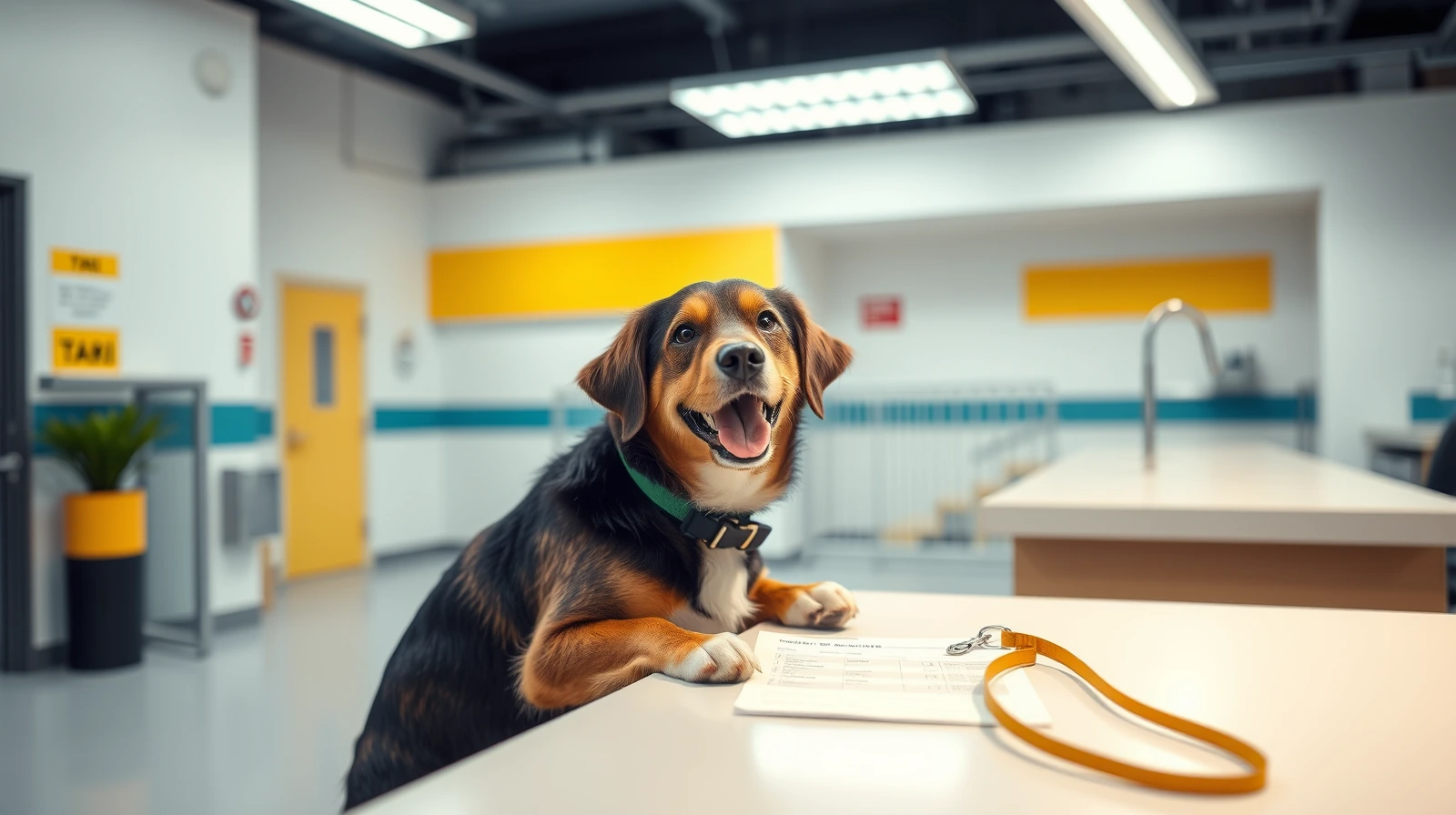
Most kennels require Rabies, DHPP, and Bordetella, with many adding canine influenza and leptospirosis. Time boosters one to three weeks ahead, give Bordetella at least five to seven days before drop-off, and confirm your facility's exact list early.
You booked the kennel, packed the food, and then the confirmation email landed with one line that stops most owners cold: "Please send proof of current vaccinations before arrival." Reputable boarding facilities require vaccines because they put dozens of dogs under one roof, sharing air, water bowls, and play yards. The shots are not red tape. They are the price of keeping a building full of strangers' pets from passing around preventable, sometimes fatal, disease. This guide breaks down exactly which dog vaccines for boarding most kennels demand, what each one protects against, when to get them done so immunity has time to build, and what to do if your dog's records are out of date.
Boarding your dog? See our guide to Long-Term Dog Boarding.
Daycare has its own shot list that overlaps with boarding. Here is the vaccines daycares require and how the timing differs.
Vaccines are one requirement, medications are another. Here is what to know about boarding a dog on medication and dose handling.
Why boarding facilities require vaccines at all
A boarding kennel is, epidemiologically speaking, a small high-density population of dogs with constant turnover. That is the ideal environment for airborne and contact-spread pathogens. A single under-vaccinated dog can seed an outbreak that sweeps a facility in days. Vaccine requirements protect your dog, every other guest, and the business itself from liability and reputational damage. According to the American Veterinary Medical Association, vaccines are divided into core (recommended for essentially every dog) and non-core (recommended based on lifestyle and exposure risk). Boarding pushes several non-core vaccines into the "required" column precisely because the lifestyle risk spikes the moment your dog walks through the door.
One thing to understand up front: there is no single national standard. Requirements vary by facility, by state, and sometimes by the individual kennel's insurance carrier. The list below covers what reputable operators typically ask for, but you must confirm the exact requirements with your chosen facility. A kennel that has no vaccine policy at all is a red flag worth walking away from.
Boarding your dog? See our guide to In-Home Dog Boarding vs Kennel.
Need overnight care? Our vetted dog boarding connects you with background-checked, insured local providers.
The core vaccines almost every kennel requires
Core vaccines are the non-negotiable baseline. Per AAHA vaccination guidelines, these protect against diseases that are widespread, severe, or transmissible to humans. Expect every legitimate boarding facility to require all of them.
Rabies
Rabies is the one vaccine mandated by law in most U.S. states, not just by kennel policy. It protects against a virus that is virtually always fatal once symptoms appear and can spread to humans. Depending on the vaccine product and your state's rules, rabies is given as a one-year or three-year shot. Your facility will want to see the certificate showing the dog is currently covered, and the expiration date must fall after your dog's checkout date. The American Kennel Club notes that rabies is universally treated as core because of both its lethality and its public-health implications.
DHPP / DAPP (the combination shot)
This single combination vaccine covers four diseases, which is why kennels treat it as one required item. The letters stand for Distemper, Hepatitis (caused by Adenovirus), Parainfluenza, and Parvovirus. You may see it written as DHPP, DAPP, DA2PP, or similar, depending on the exact formulation, but it is functionally the same core combo.
- Distemper is a serious viral disease attacking the respiratory, gastrointestinal, and nervous systems, often fatal.
- Adenovirus / Hepatitis protects against infectious canine hepatitis, which damages the liver and other organs.
- Parainfluenza is one of several pathogens that contribute to canine infectious respiratory disease, the kennel-cough complex.
- Parvovirus is a highly contagious, environmentally hardy virus causing severe vomiting and bloody diarrhea, frequently deadly in puppies.
After the puppy series, DHPP is typically boostered at one year and then every one to three years, depending on your veterinarian's protocol. Most kennels accept the standard schedule as long as the dog is currently up to date.
Bordetella (kennel cough)
Bordetella bronchiseptica is the bacterium most associated with kennel cough, and the Bordetella vaccine is the single most boarding-specific shot on this list. As the AKC explains, kennel cough spreads through the air and across shared surfaces, exactly the conditions a boarding kennel creates. Because immunity can wane, many facilities require the Bordetella vaccine to have been given within the last six months for boarding dogs, which is stricter than the annual schedule a low-risk house dog might follow. It comes in injectable, oral, and intranasal forms; the intranasal and oral versions can start protecting in as little as a few days, which matters for timing (more on that below).
Non-core vaccines that boarding facilities commonly require
These are classed as non-core for the general dog population, but because boarding raises exposure risk, many quality facilities now require them. If your facility does, do not treat them as optional.
Canine influenza (H3N2 and H3N8)
Canine influenza is a contagious respiratory infection caused by two known strains, H3N2 and H3N8. The AVMA notes that dog flu spreads readily in settings where dogs congregate, and that the vaccine is recommended for dogs at risk of exposure, which boarding squarely qualifies as. The vaccine is usually a bivalent product covering both strains and requires an initial two-dose series given two to four weeks apart before full protection, then annual boosters. If your dog has never had it, plan ahead: a last-minute single dose will not provide adequate immunity for the stay.
Leptospirosis
Leptospirosis is a bacterial infection spread through the urine of infected animals and contaminated water or soil. It can cause kidney and liver failure in dogs and, importantly, it is zoonotic, meaning it can spread to people. The CDC's overview of leptospirosis underscores the human-health angle, which is part of why facilities increasingly require it. Like canine influenza, lepto needs an initial two-dose series before it is fully protective, followed by annual boosters. Outdoor play yards and shared water make a strong case for it in a boarding context.
Vaccine and timing reference table
| Vaccine | Protects against | Core or required for boarding? | Typical timing before boarding |
|---|---|---|---|
| Rabies | Rabies virus (fatal, zoonotic) | Core, legally mandated in most states | Must be current through checkout date; ideally not given same week as travel |
| DHPP / DAPP | Distemper, Adenovirus/Hepatitis, Parainfluenza, Parvovirus | Core, near-universally required | Boost about 1 to 3 weeks ahead if due |
| Bordetella | Kennel cough (Bordetella bronchiseptica) | Required by most kennels, often within last 6 months | At least 5 to 7 days before drop-off so immunity builds |
| Canine influenza | Dog flu strains H3N2 and H3N8 | Non-core but commonly required | Two-dose series finished about 1 to 2 weeks before; plan weeks ahead if new |
| Leptospirosis | Leptospira bacteria (kidney/liver, zoonotic) | Non-core but increasingly required | Two-dose series completed 1 to 2 weeks before the stay |
Timing: why you cannot vaccinate at the last minute
The most common boarding mistake is treating vaccines as a drop-off-day errand. Vaccines do not work instantly. The immune system needs time to respond and build protective antibodies, and for vaccines that require a two-dose series, that window stretches across weeks. As a general rule, get any due boosters done roughly one to three weeks before the stay. For Bordetella specifically, aim for at least five to seven days before drop-off so immunity has time to develop. For canine influenza and leptospirosis, if your dog has never had them, the full initial series can take three to four weeks to complete, so start as soon as you know your travel dates.
There is a second, subtler timing reason to avoid same-week shots: some dogs feel briefly off after vaccination (mild lethargy or soreness). You do not want that overlapping with the stress of a new environment, and you do not want to be unable to tell a vaccine reaction apart from kennel anxiety. Building a buffer protects both immunity and your peace of mind. Spacing things out is part of the broader work of getting ready to prepare your dog for boarding without a last-minute scramble.
Proof of vaccination: the paperwork kennels actually want
Telling the front desk "he's all caught up" will not cut it. Facilities require documentation, and the cleanest source is your veterinarian. Acceptable proof usually includes:
- A vaccination certificate or printout from your vet's office listing each vaccine, the date administered, and the expiration or due date.
- The rabies certificate specifically, since it is the legally tracked one.
- Your veterinary clinic's contact details, in case the kennel wants to verify directly.
A handwritten note or a faded tag on the collar is not enough for most reputable operators. The simplest approach is to email or upload the records well before arrival and bring a paper copy on drop-off day. Keep a photo of the certificate on your phone too. Sorting paperwork early is one of the easiest items to check off when you are figuring out what to pack for dog boarding, and it spares you a stressful gate-side delay.
Puppies, seniors, and titer tests
Puppies
Puppies are a special case. They receive a series of vaccines spaced a few weeks apart starting at around six to eight weeks old, and they are not considered fully protected until that series is complete, typically around sixteen weeks or later. Many facilities will not board a puppy until the full core series and rabies are done, precisely because young dogs are the most vulnerable to parvovirus and distemper. If you are boarding a puppy, confirm the minimum age and vaccination status the facility requires before you book. For first-timers of any age, a little extra prep goes a long way, and our guide to dog boarding for the first time walks through what to expect.
Titer tests as an alternative
A titer test is a blood test that measures the level of antibodies a dog already has against specific diseases, such as distemper, parvovirus, and hepatitis. For owners who want to avoid over-vaccinating an older or sensitive dog, a sufficiently high titer can demonstrate existing immunity. Some boarding facilities accept titer results in place of a recent booster for those core viral diseases. Important caveats: titers are not a substitute for rabies, which is governed by law, and they are not meaningful for bacterial vaccines like Bordetella and leptospirosis, where immunity is shorter-lived and not well reflected by titers. Always ask your facility in advance whether they accept titers, because policies differ widely.
What happens if your dog is not vaccinated
The short version: a reputable facility will turn your dog away at the door. No exceptions, no "just this once." That is not the kennel being difficult; it is the kennel protecting every other dog in the building and itself. Showing up with lapsed records on travel morning is one of the worst situations to be in, because there is no time to fix it, and a vaccine given that day would not be effective anyway. If you find yourself stuck, you will be scrambling for a vet appointment, a different facility with looser rules (rarely a good sign), an in-home sitter, or canceling your plans entirely.
The flip side is reassuring. A facility with a strict, clearly written vaccine policy is signaling that it takes biosecurity seriously, which is exactly the kind of place you want your dog to stay. When you are comparing options, treat the vaccine policy as a quality filter, not an inconvenience. Our guide on how to choose the best dog boarding facility covers the other signals worth weighing, and once you have a shortlist, you can plan around how much dog boarding costs with confidence that the place is run responsibly.
Frequently asked questions
What vaccines does my dog need for boarding?
How long before boarding should my dog be vaccinated?
Is the Bordetella vaccine really required every six months for boarding?
Will a kennel accept a titer test instead of vaccinating?
Can I board a puppy that has not finished its vaccines?
What proof of vaccination do I need to bring?
What happens if my dog is not up to date on vaccines?
Are vaccine requirements the same at every boarding facility?
Sources & references
- akc.org https://www.akc.org/expert-advice/health/dog-vaccines/
- avma.org https://www.avma.org/resources-tools/pet-owners/petcare/vaccinations
- aaha.org https://www.aaha.org/your-pet/pet-owner-education/aaha-guidelines-for-pet-owners/vaccination/
- avma.org https://www.avma.org/resources-tools/animal-health-and-welfare/canine-influenza
- akc.org https://www.akc.org/expert-advice/health/kennel-cough-in-dogs/
- cdc.gov https://www.cdc.gov/leptospirosis/about/index.html