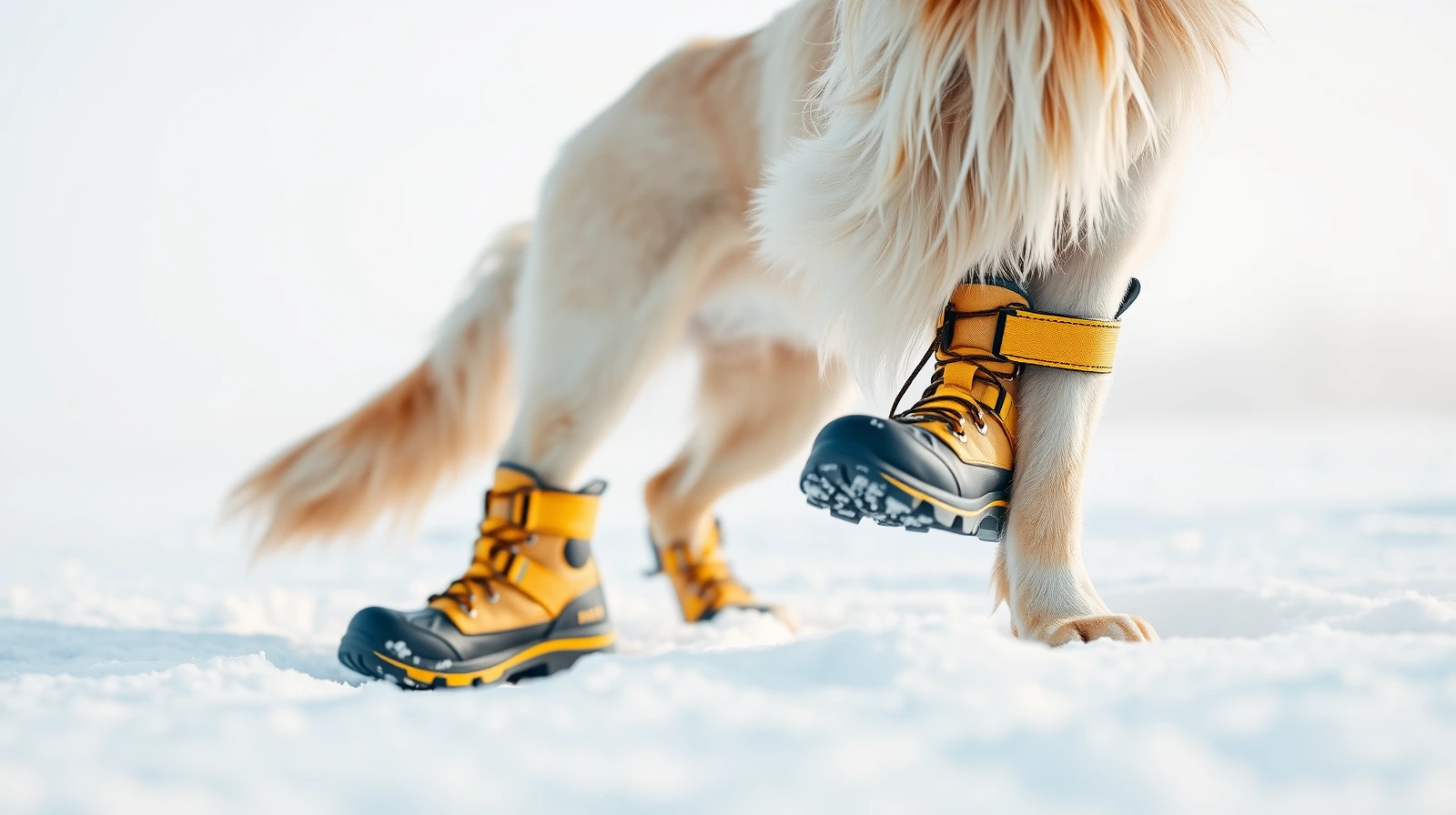
For most dogs the best winter boots are: Ruffwear Grip Trex ($75-$90) for traction and hiking, Muttluks Fleece-Lined ($40-$60) for deep cold, Kurgo Blaze Cross ($40-$55) for everyday snow, and a budget rubber pick like QUMY ($15-$25) to test fit. Confirm prices on each maker's site.
For most dogs, the best winter boots come down to four picks: Ruffwear Grip Trex (roughly $75-$90/set) for serious traction and hiking, Muttluks Fleece-Lined (about $40-$60) for insulation in deep cold, Kurgo Blaze Cross (around $40-$55) for everyday snow walks, and a budget rubber-sole pick like QUMY (about $15-$25) to test fit before spending more. Confirm current prices on each maker's site.
Winter dog boots protect paws from a different set of hazards than summer shoes do. This guide covers cold, snow, ice, and the road salt and de-icer chemicals that come with them. If you are shopping for hot-weather protection instead, see our companion guide to the best dog shoes for hot pavement, which is built for summer asphalt, not snow. Below we rank six real, currently-sold winter boots, explain why they matter, and walk through sizing and the salt-rinse routine for dogs who refuse to wear anything.
For a deeper look, see our guide to Best Dog Playpen.
Related reading: Best Dog Leash.
Gearing up for your pet? Compare our pick for the Best Dog First Aid Kit.
Why winter boots matter (the calm version)
The case for winter boots is practical, not panic-inducing. Cold-weather walks expose paws to a few specific irritants, and boots remove most of them at once.
- Ice melt and de-icer chemicals. Rock salt and chemical de-icers on sidewalks can irritate paw pads and cause discomfort, and dogs that lick the residue off their feet can ingest it. The American Veterinary Medical Association notes in its cold-weather pet safety guidance that antifreeze and de-icers are common winter hazards and recommends wiping down or rinsing paws after walks. Boots keep the residue off entirely.
- Snowballs between the toes. Snow packs into the fur between paw pads and toes, forming hard ice clumps that are uncomfortable and can make a dog limp. Dogs with long fur or feathering are most prone to it.
- Frostbite on long exposure. Extremities, including paws, ears, and tails, are vulnerable to frostbite during extended time in subfreezing conditions. The AVMA advises limiting time outdoors in extreme cold for this reason. Boots add a layer of insulation and a barrier against direct ice contact, though they are not a substitute for keeping outings short in dangerous cold.
- Cuts from ice and hidden debris. Crusted, refrozen snow and ice edges can be sharp, and salt-strewn pavement hides grit. A boot with a real sole protects against both.
None of this means a healthy dog cannot enjoy a snowy walk barefoot. It means that on salted streets, icy trails, or in deep cold, a good boot makes the difference between a happy dog and a paw-licking, limping one. For specifics on cold thresholds and exposure limits, the AVMA cold-weather animal safety page is the authority to read.
Gearing up for your pet? Compare our pick for the Best Cat Window Perch.
How we sourced this
These picks are based on published manufacturer specifications, maker product information, and aggregated owner reviews across major retailers. We have not independently lab-tested traction or insulation values, and we do not accept payment for placement. Boot construction, materials, and pricing change between seasons, so treat every price below as an approximate range and confirm the current figure, sizing chart, and materials on the manufacturer's own site before buying. Where an official product page exists, we link it directly.
Gearing up for your pet? Compare our pick for the Best Dog Gate.
The 6 best winter dog boots, reviewed
1. Ruffwear Grip Trex - best for traction and winter hiking
The Grip Trex is the boot most often recommended for dogs that actually work in winter conditions: trail dogs, hiking companions, and any dog walking on ice. Its standout feature is a Vibram rubber outsole, the same kind of grippy lugged sole found on human hiking boots, which bites into snow and packed ice far better than a flat rubber pad. The upper is a breathable mesh, so it is not heavily insulated on its own, but on dry, cold days the traction and durability are hard to beat.
- Sole: Hard (Vibram lugged rubber outsole)
- Insulation: Minimal (breathable mesh upper); pairs well with a separate liner sock in deep cold
- Best for: Hiking, icy trails, traction on packed snow, hard-wearing daily use
- Approx price: $75-$90 per set of four (confirm on maker site)
- Pros: Excellent grip, very durable, secure hook-and-loop closure, sold in single pairs for odd-sized feet
- Cons: Among the priciest; mesh upper is not warm enough alone for extreme cold; stiffer break-in than soft boots
Official page: ruffwear.com. The Grip Trex is also a sensible choice if your dog joins you on the trail year-round; for carrying a smaller or tired dog on longer outings, see our guide to the best dog backpack carriers.
2. Muttluks Fleece-Lined - best for insulation and deep cold
If your priority is warmth rather than rugged traction, the Muttluks Fleece-Lined boot is the classic cold-weather pick. As the name says, it has a fleece lining for insulation, a leather sole that stays flexible in low temperatures, and a wide opening with a dual-strap closure that many owners find easier to get onto a reluctant paw. The flexible sole gives decent grip on snow but is less aggressive than a lugged outsole on sheer ice.
- Sole: Soft (flexible leather sole)
- Insulation: High (fleece lining)
- Best for: Deep cold, snowy neighborhood walks, dogs that need warmth over technical grip
- Approx price: $40-$60 per set (confirm on maker site)
- Pros: Genuinely warm, soft and flexible so easier acclimation, stays-on reputation, water-resistant
- Cons: Soft sole is less grippy on glare ice; leather needs occasional re-treating; can wet through in slush over long walks
Muttluks are sold widely through major pet retailers and the maker's own catalog; confirm the current model and sizing on the manufacturer or an authorized retailer page before ordering.
3. Kurgo Blaze Cross - best all-rounder for snow walks
The Kurgo Blaze Cross sits in the middle of the range: more traction than a basic rubber bootie, more affordable than the Grip Trex, and easier to put on than most. It uses a rugged rubber outsole with a tread pattern, a water-resistant upper, and a reflective, toggle-and-strap closure that helps with visibility on dark winter mornings. For the average dog doing daily snow walks rather than backcountry hikes, it covers the bases well.
- Sole: Hard (treaded rubber outsole)
- Insulation: Low to moderate (water-resistant upper, not heavily lined)
- Best for: Everyday snow and slush walks, owners who want grip plus value
- Approx price: $40-$55 per set (confirm on maker site)
- Pros: Good traction-to-price ratio, reflective trim, water-resistant, easy on and off
- Cons: Not as warm as a fleece-lined boot; fit can run narrow; less rugged than the Grip Trex for hard trail use
Official page: kurgo.com.
4. QUMY (or similar) - best budget pick to test fit
Before spending real money, many owners buy an inexpensive rubber-sole boot to learn their dog's correct size and gauge whether the dog will tolerate footwear at all. QUMY is one of the better-known budget options, with a thick anti-slip rubber sole, an adjustable wide-split opening, and reflective straps. The trade-off for the low price is durability and refinement: the rubber can be stiff, the sole is not lugged for ice, and the boots may wear faster than premium picks.
- Sole: Hard (thick flat rubber sole, anti-slip but not lugged)
- Insulation: Low (rubber-and-fabric construction)
- Best for: First-time buyers testing fit and tolerance, light snow, budget-conscious owners
- Approx price: $15-$25 per set (confirm on retailer listing)
- Pros: Very affordable, waterproof rubber, wide opening for easy entry, reflective straps
- Cons: Less durable, stiffer fit, flat sole gives less grip on glare ice, sizing inconsistent across batches
Budget rubber boots are sold primarily through online marketplaces rather than a single official site, so read recent reviews and the seller's size chart carefully and measure your dog before ordering.
5. Walkee Paws leggings-style - best for dogs that kick boots off
The single biggest complaint about dog boots is that they fall off. Walkee Paws takes a different approach: instead of four separate boots, it is a connected leggings-style design where the front pair and back pair are joined over the back, so the boots cannot be flicked off one at a time. The paw covers are waterproof and protect against salt and slush. Traction on hard ice is modest compared with a lugged sole, and the connected design takes a little practice to put on, but for escape-artist paws it solves the core problem.
- Sole: Soft (flexible waterproof paw cover, light grip)
- Insulation: Low to moderate (waterproof barrier rather than heavy lining)
- Best for: Dogs that kick off conventional boots, salt and slush protection on pavement
- Approx price: $35-$60 per set (confirm on maker site)
- Pros: Stays on far better than separate boots, good salt and wet barrier, less likely to be lost individually
- Cons: Modest traction on glare ice, learning curve to fit, not a rugged hiking sole
Walkee Paws is sold through its own site and major retailers; confirm the current style and sizing on the maker's official page before buying, as the line has expanded over the seasons.
6. Cordura sledding-style booties - best lightweight snow option
Borrowed from the sled-dog world, Cordura nylon booties are the minimalist choice. They are soft, lightweight fabric sleeves with a hook-and-loop strap and no rigid sole, designed to keep snow and ice out from between the toes on long, fast outings without weighing the dog down or changing its gait much. Mushers use them by the dozen because they are cheap and disposable-ish. The catch: with no real sole, they offer little protection from sharp ice or rough ground, and they wear through faster than rubber-soled boots.
- Sole: Soft (no rigid sole; durable Cordura nylon fabric)
- Insulation: Low (thin fabric barrier against snow packing)
- Best for: Active snow dogs, running and skijoring, preventing snowballs between toes, natural gait
- Approx price: $10-$30 for a multi-pack (confirm on retailer listing)
- Pros: Very light, minimal gait change, prevents ice balls, inexpensive in multipacks, easy to carry spares
- Cons: No sole protection against sharp ice or grit, wear through quickly, can slip off without a snug strap
Comparison table: winter dog boots at a glance
| Boot | Sole type | Insulation | Best for | Approx price (set) |
|---|---|---|---|---|
| Ruffwear Grip Trex | Hard (Vibram lugged) | Minimal | Traction, winter hiking | $75-$90 |
| Muttluks Fleece-Lined | Soft (leather) | High (fleece) | Deep cold, warmth | $40-$60 |
| Kurgo Blaze Cross | Hard (treaded rubber) | Low to moderate | Everyday snow walks | $40-$55 |
| QUMY (budget) | Hard (flat rubber) | Low | Testing fit, light snow | $15-$25 |
| Walkee Paws | Soft (waterproof cover) | Low to moderate | Dogs that kick boots off | $35-$60 |
| Cordura sledding booties | Soft (no rigid sole) | Low | Active snow dogs, running | $10-$30 |
How to choose: a quick decision framework
Match the boot to the conditions and the dog, not to the marketing:
- Icy trails or hiking? Prioritize a hard, lugged sole. Grip Trex or, on a budget, the treaded Kurgo Blaze Cross.
- Extreme cold, short pavement walks? Prioritize insulation. Fleece-lined Muttluks.
- Dog kicks every boot off? Prioritize the stay-on design. Walkee Paws.
- Running, skijoring, or pure snowball prevention? Prioritize light weight. Cordura booties.
- Not sure the dog will tolerate boots at all? Start cheap. A budget rubber set to test fit and tolerance, then upgrade.
Boots are one piece of winter gear. For cold-weather road trips, our guide to a road trip with a dog covers crating, breaks, and what to pack, and older dogs with stiff joints may need extra planning, which we cover in pet transport for senior dogs.
How to size winter boots and get them to stay on
Fit is the difference between boots that work and boots that end up in a snowbank. The process is simple but worth doing carefully.
Measure the paw, not the dog's weight
Most maker size charts are based on paw width. Press the paw gently onto a sheet of paper so it spreads under the dog's weight, the way it will when walking, and mark the outside edges of the widest part. Measure that width in millimeters or inches and match it to the manufacturer's chart. Measure the front paws and the back paws separately, since many dogs have larger front feet, and size to the larger pair if they differ. Always use the specific maker's chart rather than assuming sizes carry across brands.
Snug straps, checked twice
A boot stays on when the strap sits snug above the widest part of the paw or the ankle, not loose around the foot. Tighten until secure but not so tight it pinches; you should be able to slip a finger under the strap. Many boots that "fall off" are simply a size too big or strapped too loosely. After the first few minutes of walking, stop and re-check, since straps often settle and need a small adjustment once the dog is moving.
Acclimate indoors before the snow
The high-stepping "moon walk" gait dogs do in new boots is normal and temporary. Put the boots on indoors for short, upbeat sessions with treats, let the dog walk around the house, then build up to a short yard trip before committing to a full winter walk. A few days of indoor practice turns a comical refusal into a normal stride. Keep early sessions short and positive rather than forcing a long first outing.
If your dog refuses boots: the salt and de-icer paw routine
Some dogs simply will not wear boots, and that is fine if you manage paws another way. The key is removing salt, de-icer, and ice before it can irritate pads or be licked off. The AVMA's cold-weather guidance recommends wiping or rinsing paws after winter walks.
- Rinse or wipe paws after every walk. Use warm water or a damp cloth to remove salt and de-icer residue from pads and between the toes as soon as you get home.
- Dry between the toes. Trapped moisture and ice balls cause irritation; dry thoroughly after rinsing.
- Trim paw fur. Keeping the fur between the pads trimmed reduces snowball buildup and gives you less residue to clean.
- Consider a paw balm or wax. A protective paw wax applied before walks adds a barrier against salt and ice for boot-refusing dogs, though it is less complete protection than a boot.
- Choose pet-safe de-icer at home. If you treat your own walkway, a pet-safe ice melt reduces the hazard at the source.
For the full list of winter pet hazards, including antifreeze and exposure limits, the AVMA cold-weather animal safety guidance is the primary source to rely on. If your dog also struggles in summer heat, our best dog cooling vest guide and the hot-pavement footwear guide cover the warm-season equivalents.
Hard sole vs soft sole: which winter boot is right?
The single most useful distinction in winter boots is sole type. A hard sole (lugged or thick rubber, like the Grip Trex or Kurgo) protects against sharp ice, hidden grit, and rough ground, and grips better on packed snow and ice. The trade-off is a stiffer feel that takes more acclimation and usually a higher price. A soft sole (leather, fabric, or flexible paw cover, like Muttluks, Walkee Paws, or Cordura booties) is lighter, easier for a dog to accept, and often warmer or better at staying on, but offers less protection on sharp ice and rough terrain. For ice and trails, lean hard. For warmth, comfort, and stay-on convenience on pavement, lean soft.
Do dogs really need boots in winter?
What is the best dog boot for ice and traction?
How do I keep dog boots from falling off?
How do I measure my dog's paw for boots?
Are road salt and de-icer dangerous for dogs' paws?
How cold is too cold for a dog to walk without boots?
How much do good winter dog boots cost?
Should I buy hard-sole or soft-sole winter boots?
Sources & references
- avma.org https://www.avma.org/resources-tools/pet-owners/petcare/cold-weather-animal-safety
- ruffwear.com https://ruffwear.com
- kurgo.com https://www.kurgo.com