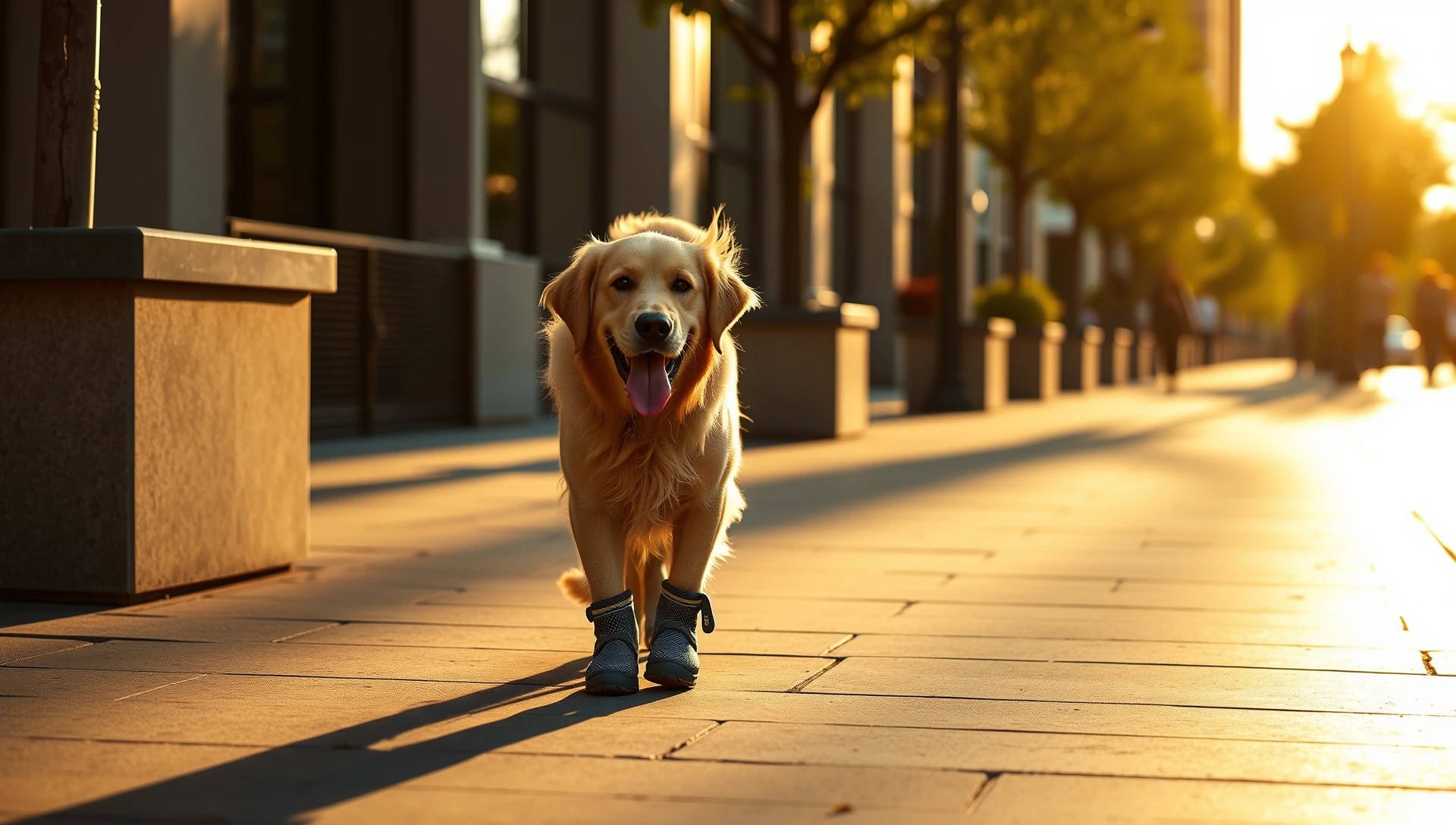
If you have ever pressed the back of your hand to a July sidewalk and recoiled, you have already done the test that matters most. Dog paws are tougher than human skin, but they are not heat-proof, and most "best dog boots" articles skip the question that decides which pair you should actually buy: what are you using them for. A trail boot is not a daily-walk boot. A senior-dog boot is not a puppy boot. This guide is organised by use case, not by a flat top 10.
[cc_quick_take]
Pavement at 125°F can burn paw pads in under 60 seconds. The 7-second hand test is the only field check that matters. For most owners, a breathable mesh boot with a thick rubber sole is enough. Hikers need a Vibram-soled boot. Seniors and puppies need a soft, low-step-in style. Measure paws while the dog is standing, full weight on the pad.
[/cc_quick_take]
Still comparing gear? Our roundup of the Best Dog Strollers for Small Dogs covers the current top picks.
Still comparing gear? Our roundup of the Best Dog Travel Bags and Supply Organizers covers the current top picks.
For more on this, read Best Dog Door.
For a deeper dive, see our guide to best crash-tested dog car harnesses and seats (2026), backed by center for pet safety data.
Related reading: best airline-approved dog carriers for in-cabin flying (2026).
If you are weighing your options, our guide to best gps trackers for pets in 2026 (dogs and cats), tested criteria goes further.
Gearing up for your pet? Compare our pick for the Best Dog Car Seat Covers and Hammocks for 2026.
When dog shoes for hot pavement are actually needed
Dog shoes are not a year-round accessory for most pets. They are a tool you reach for in three situations: the ground is too hot for bare paws, the surface is sharp or contaminated (broken glass, ice-melt, hot sand), or the dog already has a paw injury that needs covering. For hot pavement specifically, you want shoes whenever the air temperature climbs past the mid-80s Fahrenheit and the dog is walking on asphalt, dark concrete, metal, or rubberised playground surfaces in direct sun.
The honest version: if you are walking on shaded grass at 7 a.m., you do not need boots. If you are walking on a black-top parking lot at 2 p.m. in August, you do, and reading this guide is the cheapest decision you will make all summer. For everything around getting your dog out safely in hot weather, our dog walking hub is the place to start, and if you are hiring help, see how much a dog walker costs so you can ask whether they carry spare boots on hot days.
Gearing up for your pet? Compare our pick for the Best Dog Ramps for Cars and SUVs.
How hot is too hot for paws: the 7-second test and the actual numbers
The most-cited pavement heat data comes from a study referenced by the Journal of the American Medical Association and repeated by veterinary educators: when the air temperature is 86°F, asphalt in direct sun reaches roughly 135°F. At 87°F air, asphalt can hit 143°F. Skin destruction can begin in human tissue at 125°F in about 60 seconds. Dog paw pads are tougher, but they follow the same physics. Source: American Kennel Club, "How to Protect Dog Paws From Hot Pavement".
The field test is simple. Press the back of your hand flat against the pavement and hold it for seven seconds. If you cannot keep it there for the full count without flinching, the surface is too hot for your dog. The back of the hand is more heat-sensitive than the palm, which is why the test uses it. The AKC also references a 10-second variant using the palm; either works, but the seven-second back-of-hand version is the stricter, safer threshold.
- Air 77°F: asphalt around 125°F. Borderline. Test first.
- Air 86°F: asphalt around 135°F. Burns possible within a minute.
- Air 87°F: asphalt around 143°F. Skin destruction in seconds on prolonged contact.
- Air 95°F+: avoid pavement entirely or use boots. Walk on grass or wait for dusk.
Dark surfaces hold heat longer than light ones, so a black-top driveway can stay above the burn threshold an hour after sunset. Sand at the beach behaves the same way and is often worse because there is no shade. Treat any dark surface in direct sun as suspect, and run the seven-second test before you commit to a walk.
Gearing up for your pet? Compare our pick for the Best Dog Life Jackets for Swimming and Boating.
What to look for in hot-pavement dog shoes
Hot-weather boots have a different feature set than winter boots. The priorities, in order:
- Breathable mesh upper. Dogs cool through their paws as well as panting. A sealed waterproof upper traps heat and sweat and can make the boot worse than going barefoot on a moderate surface. Mesh lets air move.
- Thick, heat-insulating sole. A thin nylon or fabric sole transmits surface heat almost as fast as bare paw. Rubber or Vibram soles 3 to 6 mm thick are the meaningful range for genuine hot-pavement protection.
- Secure but not tight closure. Two adjustable straps (one at the ankle, one higher up the leg) keep the boot on without cutting circulation. Single-strap boots spin and fall off mid-walk.
- Flexible sole at the toe. The boot has to bend where the paw bends. A stiff hiking-style sole on a short city walk just teaches your dog to high-step like a Lipizzaner.
- Reflective trim. A small thing, but useful for dusk walks when the pavement is finally cool enough.
- Right size, including width. Most returns are caused by ordering by length only and ignoring paw width. See the sizing section below.
How we picked: criteria, not a vibe
We did not test every boot in a lab. We did this: surveyed product specs from the manufacturers, cross-checked against retailer listings (Chewy, REI, Amazon, the brand stores), and weighted by three criteria, in order. First, does the construction actually match a hot-pavement use case (mesh upper, thick rubber sole, two-strap closure). Second, does the brand publish a sizing chart and a returns policy that survives contact with a wriggling dog. Third, is the boot available in enough sizes to fit small and large breeds, because a guide that only helps Labrador owners is half a guide.
We did not rank by Amazon star count. Star counts are dominated by the experience of putting the boot on for the first time, which is mostly a function of the dog, not the boot. Prices change weekly; we have left specific prices out so you can check live. Where a boot is best in its category, we say why in one sentence, then list the trade-off, because every boot has one.
Best overall: Ruffwear Grip Trex
The Grip Trex is the boot most other roundups end up at, and the reason is simple: the construction matches the use case for the broadest range of dogs. Breathable mesh upper, a Vibram outsole with a lug pattern for traction, a hook-and-loop closure that cinches at the narrowest part of the leg, and reflective trim for low-light walks. Ruffwear sells the boots in pairs rather than sets of four, which sounds annoying until you realise most dogs have wider front paws than rear paws and benefit from two different sizes. Source: Ruffwear Grip Trex product page and REI listing.
Trade-off: it is the most expensive option in this guide, and the Vibram sole is overkill for a dog who only walks on suburban sidewalks. If you only ever walk on flat pavement, you can get most of the heat protection from a simpler mesh boot below for less money.
Best for daily walks: Canada Pooch Hot Pavement Boots
Built specifically for the use case in the product name. The upper is a 100% polyester mesh designed for airflow, the sole is rubber with drainage holes so the boot is also usable on wet pavement or at the beach, and the closure combines adjustable toggles with Velcro straps. The ultra-wide opening is the genuinely useful design choice: it means you can get the boot on a squirming dog without dislocating your thumb. Source: Canada Pooch Hot Pavement Dog Boots product page and Amazon listing.
Trade-off: the rubber sole is thinner than the Grip Trex Vibram, so this is not the boot to take on a four-mile rocky trail. For everyday neighbourhood walks in summer, it is the boot most reviewers stop shopping after.
Best for hiking: Kurgo Blaze Cross
The Blaze Cross is built for the kind of dog who does trails on weekends and pavement during the week. The upper is a tightly woven nylon mesh that the manufacturer describes as both water-resistant and breathable; the boot has double ankle closures rather than the single strap on cheaper options, which is what keeps it on a dog who actually moves at speed; and there is a reflective accent for visibility at trailheads. Kurgo sells the boots in packs of four, in matched sizes, which simplifies the buying decision when you are heading out the door. Source: Kurgo Blaze Cross product page and Amazon listing.
Trade-off: nylon mesh is slightly less breathable than the open polyester mesh on the Canada Pooch. On a 90°F city walk that is a minor compromise; on a granite trail at altitude it is the right one.
Best for senior dogs: PawZ rubber dog boots
For senior dogs, the priorities flip. Joints are stiffer, balance is less reliable, and the act of lifting one paw at a time to get a strap-and-buckle boot on can be miserable for both of you. PawZ are thin natural-rubber sleeves that pull on like a balloon over a paw and stay on through grip alone. There is no padding, which means the dog feels the ground, which means an older dog with proprioceptive issues does not get more disoriented. They protect against hot pavement, road salt, and contaminants without changing the gait. Source: PawZ at PetSmart and AllDogBoots PawZ listing.
Trade-off: PawZ are semi-disposable. They last multiple wears, not a season. The pack of 12 is priced to be replaced rather than washed and rotated forever. For a senior who only needs occasional summer protection, that economics works.
Best for puppies: PawZ for first acceptance, then upgrade
The first time a dog wears boots, they prance. This is universal and not a defect in the boot. The training challenge is to get a puppy to accept the sensation of something on their feet before you graduate to a structured boot they will wear for a decade. PawZ rubber sleeves work for this stage because they feel close to barefoot, are easy to pull on, and the puppy stops noticing them faster than they stop noticing a stiff Velcro contraption. Once the puppy is walking calmly in PawZ, you can move them to a Canada Pooch or Grip Trex without a relapse. PetSmart and the manufacturer both recommend distracting the puppy with a favourite toy or treat for the first few wears, which matches what trainers say.
Trade-off: a growing puppy will outgrow boots fast. Do not invest in a premium four-boot set until growth has slowed, usually around 9 to 12 months for medium breeds and later for large breeds.
Best budget pick: QUMY dog boots
QUMY is the brand most often suggested when somebody on a forum asks for "dog boots that work, cheap." They are not as durable as Ruffwear and not as use-case-tuned as Canada Pooch, but they cover the basic feature list: anti-slip rubber sole, two adjustable reflective straps, a wide split-seam opening, and sold as a set of four. For an owner who needs boots for occasional hot-pavement walks and is not sure whether the dog will tolerate them at all, the QUMY set is the low-risk entry point. Source: QUMY on Amazon.
Trade-off: the sole is thinner than the premium options, the mesh is more synthetic-feeling, and longevity is shorter. If your dog ends up loving boots and wearing them daily, you will replace QUMY sooner than you would replace a Grip Trex. For first-time buyers, that is often the right order anyway.
Sizing your dog correctly
Most boot returns are sizing errors, not boot defects. The single most common mistake is measuring the paw while the dog is sitting. A sitting paw is unweighted and narrower than a standing paw, so the boot you order ends up too tight, the dog refuses to walk in it, and you blame the boot.
- Stand the dog on a sheet of paper. All four paws on the floor, weight evenly distributed.
- Lift the paw being measured only briefly, then place it down on the paper. The pad should be flat and fully spread.
- Mark the front of the longest toenail and the back of the heel pad. Measure the distance between the lines in millimetres or to the nearest 1/8 inch.
- Mark the widest points on either side of the paw and measure the width the same way. Do not include fur.
- Measure both a front paw and a back paw. Many dogs are wider in front. If the difference is more than half a size, buy two pairs in different sizes (the reason Ruffwear sells in pairs).
- If you are between sizes, go up. A boot that is slightly loose can be cinched; a boot that is too tight cannot be made bigger.
Every reputable brand publishes its own size chart, and they do not agree with each other. A "medium" in Canada Pooch is not a "medium" in Ruffwear. Always cross-check against the brand-specific chart at order time.
How to acclimate a dog to wearing shoes
The first wear is always weird. Plan for it. The goal is not to get the boots on and immediately go for a walk; it is to associate the boots with food, play, and reward, then move to a walk once the dog has forgotten about them.
- Day 1, indoors only: put one boot on, give a high-value treat, take it off after 30 seconds. Repeat 3 to 4 times across the day.
- Day 2 to 3: two boots, both front paws. Play a short game. Take them off. Most prancing happens here. Ignore it; reward the moments the dog stands still or walks normally.
- Day 4 to 5: all four boots, indoors, for short play sessions. The dog will look ridiculous. This is fine.
- Day 6 onward: short outdoor walks on grass first, then short pavement walks. Build duration gradually.
Dogs that have travelled in a crate or a vehicle with new equipment tend to acclimate faster, because they already have a frame for "new thing, then reward." If you have not yet sorted that side of things, our guide to the best pet transport crate covers the gear that builds the same tolerance.
Red flags: when shoes don't fit or the dog is distressed
A small amount of awkwardness in the first wear is normal. Persistent signs of distress are not. Stop the walk and remove the boots if you see any of the following.
- Limping or refusing to bear weight on a booted paw after the first five minutes. Boot is probably too tight or the strap is on a tendon.
- Chewing or biting at the boot immediately on putting it down. Either the fit is wrong or you have skipped the acclimation steps above.
- The boot spinning around the leg so the sole is on top. Too loose. Re-strap or size down.
- Red marks or hair loss on the ankle after a walk. The strap is cinched too tight. Loosen one notch and re-check.
- Excessive panting or distress on a moderate-temperature day in boots. Some dogs do not tolerate footwear at all. PawZ-style rubber sleeves are the gentler fallback.
- The boot coming off mid-walk and the dog stepping on hot pavement. If this happens, end the walk, carry the dog if you can, and check pads for redness or blistering when you get home.
If you do find a burned pad (red, dark, peeling, or with visible blister), rinse with cool water, do not apply ice, and call a vet the same day if the burn covers more than a small area. For more on choosing reviewed gear and operator-tested kit, our reviews hub tracks what we have actually used.