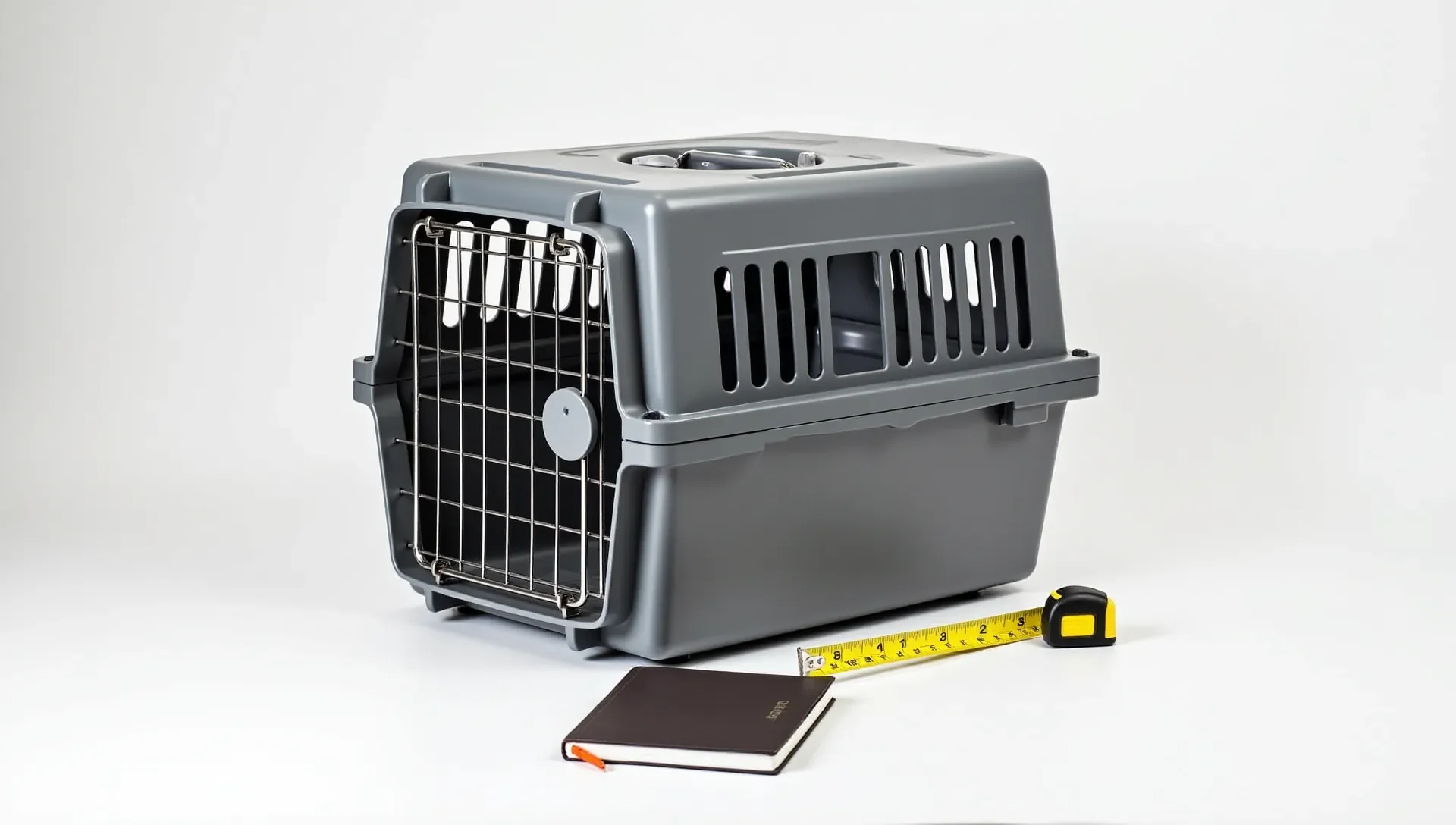
The IATA sizing rule: pet length (nose to tail base) plus half leg length equals minimum crate length. Pet height (standing, ears not pressed) plus 3 inches equals minimum crate height. Wire crates fail for air travel. Hard-sided rigid plastic with metal door and bolted halves is the only IATA-compliant choice.
Most US owners who get denied boarding at the cargo counter share the same story. They measured the dog roughly, ordered a "large" online because the size chart said large fit dogs up to 70 pounds, drove three hours to the airport, and watched a station agent tape an oversized "REJECTED" sticker on the crate while the dog panted on the floor. The crate was technically large. It was not IATA compliant for that particular dog, on that particular airline, on that particular route.
The International Air Transport Association publishes the Live Animals Regulations (LAR), and every commercial airline that moves pets in cargo follows it. The LAR sizing rule itself is a single paragraph. The reason owners fail is not the rule, it is the application: where exactly to measure from, which airline overlays a stricter rule on top, and which crate features the rule mentions in passing but station agents enforce strictly (the four-bolt door, the zip-tied nuts, the metal hardware only, the "no wheels" requirement at the gate).
This guide walks through the IATA sizing formula, shows the exact measurements to take on your dog, runs the math on a real 50 pound Labrador, and gives a 10-airline cheat sheet of crate rules so you can cross-check before you book. If you are looking for specific crate model recommendations after you know your size, our companion review at /best-pet-transport-crate/ ranks the top 10 IATA-compliant crates by build quality, price, and airline track record.
Flying a different carrier? Our guide to Hawaiian Airlines Pet Policy breaks down that airline's pet fees and rules.
Flying a different carrier? Our guide to Air Canada pet policy breaks down that airline's pet fees and rules.
You may also want our guide to Emotional Support Animal Flying.
For a deeper dive, see our guide to delta airlines pet policy in 2026: fees, cabin rules, and the cargo reality.
Related reading: alaska airlines pet policy in 2026: cabin fees, pet connect cargo, and restrictions.
If you are weighing your options, our guide to snub-nosed dog breeds and flying: which are banned and what to do instead goes further.
Flying a different airline? See our guide to Spirit Airlines Pet Policy.
A compliant crate matters even more on a multi-leg trip; see our guide to connecting flights with a pet for layover-specific planning.
IATA Live Animals Regulations: the 4 sizing rules every crate must meet
The relevant section is LAR Container Requirement 1 (CR1), which applies to dogs and cats traveling as cargo or checked baggage. The four sizing rules are simple in print and unforgiving at the counter.
Rule 1: Length. The crate's internal length must be at least equal to the animal's length from the tip of the nose to the root of the tail, plus half the length of the front leg measured from the elbow to the ground. In equation form: A + (B / 2) where A is nose-to-tail-root and B is elbow-to-floor.
Rule 2: Width. The crate's internal width must be at least equal to the animal's width across the shoulders multiplied by 2. The pet must be able to stand without touching either wall and turn around freely.
Rule 3: Height. The crate's internal height must allow the animal to stand in a natural position with the head erect and the ears not touching the top. IATA recommends at least 3 inches of clearance between the highest point of the head or ears and the top of the crate.
Rule 4: Posture. The animal must be able to stand, sit erect, turn around, and lie down in a natural position. If any one of those four postures requires the animal to crouch, the crate is non-compliant regardless of what the size chart says.
These four rules are the floor. Several US airlines have written internal policies that go further (extra width for snub-nosed breeds, weight-based caps, door-orientation requirements), and those are covered in the cheat sheet below.
Flying a different airline? See our guide to Allegiant Air Pet Policy.
The exact measurements you take on your dog
Get a soft tape measure, treats, and a second person to hold the dog. Take all three measurements with the dog standing on a flat surface, weight evenly distributed.
Measurement A: Length (nose to tail root). From the tip of the nose to the base of the tail where it joins the body. Do not include the tail. This is the single most-failed measurement because owners include the tail and end up oversizing, then later trim down to a "more reasonable" crate. The IATA tail-included error works in your favor; tail-excluded undermeasurement gets you denied.
Measurement B: Leg length (elbow to ground). With the dog standing, find the elbow joint of the front leg (where the upper foreleg meets the lower foreleg, roughly mid-chest level). Measure straight down from the elbow to the floor.
Measurement C: Height (top of head or ear tip to ground). With the dog standing naturally and head held in a normal position (not tilted down for a treat, not stretched up), measure from the floor to whichever is higher: the top of the head or the tip of the ear. For floppy-eared breeds (Labs, Spaniels, Beagles) measure to the top of the head. For prick-eared breeds (German Shepherds, Huskies) measure to the ear tip.
Measurement D: Width (across shoulders). Across the widest point of the shoulders. For most breeds this is at the front-leg attachment point.
Write all four down in inches. You will use A and B for length, C for height, D for width.
Calculating the crate size: formula + example for a 50 lb Lab
Let's run a real example. A 50 pound female Labrador Retriever, measurements taken:
- A (nose to tail root): 32 inches
- B (elbow to ground): 12 inches
- C (head to floor, standing): 22 inches
- D (shoulder width): 9 inches
Minimum internal length: 32 + (12 / 2) = 32 + 6 = 38 inches Minimum internal width: 9 × 2 = 18 inches Minimum internal height: 22 + 3 = 25 inches
Now compare to standard hard-sided crate sizes. The IATA-compatible numeric size system runs from 100 (smallest) to 700 (largest). A "500 series" crate typically has internal dimensions around 36 × 23 × 26 inches. Length 36 fails our minimum of 38. So a 500 series is too small for this Lab even though many size charts list 500 as "up to 70 lbs." The owner needs a 600 series (roughly 40 × 27 × 30 internal) to meet IATA length and clear the airline counter.
This is the gap that traps people. Crate manufacturer size charts are based on weight averages. IATA compliance is based on each individual dog's measurements. A long, lean dog at 50 pounds may need a 600. A stocky, compact dog at 60 pounds may fit a 500. Always measure, never trust the weight chart alone.
Crate type that's IATA-compliant (hard-sided rigid plastic only)
IATA CR1 specifies the construction: rigid plastic, fiberglass, metal, weld-mesh, solid wood, or plywood. In practice, every airline-approved crate on the consumer market is hard-sided rigid plastic with steel hardware. Three crate categories that you might own and that will get denied at the counter:
Wire crates (the collapsible folding kind for home use): not IATA-compliant. They flex under load, the bottoms are open tray-style, and they are explicitly listed as unsuitable in LAR.
Soft-sided carriers (mesh-walled, zipper-closed): not IATA-compliant for cargo or checked baggage. Soft-sided is only acceptable for in-cabin carriage, where the carrier rides under the seat in front of you. Different rule set entirely.
Plastic crates with plastic door latches: non-compliant. The door must be welded or cast metal with metal latches. Plastic latches fail vibration and pressure-cycling tests.
The compliant build looks like this: two-piece molded plastic shell (top and bottom halves), bolted together with metal nuts and bolts at every connection point (not plastic clips), a welded-steel-mesh front door with a spring-loaded metal latch that engages at top and bottom, ventilation openings on at least three sides (some airlines require all four), and "Live Animal" stickers with directional arrows. The seller might call it "airline approved." That phrase has no regulatory meaning. Look for "IATA CR1 compliant" or "meets IATA Live Animals Regulations" in the product description and verify the build features above.
10 US airlines' specific crate requirements (cheat sheet)
Each US airline has a pet policy page, and each layers airline-specific rules on top of IATA CR1. The table below summarizes the cargo and checked-baggage rules in effect for 2026. Always re-verify on the airline's site before booking, policies change without notice.
| Airline | Cargo program | Max weight (pet + crate) | Breed restrictions | Crate-specific notes |
|---|---|---|---|---|
| American Airlines | Cargo (priority pet) | 100 lbs combined | No brachycephalic dogs or cats in cargo | Hard plastic only, metal hardware, four sides ventilated, zip-ties on nuts required |
| United Airlines (PetSafe) | Cargo only since 2018 (no checked baggage) | Varies by route; 700-series typical cap | Brachy restrictions, no bully breeds | Two food/water dishes attached inside door, absorbent bedding mandatory |
| Delta Air Lines | Cargo (Delta Cargo) only, no checked baggage | No published combined cap, but station discretion | Brachy not accepted | Crate must allow stand-turn-lie-sit; four bolts per side; no wheels at gate |
| Alaska Airlines | Cargo (Pet Connect) + checked baggage on select routes | 150 lbs combined for cargo | No snub-nosed in summer heat embargo | One of the more lenient policies; checked-baggage option still available |
| Hawaiian Airlines | Checked baggage and cargo | 70 lbs combined for checked baggage; higher for cargo | Hawaii's pet quarantine rules layer on top | Direct release program requires 5 Day or Neighbor Island Inspection paperwork |
| Southwest Airlines | In-cabin only (no cargo, no checked) | Carrier 18.5 × 8.5 × 13.5 inches max | Pet must fit fully under seat | Soft-sided OK in cabin; no cargo program at all |
| JetBlue | In-cabin only | 20 lbs (pet + carrier) | Pet must fit under seat | No cargo or checked-baggage pet program |
| Frontier Airlines | In-cabin only | Carrier 18 × 14 × 8 inches max | Dogs, cats, rabbits, small household birds only | No cargo |
| Spirit Airlines | In-cabin only | Carrier 18 × 14 × 9 inches max, 40 lbs total | No exotic pets | No cargo |
| Allegiant Air | In-cabin only on domestic flights | Carrier 9 × 16 × 19 inches max | Domestic dogs/cats only | No cargo |
The takeaway: of the 10 largest US carriers, only four (American, United, Delta, Alaska) and the route-limited Hawaiian operate active cargo programs that accept dogs over the in-cabin weight ceiling. If your dog is over 20 pounds and you fly Southwest, JetBlue, Frontier, Spirit, or Allegiant, you need a different airline or a ground transport operator. See our deeper breakdowns at /american-airlines-pet-transport/ and /united-airlines-pet-transport/ for booking workflow, fees, and embargo windows.
Brachycephalic breed crate exceptions (extra height, ventilation)
Brachycephalic ("short-nosed") breeds include English and French Bulldogs, Boxers, Pugs, Boston Terriers, Pekingese, Shih Tzus, Bullmastiffs, and Persian and Himalayan cats. Their anatomy makes them prone to respiratory distress under heat or stress, and most US airline cargo programs refuse to carry them in cargo entirely. American, United, and Delta all maintain published brachycephalic no-fly lists.
If a carrier does accept a brachy breed (some smaller carriers and pet-specialty operators do), the crate rules tighten. IATA recommends a crate one size larger than CR1 would otherwise require, with ventilation on all four sides (not just three) and at least 4 inches of head clearance instead of 3. The reasoning is airflow: brachy breeds need more passive ventilation because they cannot pant efficiently to thermoregulate.
If you own a brachy breed and need to move them more than driving distance, ground transport is almost always the answer.
Cat crate specs (different rules, stricter ventilation)
Cats follow the same IATA CR1 sizing formula (length, width, height, posture rule), but the practical numbers are smaller. A typical 10 pound domestic shorthair fits a 200 series crate (roughly 27 × 20 × 19 internal). Larger breeds (Maine Coon, Ragdoll) may need a 300 (32 × 22 × 23).
Two cat-specific rules apply:
Ventilation on all four sides. Cats are required by most airlines to have four-sided ventilation (dogs typically need three). This is an LAR recommendation and an enforced rule at American and United cargo counters.
No twin compartments. Two cats from the same litter under 14 kg (about 30 lbs combined) can travel in one crate, but only if both can stand, turn, and lie down in their own space. Most owners find a single crate per cat is simpler and rejected less often.
Materials, ventilation, door type, fasteners (zip-tie the screws)
The door, hardware, and ventilation pattern are where compliant crates get rejected at the counter. Inspect these on your crate before you head to the airport.
Door: welded steel mesh, spring-latched, dual-locking at top and bottom. Single-latch doors get denied at American and United (both updated policies in 2020). The latch must engage when the door is shut without requiring a separate slide bolt.
Fasteners: the two halves of the crate must be bolted together with metal nuts and bolts at every position. Plastic snap-locks are not enough, even on crates sold as "airline approved." Replace plastic snaps with metal hardware (kits cost $5-15 at any pet store).
Zip-tie requirement: American Airlines and several others require nylon zip-ties through each metal nut after the crate is bolted shut, so the nuts cannot back out from vibration. Bring 8-12 zip-ties to the counter, you will install them in front of the agent.
Ventilation: at least three sides of the crate must have ventilation openings (four for cats and brachy breeds). The openings must total at least 14 percent of the wall area. Most CR1 crates from PetMate, SportPet, and Gunner meet this by default.
Wheels: if your crate came with wheels, remove them before checking the pet in. Wheels at gate or in-flight are explicitly prohibited; some airlines reject crates with even the wheel-mount holes if they look like load-bearing damage. Use a furniture dolly to move the crate through the terminal, then take the dolly with you.
No collar on the dog inside the crate. Choke and prong collars can snag on ventilation grates during turbulence. Take the collar off before loading.
The 6 features that aren't IATA-required but matter for dog comfort
IATA covers safety and survivability. The features below cover the dog's stress level on a long flight.
- Absorbent bedding: towels or a piece of fleece. Bedding pads marketed as "training pads" are required by some airlines for flights over 6 hours.
- Two attached dishes: one food, one water. The water dish should be the kind that attaches to the inside of the door so ground crew can refill it without opening the door.
- Solid back wall (no view): dogs are calmer when they can see out the door only, not on all sides. Crates with solid plastic on three sides outperform fully ventilated crates on stress markers.
- Familiar scent: an unwashed t-shirt the owner has worn for two days. Place under the bedding.
- Frozen water bowl: clip in a small dish of frozen water that melts during loading. Live water spills during taxi.
- Identification: "Live Animal" stickers, directional arrows, and a laminated card with the owner's name, destination phone, vet's phone, microchip number, and a recent photo of the pet. Tape to the top of the crate.
When to buy vs rent vs borrow
Buy if you fly the pet more than twice a year, if you have a senior or anxious dog (familiarity with the crate from home use reduces stress significantly; see our guidance on /pet-transport-for-senior-dogs/), or if your dog is an unusual size that needs a custom-fit purchase.
Rent if you are doing a one-time international move and the crate size will not be reused. Several pet-relocation operators include crate rental in their service quote. Rental rates run $50-150 for a multi-week rental.
Borrow only if the crate has been bought by someone who used it for a same-sized dog on an actual flight (so it has been counter-inspected and passed). Inherited crates from non-airline use often have plastic hardware substitutions that fail inspection.
For model-by-model picks across all size ranges, our companion review at /best-pet-transport-crate/ covers the 10 IATA-compliant crates we recommend in 2026. To compare crate rules across all major US carriers in a sortable format, our /tools/airline-pet-policy-comparison/ tool lets you filter by route, breed, and crate size.