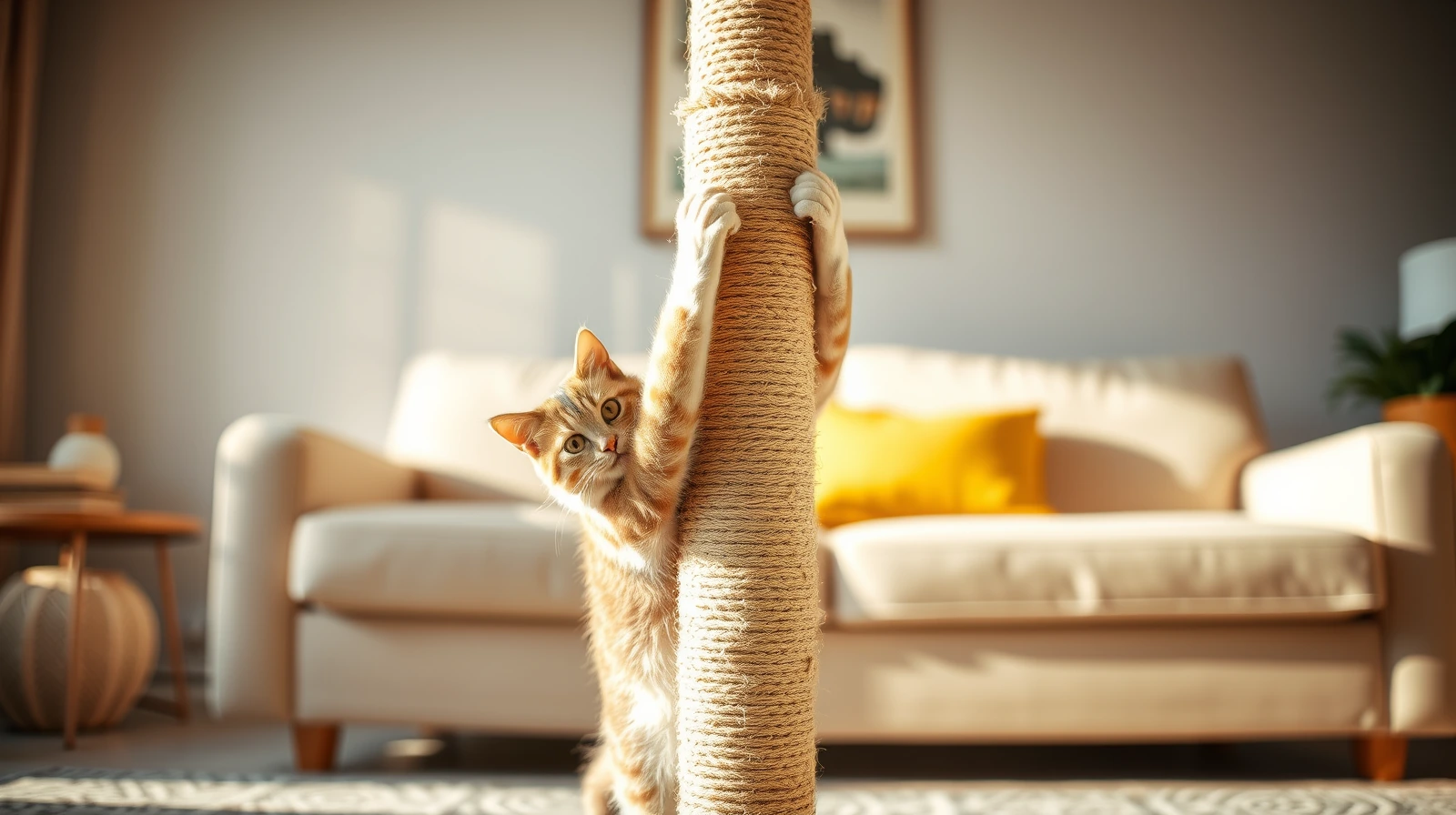
You cannot stop a cat from scratching, and you should not try. Scratching is healthy and necessary. The fix is redirection: give your cat better targets (tall, sturdy posts in the right spots), make the furniture unappealing, keep nails trimmed, and never punish.
If your couch arm is fraying and your favorite chair looks like it lost a fight, the instinct is to make the scratching stop. Here is the part most owners do not want to hear: you cannot stop a cat from scratching, and trying to is the wrong goal. Scratching is a normal, healthy, hardwired behavior. The realistic win is redirection: teaching your cat to take that behavior to surfaces you choose, while making your furniture a far less appealing option. Below is the approach that vet and feline-behavior authorities actually recommend, with no quick-fix gimmicks and no punishment.
For cat owners: our guide to Flying With a Cat in the Cabin.
Why cats scratch (and why you should not try to stop it)
Scratching is not your cat being spiteful or poorly behaved. According to the ASPCA, cats scratch for several built-in reasons at once: it removes the dead outer sheath of the claw and keeps nails healthy, it gives them a full-body stretch through the shoulders and back, and it marks territory both visually and with scent glands in their paws. Many cats also scratch as a way to release energy or relieve stress, which is why you often see a big stretch-and-scratch right after a nap or during play.
Because the behavior serves real physical and emotional needs, the goal is never elimination. The PetMD editorial team and the ASPCA both frame the task the same way: do not try to stop your cat from scratching, teach her where and what to scratch instead. Once you accept that, the whole problem becomes solvable.
It also helps to understand why cats so often pick the couch in the first place. From a cat's point of view, your sofa is close to ideal: it is sturdy enough to pull against without tipping, it sits in a busy part of the home where territory matters most, and its woven fabric shreds satisfyingly under the claws. In other words, your cat is not choosing the furniture to spite you. It is choosing it because it checks every box a good scratching surface should. The strategy that follows simply gives those same boxes to a target you approve of, then makes the furniture stop checking them.
For cat owners: our guide to How to Trim Cat Nails.
The core strategy: give your cat a better option
The single most effective move is providing scratching surfaces your cat actually prefers over your sofa. The ASPCA recommends offering a variety of posts in different materials and orientations, because cats have individual tastes: some like sisal rope, others prefer cardboard, carpet, jute, or bare wood. Some are vertical scratchers who rear up to claw, while others favor flat, horizontal surfaces.
Two qualities matter most for a vertical post. It needs to be tall enough for a full stretch (cat behaviorist Jackson Galaxy stresses that a cat should be able to stand on its hind legs and fully extend), and it needs a wide, heavy base so it does not wobble. If a post tips or rocks when used, the cat abandons it and the steady couch wins. For a deeper rundown of what to look for, see our guide to the best cat scratching posts, and if you want a vertical structure that doubles as climbing and napping space, our best cat tree picks cover sturdy options with built-in scratching surfaces.
Pay attention to your cat's natural style, too. A cat that rears up against the sofa wants a tall vertical post, while one that drags its claws across rugs and carpet usually prefers a flat, horizontal scratcher or an angled cardboard ramp. When in doubt, offer both. Behavior experts generally suggest having more scratching options than you think you need, especially in multi-cat homes, so that each cat has an appealing target in every room where it spends time. A single post for a whole house is often the quiet reason a redirection plan stalls.
For cat owners: our guide to How to Stop a Cat From Spraying.
Placement: put the post where the scratching already happens
Even a great post fails in the wrong spot. The most common mistake is tucking the post in a back corner of a spare room, far from where the cat actually wants to scratch. The fix is the opposite of subtle.
- Right next to the targeted furniture. If the cat is destroying the left arm of the couch, stand the post directly beside it as the legal alternative, then move it away by inches over weeks once the habit shifts.
- By sleeping and napping areas. Cats scratch when they wake up, so a post near beds, windowsills, and favorite napping spots gets used often.
- In social, prominent rooms. Because scratching is partly territorial marking, cats want to do it where the action is, not hidden away. The Humane Society notes posts belong in well-trafficked living areas, not isolated ones.
Make the post attractive
Once the post is in the right place, make it the more rewarding choice. The ASPCA suggests scenting posts with catnip, hanging toys on or near them, and playing around the post so the cat associates it with good things. Sprinkle catnip into the base or rub it on the surface, then praise or offer a small treat the moment your cat uses it. What you should never do, per the ASPCA, is grab your cat and force its paws onto the post: it frightens many cats and can teach them to avoid the post entirely. Let curiosity and reward do the work.
Make the furniture unattractive
While you are building the post habit, change the texture and scent of the furniture so it stops feeling good to scratch. These deterrents are temporary training aids, not permanent decor. The Humane Society of the United States and the ASPCA recommend covering the targeted area so the surface is no longer satisfying.
- Double-sided sticky tape (products like Sticky Paws are made for this). Cats dislike the tacky feel on their paws.
- Aluminum foil taped over the scratched zone, which most cats find unpleasant underfoot.
- Citrus or other cat-safe deterrent scents, since many cats avoid citrus smells.
- Furniture protectors, slipcovers, or vinyl guards on the corners and arms taking the damage.
- Upside-down vinyl carpet runner (knobby side up) on the floor where the cat stands to scratch.
The key is pairing deterrent with alternative: cover the couch arm AND stand an attractive post right beside it, so the cat has somewhere obvious to redirect.
Keep nails trimmed, and consider nail caps
Regular nail trims limit how much damage any scratching can do. PetMD suggests trimming every two to four weeks with a pet-safe clipper, taking off just the sharp tip and avoiding the pink quick. If your cat resists, go slowly, one or two nails per session, with treats.
For cats that still cause damage, vinyl nail caps (sold as Soft Paws and similar) are a humane add-on. As PetMD describes, these soft caps glue temporarily over the claws, blunting them without harming the cat, and typically last four to six weeks before they shed with the nail sheath. They are a useful stopgap, not a substitute for giving your cat proper posts.
Pheromones and stress reduction
Because some scratching is scent-marking driven by stress or insecurity, synthetic feline pheromone products such as Feliway can help. The idea, as PetMD explains, is that a pheromone spray or diffuser signals an area is already familiar and safe, which can reduce the urge to mark it by scratching. Pheromones work best as one part of a calmer environment rather than a standalone fix; our roundup of cat calming aids walks through diffusers, sprays, and supplements. If the scratching spiked after a household change, the trigger may be stress: our guides on introducing two cats and settling a cat into a new home address the social and environmental causes behind a lot of sudden scratching.
Reward, never punish
Yelling, swatting, or spraying your cat with water does not teach it where to scratch. It teaches the cat to fear you and to scratch when you are not watching. Worse, punishment raises stress, and since stress is itself a scratching trigger, it often makes the problem worse. Reward-based redirection is the consensus method across the ASPCA, PetMD, and the Humane Society. Here is the short version.
| Do | Do not |
|---|---|
| Offer tall, sturdy posts in several materials | Buy one short, wobbly post and call it done |
| Place posts beside the scratched furniture | Hide the post in a back room |
| Reward use with catnip, treats, and praise | Force the cat's paws onto the post |
| Cover targeted furniture with tape or foil | Rely on deterrents with no alternative nearby |
| Trim nails and consider soft nail caps | Yell, swat, or use a squirt bottle |
| Treat sudden scratching as a possible stress signal | Consider declawing |
Why declawing is not the answer
Declawing is not a nail trim and not a grooming convenience. As PetMD explains, declawing (onychectomy) is the surgical amputation of the last bone of each toe, anatomically equivalent to removing a human finger at the last knuckle. Veterinary research links it to chronic pain, lameness, litter-box avoidance, and increased biting. For these reasons the procedure is opposed by leading veterinary groups and is illegal or banned in many places, including a growing number of U.S. cities and states and numerous countries. The humane path is the one above: redirect the behavior, protect the furniture, and keep the claws your cat needs. With a good post in the right spot and a little patience, most owners see real change within a few weeks.
Can I completely stop my cat from scratching?
Why does my cat ignore the scratching post I bought?
Where should I put the scratching post?
How do I make the post more appealing than my couch?
How do I stop my cat from scratching a specific spot?
Do nail caps and trims actually help?
Will punishing my cat work?
Isn't declawing a simple solution?
Sources & references
- aspca.org https://www.aspca.org/pet-care/cat-care/common-cat-behavior-issues/destructive-scratching
- petmd.com https://www.petmd.com/cat/behavior/how-to-stop-cats-from-scratching-furniture
- petmd.com https://www.petmd.com/cat/general-health/risks-and-alternatives-to-declawing-cats
- humanesociety.org https://www.humanesociety.org/resources/cats-destroying-your-furniture-heres-how-stop-it
- jacksongalaxy.com https://www.jacksongalaxy.com/blogs/news/scratching