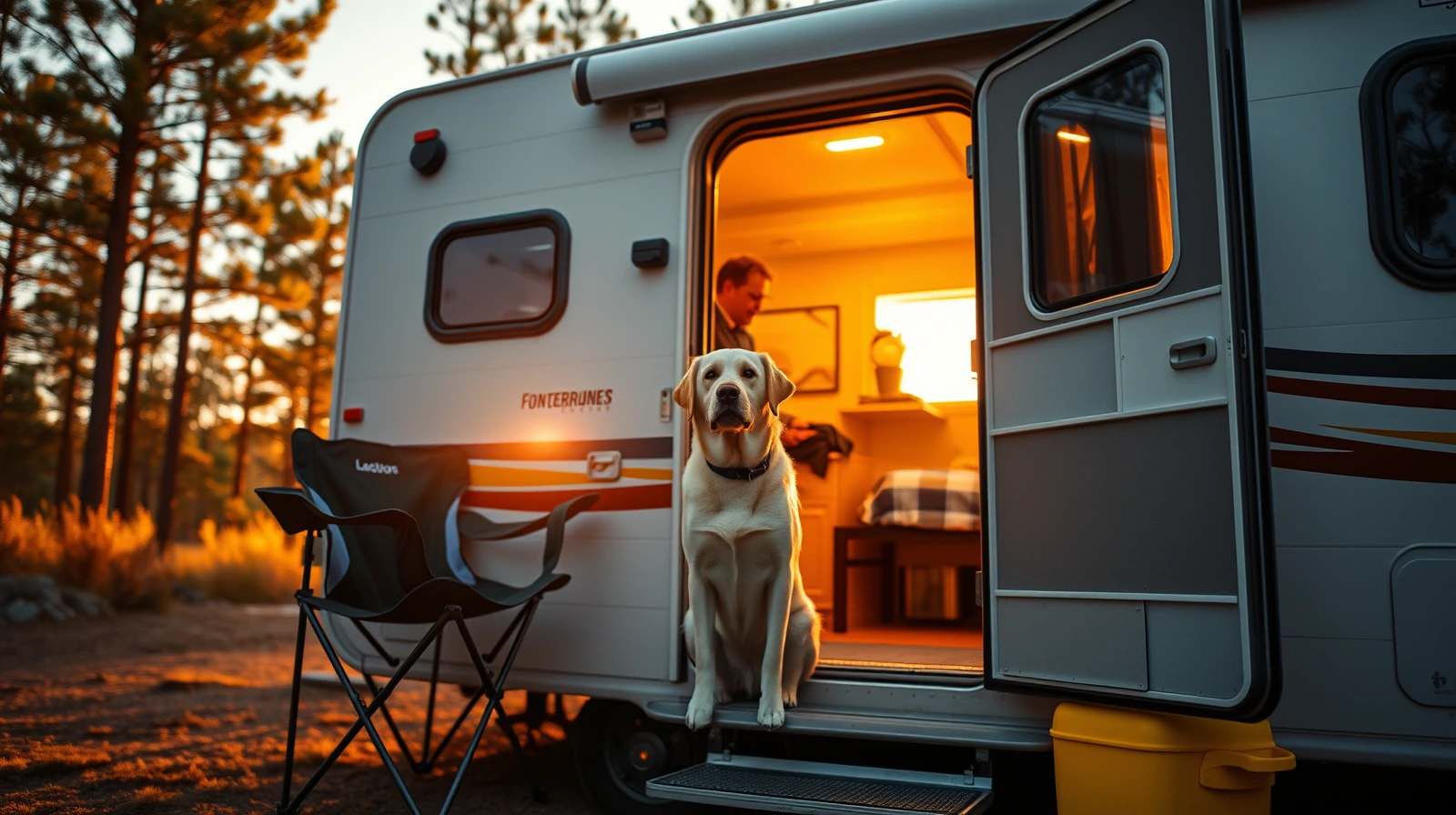
Restrain your dog in a crash-tested crate or harness while the RV moves, never leave it in a parked RV without working climate control, and monitor the interior temperature remotely. Plan frequent stops, pack water and ID, get a vet check before a long trip, and confirm each campground's pet rules in advance.
An RV promises the best of both worlds for a dog owner: your pet stays with you instead of boarding, and you both get to roam. But an RV is still a moving vehicle and a sealed metal box, which means the same two risks that make road trips dangerous for dogs, an unrestrained animal in a crash and a parked vehicle that overheats, are amplified. This guide walks through how to keep your dog safe and comfortable on the road, at camp, and everywhere in between, with a pre-trip checklist and packing list at the end.
If the dog riding along is a task-trained service animal rather than an ordinary pet, a few extra considerations apply; see our service dog road trip guide.
Restrain your dog while the RV is moving
A loose dog in a moving RV is a hazard to itself and to you. In a sudden stop or collision, an unsecured dog becomes a projectile, and even routine braking can throw a pet off a dinette bench or out of a loft bed. The American Kennel Club recommends that your dog travel either in a secured crate or attached to a dog-safe seat belt, and notes that a kennel is generally the safest option because it offers the most protection in an accident or hard stop (AKC).
If you prefer a harness, choose a crash-tested model and clip it to a proper anchor point, not a decorative loop. The same restraint logic applies in an RV as in a passenger car, so the gear and fit standards carry over directly. Our guide to the best crash-tested dog car harness covers what independent testing actually validates, and our overview of how to transport a dog in a car explains crate versus harness trade-offs in more depth.
One rule is non-negotiable: never let your dog ride in a towed trailer or in the towed portion of a fifth-wheel while you drive. The AKC warns that a towed unit can become dangerously hot and fill with exhaust, and you have no way to monitor or reach your dog back there. Your pet rides up front with you, restrained, where you can see it.
The cardinal rule: never leave a dog in a parked RV without climate control
This is the single most important point in the entire guide. A parked RV heats up the same way a parked car does, and the numbers are sobering. The American Veterinary Medical Association reports that a vehicle's interior can climb about 20 degrees Fahrenheit in 10 minutes and roughly 30 degrees in 20 minutes, so on a mild 70-degree day the inside can pass 110 degrees within an hour (AVMA). Cracking a window does not meaningfully slow that rise, and the AVMA notes that hundreds of pets die every year from heat in parked vehicles (AVMA).
The AKC echoes this directly: never leave a dog in an RV or motorhome that is completely closed up, even with the generator and air conditioning running, and once temperatures top about 80 degrees, heatstroke becomes a real and potentially fatal risk (AKC). Heatstroke can develop in minutes, and any dog showing signs needs immediate veterinary care even if it seems to recover after cooling. If you cannot guarantee continuous, monitored climate control, the dog comes with you or does not get left behind. For the underlying science on safe thresholds, see our explainer on how hot is too hot for a dog in a car.
Keeping the RV cool and monitored
If you ever step away from the RV with your dog inside, redundancy is the goal. Air conditioning is the baseline, but A/C and generators can fail, trip a breaker, or run out of fuel. Go RVing recommends pairing climate control with a dedicated pet temperature monitor so you get an alert on your phone the moment the interior climbs (Go RVing).
These monitors come in two broad types. Cellular units cost more and usually need a subscription, but they alert you over the mobile network and do not depend on your RV's Wi-Fi staying up. Wi-Fi monitors are cheaper and simpler but only work while that local network holds. Confirm current models and pricing before you buy, since the category changes quickly. Beyond a monitor, practical cooling steps include parking in shade or facing away from direct sun, running roof vent fans for cross-ventilation, using reflective window shades, and leaving plenty of fresh water. Whatever you set up, also notify a neighbor or the campground office and leave an emergency contact number, as Go RVing advises.
Routine, feeding, water, and frequent stops
Dogs settle better when their daily rhythm survives the trip. Try to keep feeding times close to home schedule, and feed lighter on travel days to reduce the chance of an upset stomach. Keep fresh water available at camp and bring a spill-resistant option for the road; a dog travel water bottle makes roadside hydration easy without soaking the RV floor.
Plan to stop often. The AKC recommends frequent breaks so your dog can stretch, relieve itself, and drink (AKC). A common rhythm is a stop every two to three hours, adjusted for puppies, seniors, and dogs with smaller bladders. Always leash your dog before opening the RV door at a rest area or fuel stop, since an excited dog bolting into a parking lot is a real risk. For more on building a comfortable travel cadence, see our road trip with a dog guide.
ID, microchip, vaccination records, and a pre-trip vet visit
A dog is most likely to slip away in unfamiliar territory, so layered identification matters more on the road than at home. Make sure your dog wears a collar with a current ID tag, that its microchip registration lists a phone number you will actually answer while traveling, and that you carry a recent photo on your phone in case you need to make a lost-pet flyer fast.
Before any long trip, schedule a vet visit. Confirm vaccinations are current, ask whether your destinations have region-specific risks such as ticks or heartworm exposure, and carry a copy of vaccination records, since many campgrounds and some state lines ask for proof of rabies vaccination. The AKC also flags warm-weather precautions worth reviewing before you go (AKC). This is also the moment to discuss any chronic conditions and to refill medications so you are not hunting for a pharmacy mid-trip.
Motion sickness and travel anxiety
Some dogs get carsick or anxious in a swaying, rumbling RV, especially on early trips. Signs include drooling, lip-licking, whining, restlessness, and vomiting. You can ease the transition by feeding lightly before driving, giving the dog a clear view forward where possible, keeping the cabin cool and ventilated, and taking short practice drives before committing to a multi-day haul.
If your dog struggles with the motion or the noise, ask your veterinarian about options; there are prescription anti-nausea medications made for dogs, and a vet can advise on what fits your pet. For broader strategies on calming a nervous traveler, our piece on dog car anxiety covers desensitization and comfort tactics that apply equally to an RV.
RV park and campground pet rules
Pet policies vary widely from one park to the next, and assuming is how trips go sideways. Common rules include a strict leash requirement (often six feet, no retractable leashes), a cap on the number of dogs per site, designated pet relief areas, and breed or size restrictions at some private parks. Many parks also prohibit leaving a dog unattended at the site, including tied outside the RV, because of barking, escape, and weather risk.
Call ahead or check the park's website to confirm current pet rules before you book, and clean up after your dog every time. Go RVing's guidance for new owners traveling with pets is a useful starting point for what most parks expect (Go RVing). When you plan stops, look specifically for pet-friendly campgrounds and dog-welcoming trails or beaches near your route, rather than discovering restrictions after you arrive.
Pre-trip checklist and packing list
Run through this before you pull out of the driveway. Verify the safety items first; the comfort items can be topped up on the road.
Pre-trip checklist
- Vet visit completed, vaccinations current, medications refilled
- Microchip registration updated with a phone you will answer on the road
- Collar with current ID tag fitted, recent photo saved to your phone
- Crash-tested crate or harness installed and a secure anchor point confirmed
- Pet temperature monitor installed and tested, alerts reaching your phone
- Generator and A/C checked, fuel topped off, vent fans working
- Each campground's pet rules confirmed (leash, breed limits, unattended policy)
- Pet-friendly stops and emergency vet locations identified along the route
- Copy of vaccination records packed (digital and printed)
Packing list
| Category | Items |
|---|---|
| Safety and restraint | Crash-tested crate or harness, anchor straps, temperature monitor, reflective window shades |
| Food and water | Regular food in a sealed container, collapsible or spill-resistant bowls, travel water bottle, extra water for hot days |
| Health and ID | Medications, vaccination records, first-aid supplies, recent photo, backup ID tag |
| Comfort and outdoors | Familiar bed or blanket, favorite toy, six-foot leash, waste bags, towel, cooling vest for hot climates |
In genuinely hot weather, a dog cooling vest can take the edge off during midday walks and shaded camp time, though it is a supplement to shade and water, never a substitute for proper climate control.
The bottom line
Traveling with a dog in an RV is very doable when you treat the two big risks seriously: keep your dog restrained in a crate or crash-tested harness while you drive, and never leave it in a parked RV without monitored, working climate control. Add frequent stops, current ID, a vet check, and a quick call to confirm each park's pet rules, and you have the foundation for a safe trip. Always confirm current temperature monitor models, medications, and campground policies before you depart, since these change over time.
Can my dog ride loose in the RV while it is moving?
Is it ever safe to leave my dog alone in a parked RV?
How hot is too hot inside an RV for a dog?
Do I really need a pet temperature monitor?
How often should I stop on a long RV drive with a dog?
What documents should I bring for my dog?
What if my dog gets carsick in the RV?
What pet rules do RV parks usually have?
Sources & references
- akc.org https://www.akc.org/expert-advice/travel/rv-travel-dog/
- gorving.com https://www.gorving.com/tips-inspiration/expert-advice/top-10-tips-new-rv-owners-traveling-pet
- gorving.com https://www.gorving.com/tips-inspiration/expert-advice/pet-safety-monitoring-while-rving
- avma.org https://www.avma.org/resources-tools/pet-owners/petcare/pets-vehicles
- avma.org https://www.avma.org/resources-tools/pet-owners/petcare/hot-cars-and-loose-pets
- akc.org https://www.akc.org/expert-advice/health/summer-safety-tips-for-dogs/