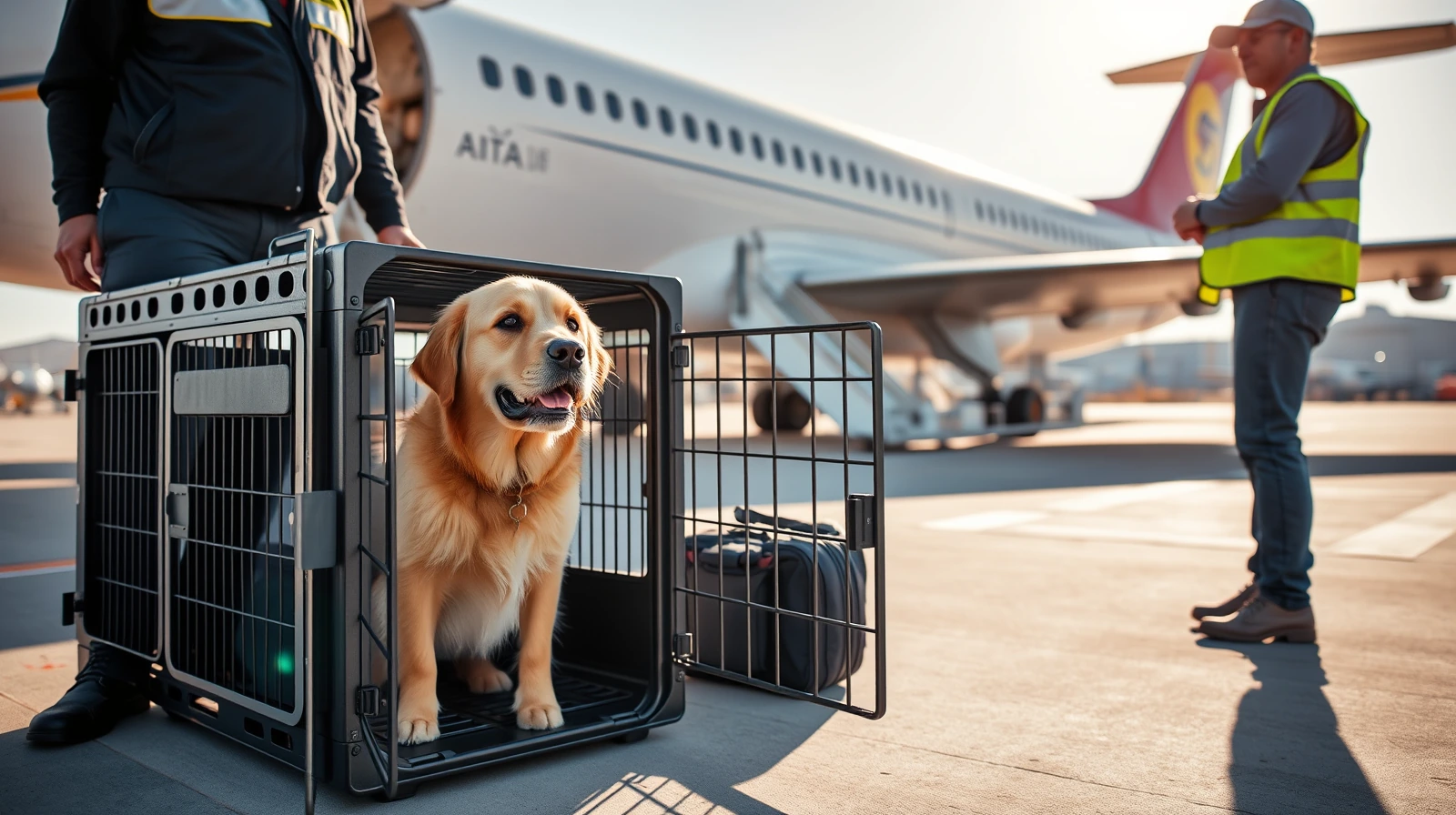
Emirates does not carry pet dogs or cats in the cabin. Only falcons on select routes and trained assistance dogs (route-dependent) are allowed in the cabin. Pet dogs and cats fly as checked baggage in the temperature-controlled hold or as manifest cargo through Emirates SkyCargo. Confirm current rules with Emirates before booking.
Emirates does not carry pet dogs or cats in the cabin. According to Emirates, the only animals allowed in the cabin are falcons on select routes and trained assistance dogs (route-dependent). Pet dogs and cats fly as checked baggage in the temperature-controlled hold or as manifest cargo through Emirates SkyCargo. Confirm current rules with Emirates before booking.
That single fact reshapes how you plan a trip with a dog or cat on Emirates. There is no carrier-under-the-seat option for ordinary pets, so every booking comes down to two paths: checked baggage on a passenger flight you are also travelling on, or a SkyCargo shipment that moves independently of you. This guide decodes which path fits, what each costs in rough terms, the snub-nosed and heat rules that can stop a booking, and the extra paperwork Dubai entry adds. Airline policies and fees change often, so treat every figure here as a starting point and verify directly with Emirates and Emirates SkyCargo before you commit.
Related reading: Virgin Atlantic Pet Policy.
Why there are no cabin pets on Emirates
Many carriers let small dogs and cats ride in the cabin in a soft carrier under the seat. Emirates does not. According to Emirates' travelling-with-pets pages, ordinary pets are not permitted in the passenger cabin on any route. The famous exception is the falcon, which can travel in the cabin on certain Middle East routes with its own falcon passport, and that exception is often misread as "Emirates allows pets in the cabin." It does not apply to dogs or cats.
The only dogs that may enter the Emirates cabin are trained assistance dogs, and even that is route-dependent and subject to advance approval and documentation. If you rely on an assistance dog, contact Emirates well ahead of travel to confirm the route qualifies. For every other dog or cat, the two real options are checked baggage or SkyCargo, both of which place the animal in a heated, ventilated, pressurised hold compartment rather than the cabin.
If cabin travel is a hard requirement for your pet, an Emirates booking is not the right tool, and you may want to compare the trade-offs in our explainer on pet cargo versus in-cabin travel or look at carriers with broader cabin policies, such as the options covered in our Lufthansa pet transport guide.
Checked baggage vs SkyCargo: which path is yours
The first decision is structural. Checked baggage means the pet travels in the hold of the same passenger flight you are on, booked as an add-on to your ticket. SkyCargo means the pet ships as freight on its own air waybill, managed through Emirates' cargo division, often arranged via a licensed pet shipper. They differ on who can book, what crate sizes are allowed, where you collect the animal, and price.
| Factor | Checked baggage (hold) | Emirates SkyCargo (manifest) |
|---|---|---|
| Who travels | You must be on the same flight | Pet ships independently; you need not fly |
| Booking | Add-on to your passenger ticket | Air waybill, usually via a pet shipper or agent |
| Crate size limit | Smaller, capped by aircraft hold door | Larger crates and giant breeds accepted |
| Typical rough cost | About $650 to $800 USD, weight-based | About $1,500 to $5,000 USD, route and size based |
| Collection | Oversize/baggage area at arrival | Dedicated cargo terminal, customs clearance |
| Best for | One pet, you are flying, standard crate | Large dog, multiple pets, you are not flying, or strict import route |
As a rule of thumb, if you are flying Emirates yourself with one normally sized dog or cat, checked baggage is usually cheaper and simpler. If your animal is large, if you are shipping multiple pets, if you are not travelling, or if the destination (Dubai included) requires manifest cargo for import clearance, SkyCargo is the route. Some destinations and breeds force SkyCargo regardless of preference, so confirm the requirement for your specific route with Emirates before assuming you can use checked baggage.
Snub-nosed breeds and the heat embargo
This is the section most likely to change your plans, so read it before you book anything. Snub-nosed (brachycephalic) dogs and cats have compressed airways that make air travel in a cargo hold riskier, especially in heat. Airlines apply restrictions on these breeds as a welfare measure, not as an arbitrary rule. Emirates is among the carriers that limit or refuse brachycephalic animals, and the policy has both a seasonal and a temperature component.
According to Emirates' published pet guidance, snub-nosed breeds are commonly subject to a seasonal acceptance window (often quoted as roughly November 1 to April 30) and are refused when temperatures are forecast to exceed about 29C (85F) at the origin, any transit point, or the destination. Emirates does not transport English Bulldogs or French Bulldogs at any time of year. Treat the dates and temperature threshold as indicative and confirm the current values with Emirates for your exact travel dates, because these windows shift.
Breeds commonly classed as snub-nosed
Airlines, Emirates included, publish their own breed lists, and the lists vary slightly. The breeds below are widely treated as brachycephalic across carriers. This is a neutral welfare classification, not a comment on any individual animal's health.
- Dogs: Boxer, Boston Terrier, Pug, Shih Tzu, Lhasa Apso, Pekingese, and Bulldogs (English and French Bulldogs are not carried at all).
- Cats: Persian, Himalayan, Exotic Shorthair, Scottish Fold, and Burmese.
When a permitted snub-nosed breed is accepted, Emirates may require a crate one size larger than the animal would otherwise need, to give extra ventilation and room, plus a signed indemnity waiver acknowledging the elevated risk. Getting the crate right matters here; our guide on how to choose a pet transport crate covers IATA-compliant sizing, and you can read more on the breed rules generally in our piece on the snub-nosed dog breed flying restrictions. Always confirm the exact crate requirement and any waiver with Emirates before travel.
Emirates pet fees: rough ranges
Emirates charges for pets by weight (animal plus crate) for checked baggage, and by a route-and-size based rate for SkyCargo. The figures below are approximate market ranges to help you budget, not quoted prices. Actual charges depend on your route, the season, the crate dimensions, and the total weight, and they change. Get a firm quote from Emirates or your pet shipper before booking.
| Method | Weight or basis | Rough cost (USD) | Notes |
|---|---|---|---|
| Checked baggage | 24 to 32 kg (pet + crate) | ~$650 | Per direction; you must be on the flight |
| Checked baggage | Over 32 kg (pet + crate) | ~$800 | Heavier band; larger crates |
| SkyCargo (manifest) | Route + size based | ~$1,500 to $5,000 | Higher end for long-haul, giant breeds, multiple pets |
Beyond the airline charge, budget for the crate itself, a pre-travel veterinary health certificate, any import permit, and a pet shipper's fee if you use one. For international moves, those extras frequently add up to as much as or more than the flight, so it pays to model the whole journey. Our breakdown of international pet shipping costs lays out the full line items, and broader planning lives in our pet relocation guide. Confirm all current figures with Emirates and the relevant authorities before booking.
Crate, health and documentation basics
Whichever path you take, the crate must meet IATA Live Animals Regulations: rigid construction, secure metal-bolted door, ventilation on multiple sides, leak-proof floor, and enough room for the animal to stand, turn around, and lie down naturally. Emirates can refuse an animal whose crate does not comply, so do not improvise with a soft carrier or a household kennel for hold travel.
On the health side, you will generally need a current rabies vaccination, a veterinary health certificate issued within the destination country's accepted window, and, for many routes, microchip identification. Requirements are set by the destination government, not by Emirates, so the airline carrying your pet does not exempt you from import rules. For United States departures, check current export and certificate steps with USDA APHIS Pet Travel, and cross-check airline acceptance against the IATA pet travel guidance. Confirm the exact paperwork and timing for your route before you fly.
Flying a dog or cat to Dubai (UAE entry)
If your destination is Dubai or anywhere in the United Arab Emirates, there is an extra layer. The UAE requires an import permit issued by the Ministry of Climate Change and Environment (MOCCAE) before the animal arrives, and pets generally must enter as manifest cargo through SkyCargo rather than as checked baggage. That means a cargo-terminal collection and customs clearance, and it usually means working with a licensed handler at the Dubai end.
The MOCCAE permit has its own validity window and documentation list (vaccination records, microchip, health certificate), and certain breeds are banned from import into the UAE entirely. Because the permit, the cargo requirement, and the breed rules interact, a Dubai move is one of the clearest cases for using a professional shipper. We cover the full step-by-step in our dedicated pet transport to Dubai guide. Always verify the current MOCCAE import requirements with the UAE authority before booking, as import rules are updated frequently.
Who should use a pet shipper
A licensed pet shipper books the air waybill, supplies a compliant crate, handles export and import paperwork, and arranges airport-to-airport or door-to-door logistics. For a straightforward checked-baggage trip where you are flying with one healthy, non-snub-nosed pet on a simple route, you can often arrange it yourself with Emirates directly. A shipper earns its fee when complexity rises.
- The move requires manifest cargo (most UAE/Dubai imports and many long-haul routes).
- Your dog is a large or giant breed that exceeds checked-baggage crate limits.
- You are shipping a permitted snub-nosed breed and need the upsized crate and waiver handled correctly.
- You are not travelling on the same flight as your pet.
- The destination has strict permits or quarantine steps you do not want to manage alone.
Membership of the International Pet and Animal Transportation Association (IPATA) is a reasonable baseline when vetting a shipper. You can verify members through the IPATA directory. Get written quotes from at least two shippers and confirm exactly which steps are included before you commit.
How we sourced this
This guide synthesises Emirates' own travelling-with-pets and SkyCargo guidance, IATA Live Animals Regulations, USDA APHIS pet-travel requirements for US departures, and the UAE's MOCCAE import-permit framework, alongside typical market fee ranges for checked-baggage and manifest pet shipments. Airline fees, seasonal embargo dates, breed lists, and country import rules all change, sometimes at short notice. We have hedged every figure and flagged where you must verify. Always confirm current requirements and prices directly with Emirates, Emirates SkyCargo, and the destination authority before booking.
Can my dog or cat fly in the Emirates cabin?
How much does it cost to fly a pet on Emirates?
Does Emirates carry snub-nosed breeds?
What is the difference between checked baggage and SkyCargo?
What do I need to fly a pet to Dubai on Emirates?
Do I have to be on the same flight as my pet?
What kind of crate does Emirates require?
Should I use a pet shipper for Emirates?
Sources & references
- emirates.com https://www.emirates.com
- skycargo.com https://www.skycargo.com
- aphis.usda.gov https://www.aphis.usda.gov/pet-travel
- iata.org https://www.iata.org/en/programs/cargo/live-animals/pets/
- ipata.org https://www.ipata.org