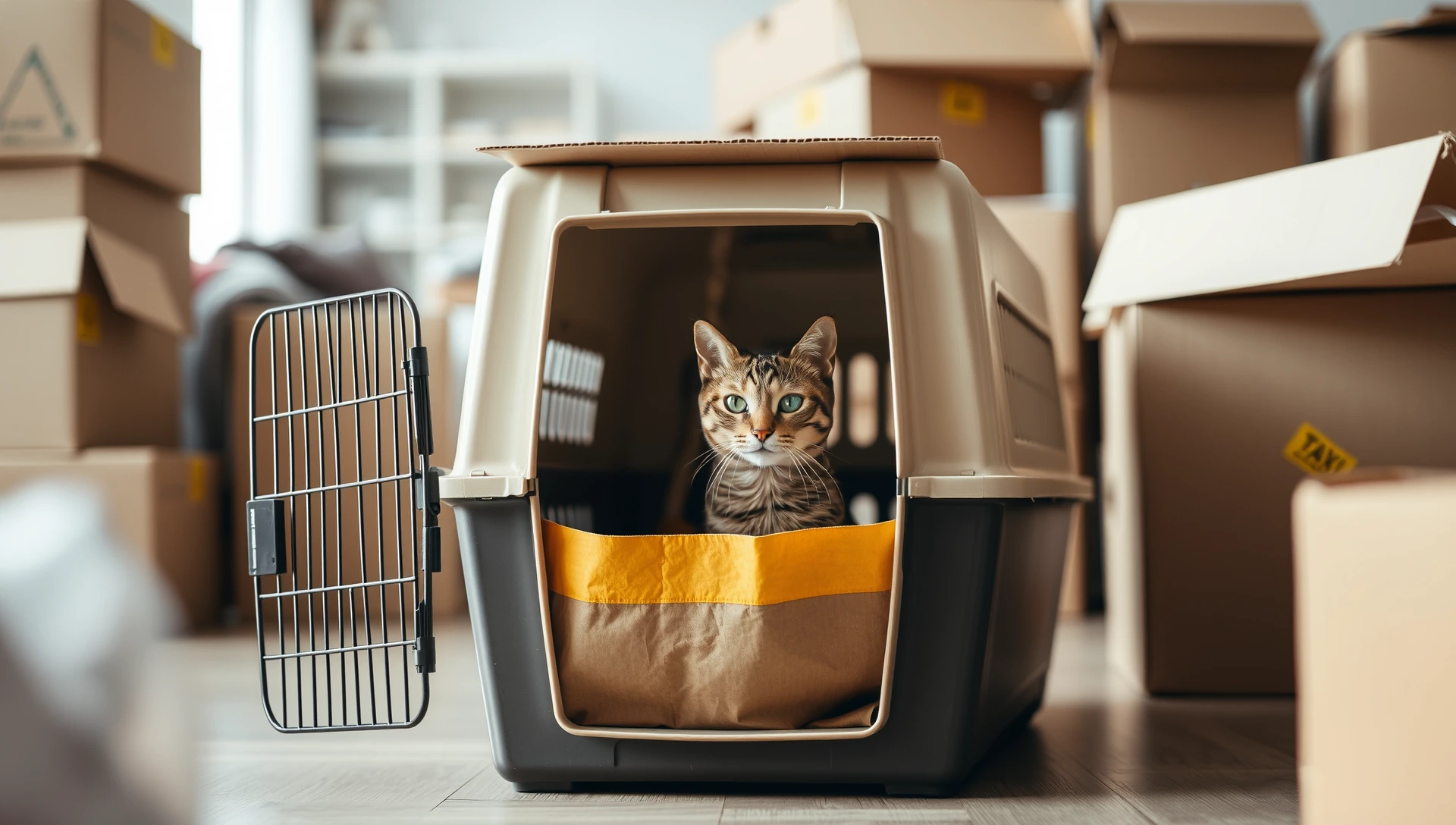
Moving with a cat goes best when you plan ahead. Acclimate the carrier for weeks, update the microchip, confine your cat on moving day so it cannot bolt, secure the carrier in the car, then use a single safe room and keep an indoor cat inside for several weeks before any outdoor access.
Cats are creatures of territory and routine, so a house move can rattle even the most easygoing feline. The good news is that most of the stress is preventable with a plan that starts weeks before the truck arrives and continues for a few weeks after you unpack. This guide walks the whole move: before, during, and after. If you are looking specifically for the settling-in steps once you have arrived, our companion piece on how to introduce a cat to a new home goes deeper on that final stage.
If travel is part of your plans, learn how far in advance to book a cat sitter so you are not scrambling for care at the last minute.
For cat owners: our guide to How to Bathe a Cat Safely, Step by Step.
Moving a dog instead of a cat changes the details; see moving to another state with a dog for the canine version.
For an international move rather than a domestic one, see our guide to moving abroad with a cat.
Military families moving a cat on orders should also read a PCS with a cat.
Start weeks ahead: the prep that prevents panic
The single biggest predictor of a calm move is preparation. International Cat Care notes that planning ahead helps the transition go smoothly and lowers the risk of your cat feeling anxious about the change. Aim to begin two to four weeks out where you can, and longer if your cat is nervous or you are moving a long way.
For cat owners: our guide to How to Keep Cats Off Counters.
Book a vet visit and gather records
The ASPCA recommends a checkup before any move so your veterinarian can confirm vaccinations are current, discuss anxiety management, and issue any paperwork you may need. Ask for a copy of your cat's medical records and a few weeks of any regular medication. If you are crossing state lines or flying, ask whether a health certificate is required, since timing rules vary. This is also the moment to ask your vet about calming options for a cat that travels badly.
For cat owners: our guide to How to Stop a Kitten From Biting.
Update the microchip and ID before, not after
An escaped cat is the worst-case scenario of a move, and it is most likely in the chaotic window around moving day. Update your microchip registration with your new address and current phone number ahead of the move, and refresh any collar ID tag. A microchip only helps if the contact details on file are correct, so do not leave this for the unpacking week.
Acclimate the carrier over several weeks
Most cats only see the carrier right before a vet trip, which teaches them to dread it. Reverse that association by leaving the carrier out as ordinary furniture. The common veterinary approach is gradual: set it out open with a familiar blanket inside, add treats and meals near it, then inside it, and eventually feed with the door closed for short periods. Our step-by-step walkthrough on how to get a cat into a carrier covers the full desensitization sequence. A cat that already finds the carrier safe is far easier to load on moving day.
Plan the calm room and try pheromones
Decide now which room your cat will retreat to while you pack and on moving day. International Cat Care suggests confining your cat to one room with its carrier, bed, food and water bowls, scratching post, and litter tray, since these familiar resources offer reassurance. Synthetic feline facial pheromone products, sprayed in the carrier or plugged in near the calm room, are widely used to ease transport and new-environment stress. Research summarized by veterinary sources suggests they can help some cats, though they work best alongside a secure, familiar setup rather than on their own.
Moving day: keep your cat confined and safe
Moving day is loud, doors stand open for hours, and strangers come and go. The ASPCA advises keeping your cat in a quiet closed room or at a friend's house so a frightened cat cannot dash out while movers load the truck. Both options are valid: pick whichever lets your cat stay calmest and safest.
- Set up the calm room early with food, water, litter, and a sign on the door so no one opens it.
- If boarding for the day, drop your cat off the night before or first thing so the home is empty of helpers when you collect them.
- Put your cat in the secured carrier before the last furniture leaves, so the room emptying around them does not trigger a bolt.
- Carry the carrier yourself rather than leaving it with movers, and never let a cat ride loose in a vehicle.
A cat loose in a car can wedge under a pedal or panic and injure itself, so the carrier stays closed for the entire drive. International Cat Care recommends placing the carrier in a rear footwell or on the back seat, secured with a seatbelt, and covering it with a light blanket to reduce visual stress.
The journey: car travel basics for cats
For most local and regional moves you will drive, and a calm carrier setup does most of the work. Keep the cabin cool and quiet, avoid loud music, and resist the urge to open the carrier to comfort your cat, which only invites an escape. Many cats settle faster in a covered carrier than they would loose on a lap.
The most important rule is one you cannot bend: never leave a cat alone in a parked car. Temperatures inside a vehicle climb dangerously fast even on mild days, and heatstroke can be fatal. If you must stop, park in shade, keep the trip short, and take the carrier with you when practical.
Long drives: food, water, and litter stops
On a multi-hour or multi-day move, offer water at stops and a small meal if your cat will eat, though many cats decline food while anxious, which is normal for a short trip. For overnight stops, a soft-sided travel crate or a quiet motel room lets your cat use a portable litter tray and stretch in a contained space. Withhold a large meal right before driving to reduce car sickness. For the deeper mechanics of in-car travel, see our guide to traveling with a cat in a car.
If you are flying with a cat
For a cross-country or overseas move, flying may be unavoidable. In-cabin travel, where the cat rides in an airline-approved soft carrier under the seat, is generally less stressful than cargo when your cat meets the size limits. Book early, confirm the airline's pet policy and carrier dimensions, and have the health certificate ready within the required window. Long-haul and international moves carry extra rules and timelines, which we cover in our pieces on long-distance cat transport.
Arrival: the safe-room method
Resist the temptation to let your cat explore the whole house at once. The ASPCA and the San Francisco SPCA both recommend starting your cat in a single room as a home base, stocked with its litter box, food and water, bed, and favorite toys. A whole new house is overwhelming territory to map; one room is manageable. Set the carrier down open in that room and let your cat emerge on its own schedule.
Keep your cat in this safe room for at least the first several days, longer if your new home is large or your cat is shy. Spend quiet time in there, but let the cat set the pace. When it is eating, using the litter box, and moving around the room confidently, you can begin opening the door to the rest of the house.
The 3-3-3 rhythm of adjustment
Shelters often describe a rough 3-3-3 pattern: the first three days are about decompressing and hiding, the first three weeks are about learning the new routine, and the first three months are about truly feeling at home. Treat these as loose guideposts, not a schedule. Every cat moves on its own timeline, and a confident cat may speed through while an anxious one needs longer. The point is to expect a settling-in period rather than instant normalcy.
Open the house gradually
Introduce the rest of the home one room or area at a time, keeping some doors shut so your cat is never flooded with too much space. Add scratching posts, hideaways, and a perch or two so the new territory feels claimable. Keep the litter box in a consistent, accessible spot, and do not move food and water far from where your cat first found them.
Keep an indoor-outdoor cat inside for several weeks
If your cat has outdoor access, this is the rule that prevents heartbreak: keep them strictly indoors after the move before allowing any time outside. Veterinary and welfare sources commonly advise a confinement period of at least two to four weeks, and sometimes longer, so the cat firmly bonds the new house as home base. A cat let out too soon may try to navigate back toward the old territory and get lost. When you do allow outdoor access, start with short supervised sessions before a meal, so hunger draws your cat back in.
Watch for stress signs, and special cases
Some hiding, reduced appetite, and clinginess are normal in the first days. Watch for signs that cross into a problem: refusing food for more than a day or two, no urination or bowel movements, persistent hiding well beyond the first week, over-grooming, or litter box accidents that do not resolve. The Cornell Feline Health Center and your own veterinarian are the right resources when stress behaviors linger or worsen. A cat that stops eating, in particular, can develop serious liver problems, so a prolonged hunger strike warrants a call to the vet rather than a wait-and-see.
- Multiple cats: give each cat its own safe room if possible, since a stressful move can spark squabbles even between bonded cats. Reintroduce them slowly rather than assuming they will pick up where they left off.
- Long-distance and overnight moves: map your stops, pack a portable litter setup, and never leave the cat in the car. See our long-distance transport guidance for the logistics, and our broader rundown on moving across states with multiple pets if you have a full household.
- Moving with a dog too: dogs settle differently, and our piece on helping a dog adjust to a new home pairs well with this one for a mixed-pet household.
- International moves: these involve quarantine rules, import permits, and tight paperwork windows that vary by destination, so start months ahead and work from official requirements.
Quick phased checklist
| Phase | Key actions |
|---|---|
| Weeks before | Vet checkup and records, update microchip and ID, acclimate the carrier, pick the calm room, try pheromones |
| Moving day | Confine to a closed room or board for the day, load the secured carrier before the last furniture leaves, carry it yourself |
| The journey | Carrier secured and covered in the car, cabin cool and quiet, water at stops, never leave the cat in a parked car |
| First days | Set up one safe room, let the cat emerge on its own, keep the rest of the house closed off |
| First weeks | Open the house gradually, keep an indoor-outdoor cat inside for several weeks, watch for stress signs |
Frequently asked questions
How long before a move should I start preparing my cat?
Should I confine my cat or board it on moving day?
Can I let my cat ride loose in the car during the move?
How long should I keep my cat in one room at the new house?
How long until my cat feels at home?
When can my indoor-outdoor cat go outside again?
My cat is hiding and not eating. Is that normal?
Do calming pheromones actually help during a move?
Sources: ASPCA, Moving With Your Pet; International Cat Care, Moving house with your cat; Cornell Feline Health Center; San Francisco SPCA, Moving with Your Cat; VCA Animal Hospitals, Moving to a New Home with Cats.
Sources & references
- aspca.org https://www.aspca.org/pet-care/general-pet-care/moving-your-pet
- icatcare.org https://icatcare.org/articles/moving-house-with-your-cat
- vet.cornell.edu https://www.vet.cornell.edu/departments-centers-and-institutes/cornell-feline-health-center
- sfspca.org https://www.sfspca.org/resource/moving-with-your-cat/
- vcahospitals.com https://vcahospitals.com/know-your-pet/moving-to-a-new-home-with-cats