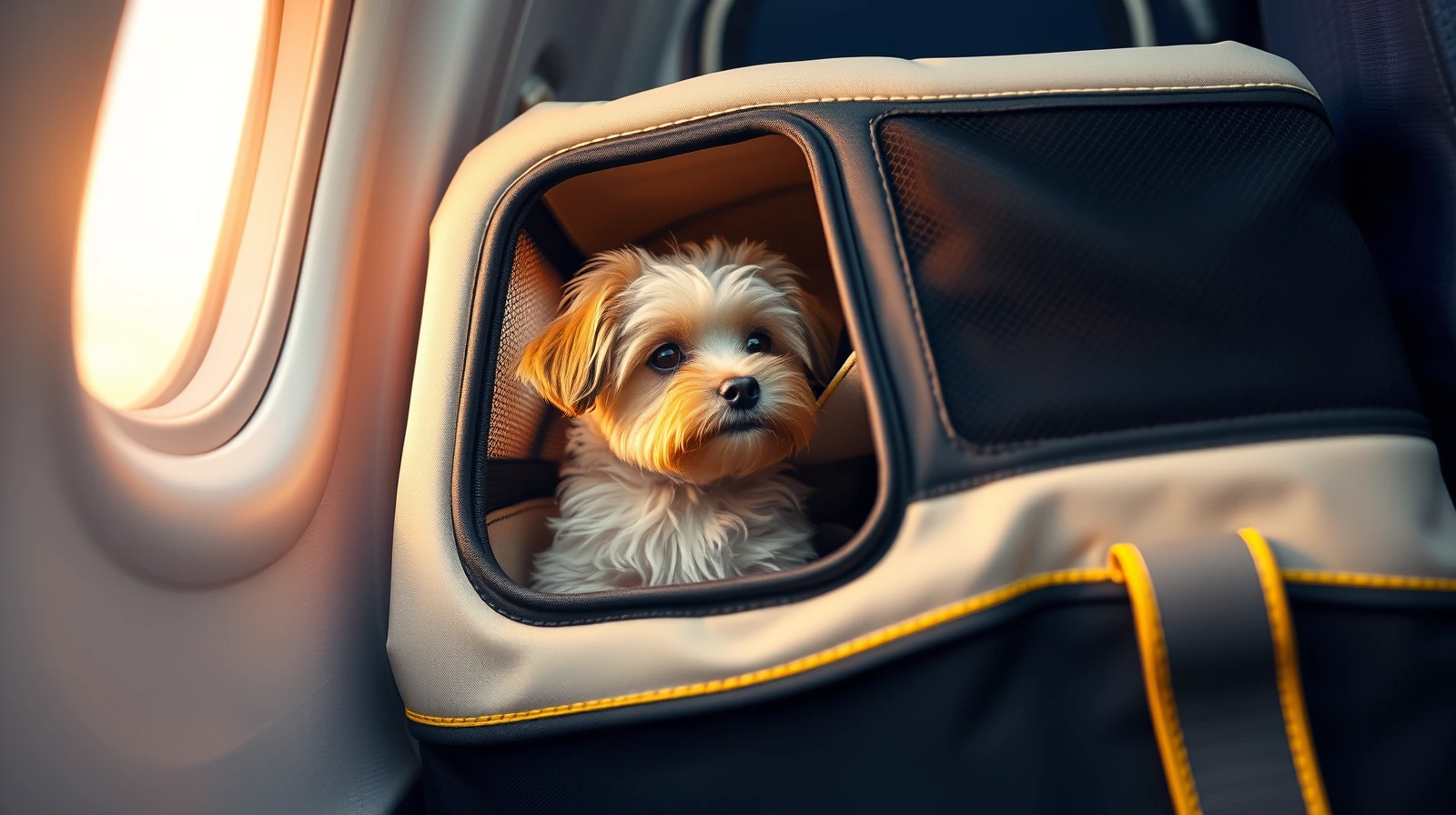
Southwest Airlines carries small cats and dogs in the cabin only, for about $125 each way (listed as refundable). There is no cargo or checked-pet option, so the pet plus carrier must fit under the seat. Simple for small pets, a non-starter for medium and large dogs.
Southwest Airlines carries small cats and dogs in the cabin only, for a fee of about $125 each way (Southwest lists this fee as refundable). There is no cargo or checked-pet option, so the pet plus carrier must fit under the seat in front of you. That makes Southwest simple for small pets and a non-starter for medium and large dogs, who need a cargo-capable airline or ground transport.
For more on this, read Flying With a Puppy.
Southwest is in-cabin only, and that is the whole story
Most airline pet policies have three lanes: in-cabin, checked baggage, and cargo. Southwest only has one. According to Southwest's published pet policy, the airline accepts small vaccinated cats and dogs in the passenger cabin and does not transport pets as checked baggage or as cargo. There is no temperature embargo to track and no separate cargo booking line, because that service simply does not exist here.
This is the single most important thing to understand before you book. If your dog is too big to ride under the seat in an approved carrier, Southwest cannot fly it under any circumstance, at any price. The policy is binary: small pet in an under-seat carrier, or no pet. There is no upgrade, no exception, and no cargo hold workaround.
The upside is real, though. An in-cabin-only policy means your pet stays in the climate-controlled cabin with you the entire flight, never riding in a hold. For owners of genuinely small animals, that is the safest and least stressful way to fly. The trade is simply that the door is narrow: it fits a Chihuahua or a cat easily, and shuts out a Labrador completely.
Who can and cannot use Southwest for their pet
The eligibility test is about size, not breed. Southwest does not publish a breed ban, so snub-nosed (brachycephalic) breeds like French Bulldogs, Pugs, and Persian cats are not categorically excluded the way some airlines exclude them from cargo. The only hard gates are that the animal must be a vaccinated domestic cat or dog, at least 8 weeks old, and small enough to stand up and turn around comfortably inside a carrier that fits under the seat.
You can probably use Southwest if
- You have a small dog or a cat that fits inside an 18.5 by 8.5 by 13.5 inch carrier and can still turn around.
- Your pet is a vaccinated domestic cat or dog at least 8 weeks old.
- You are flying a U.S. domestic route in the continental states (or between Hawaiian islands).
- Your pet is calm enough to stay quiet inside a zipped carrier for the duration of the flight.
You cannot use Southwest if
- Your dog is medium or large and will not fit in an under-seat carrier (Beagles, most Spaniels, and anything bigger are out).
- You need to fly internationally. Southwest's pet program is domestic only.
- You are flying to or from mainland Hawaii. Pets are not accepted on those routes (interisland Hawaii flights are the exception).
- You are transporting a species other than a cat or dog.
If you fall into the "cannot" list because of size, your realistic options are an airline that flies pets in cargo, or professional ground transport. Our explainer on pet cargo versus in-cabin travel walks through that decision in detail, and you can compare carriers side by side on our airline pet policy comparison tool.
Southwest pet fees and rules at a glance
Here are the core numbers Southwest publishes, gathered into one table. Treat every figure as a starting point and confirm the current amount with Southwest when you book, because airline fees change without much notice.
| Rule | Southwest policy |
|---|---|
| Travel type | In-cabin only (no checked pets, no cargo) |
| Pet fee (mainland) | About $125 each way, per carrier (listed as refundable) |
| Pet fee (Hawaii interisland) | About $35 each way, per carrier |
| Eligible animals | Vaccinated cats and dogs, at least 8 weeks old |
| Breed restrictions | None published |
| Max carrier size | 18.5 in L x 8.5 in H x 13.5 in W |
| Carrier type | Soft-sided or hard-sided, leak-proof, ventilated |
| Pets per customer | 1 carrier (up to 2 same-species pets inside) |
| Pets per flight | 6 carriers total |
| How to book | By phone with Southwest (not online) |
| International | Not permitted |
Two details in that table catch people out. First, the fee is charged "each way," so a round trip is roughly double the one-way figure. Second, the six-carrier cap is per flight across the whole plane, not per passenger, which is why booking early matters (more on that below).
The carrier rules, decoded
The carrier is where most Southwest pet plans succeed or fail, so it is worth getting exact. Southwest's published maximum is 18.5 inches long, 8.5 inches high, and 13.5 inches wide. The carrier may be soft-sided or hard-sided, but it must be leak-proof and properly ventilated, and your pet has to be able to stand up and turn around inside it.
In practice, a soft-sided carrier is the safer bet. The published height limit of 8.5 inches is genuinely short, and a soft carrier can compress slightly to slide under the seat in front of you while a rigid hard-sided box of the exact same listed dimensions may not. The pet must stay fully inside the zipped carrier and under the seat for taxi, takeoff, and landing. You cannot hold your pet, place the carrier on your lap during those phases, or buy it a seat.
One carrier can hold up to two pets, but only if they are the same species: two cats or two dogs, never one of each. Mixing species in a single carrier is not allowed. If you have one cat and one dog, that is two carriers, and since each customer is limited to one carrier, you would need a second adult traveler to bring the other. For help picking a compliant bag, see our guide to the best airline-approved dog carriers, and measure your specific carrier against the numbers above rather than trusting a label that just says "airline approved."
How to book a pet on Southwest
You cannot add a pet during the normal online checkout. Southwest requires you to book the pet by phone with its reservations team, and because only six carriers are allowed on any given flight, the pet space can sell out independently of the human seats. The practical sequence looks like this:
- Confirm your pet meets the size, age, and vaccination requirements, and that your carrier fits the 18.5 by 8.5 by 13.5 inch limit.
- Book your own flight as early as you reasonably can, ideally on a route with open pet space.
- Call Southwest to add the pet and pay the fee, before all six carrier slots on your flight are taken.
- Bring proof of vaccination and a properly closed carrier to the airport, and check in at the ticket counter rather than the kiosk.
Because the pet fee is described as refundable, a change of plans should not cost you the pet charge, though you should confirm the refund terms on your specific fare when you call. Arrive with margin: a pet adds a counter visit that the self-service kiosk and mobile boarding pass skip.
The Hawaii restriction, explained
Hawaii is the one geography where Southwest's pet rules split. You cannot fly a pet to or from mainland Hawaii on Southwest, meaning a flight between, say, California and Honolulu is off the table for your dog or cat. You can, however, fly a pet between the Hawaiian islands, and the interisland fee is lower, around $35 each way rather than the mainland $125.
The reason is regulatory, not just a Southwest quirk. Hawaii runs a strict rabies-quarantine and animal-import program, and pets entering the state must clear specific health, vaccination, and documentation steps administered by the Hawaii Department of Agriculture. Layered on top, federal pet-travel rules from USDA APHIS govern movement of animals, and the combination is why mainland-to-Hawaii pet travel is handled through programs and routes built for it, not a standard cabin booking. If Hawaii is your destination with a pet, plan that leg separately and start with the state's import requirements.
How Southwest compares to AA, United, Delta, Alaska, and JetBlue
Southwest sits at the simple end of the spectrum. It does one thing, small pets in the cabin, with no breed bans and a refundable fee, but it offers nothing for larger animals and no international travel. The other major U.S. carriers each draw the lines differently, so the right airline depends entirely on your pet's size and your route.
- American Airlines: in-cabin for small pets, with cargo handled through a separate program in limited cases. See our American Airlines pet policy guide.
- United Airlines: in-cabin small pets, and historically the broadest cargo program of the legacy carriers. See our United Airlines pet policy guide.
- Delta Air Lines: in-cabin for small pets, with checked-pet and cargo options that have tightened over time. See our Delta pet policy guide.
- Alaska Airlines: often the most pet-friendly of the bunch, allowing in-cabin, checked, and cargo, with a generous per-flight pet count. See our Alaska Airlines pet policy guide.
- JetBlue: in-cabin only like Southwest, with its own carrier limits and a loyalty perk on pet fees. See our JetBlue pet policy guide.
The pattern: if your pet is small and you are flying domestically, Southwest and JetBlue are clean, low-friction choices. If your dog is too big for a cabin carrier, you want Alaska or United and their cargo programs, or ground transport. Our pet airlines pillar guide compares every major carrier's rules in one place, and the airline pet policy comparison tool lets you filter by what matters for your trip.
Flying safely with a small pet in the cabin
Even on the safest option, an in-cabin flight, a little preparation goes a long way. The American Veterinary Medical Association advises talking to your vet before air travel, especially for snub-nosed breeds and senior or anxious animals, and generally recommends against sedation for flying because it can affect breathing and balance at altitude. Let the carrier become a familiar, comfortable space at home in the weeks before the trip rather than a box your pet sees for the first time at the airport.
A few practical habits: keep feeding light before departure to reduce nausea, offer water on long layovers, line the carrier with an absorbent pad given the leak-proof requirement, and clip a small ID tag to both your pet and the carrier. Carry a copy of vaccination records. For the broader rules of the road, the international air-transport standards from IATA are the reference framework most airlines build their live-animal policies around, even for domestic cabin travel.
How we sourced this
The fees, carrier dimensions, eligibility rules, and Hawaii restrictions in this guide are drawn from Southwest's own published pet policy, cross-checked against federal pet-travel guidance from USDA APHIS, live-animal transport standards from IATA, and veterinary travel guidance from the AVMA. Airline fees and capacity rules change, so we present prices as approximate and urge you to confirm the current figure with Southwest at the time you book. This article is editorial guidance, not the airline's contract of carriage.
How much does it cost to fly a pet on Southwest?
Can large dogs fly on Southwest Airlines?
What size carrier does Southwest allow for pets?
Does Southwest have breed restrictions for pets?
Can I fly my pet to Hawaii on Southwest?
How do I book a pet on a Southwest flight?
Can two pets share one carrier on Southwest?
How old does my pet have to be to fly Southwest?
Sources & references
- support.southwest.com https://support.southwest.com/helpcenter/s/article/pet-policy
- aphis.usda.gov https://www.aphis.usda.gov/pet-travel
- avma.org https://www.avma.org/resources-tools/pet-owners/petcare/traveling-your-pet
- iata.org https://www.iata.org/en/programs/cargo/live-animals/pets/