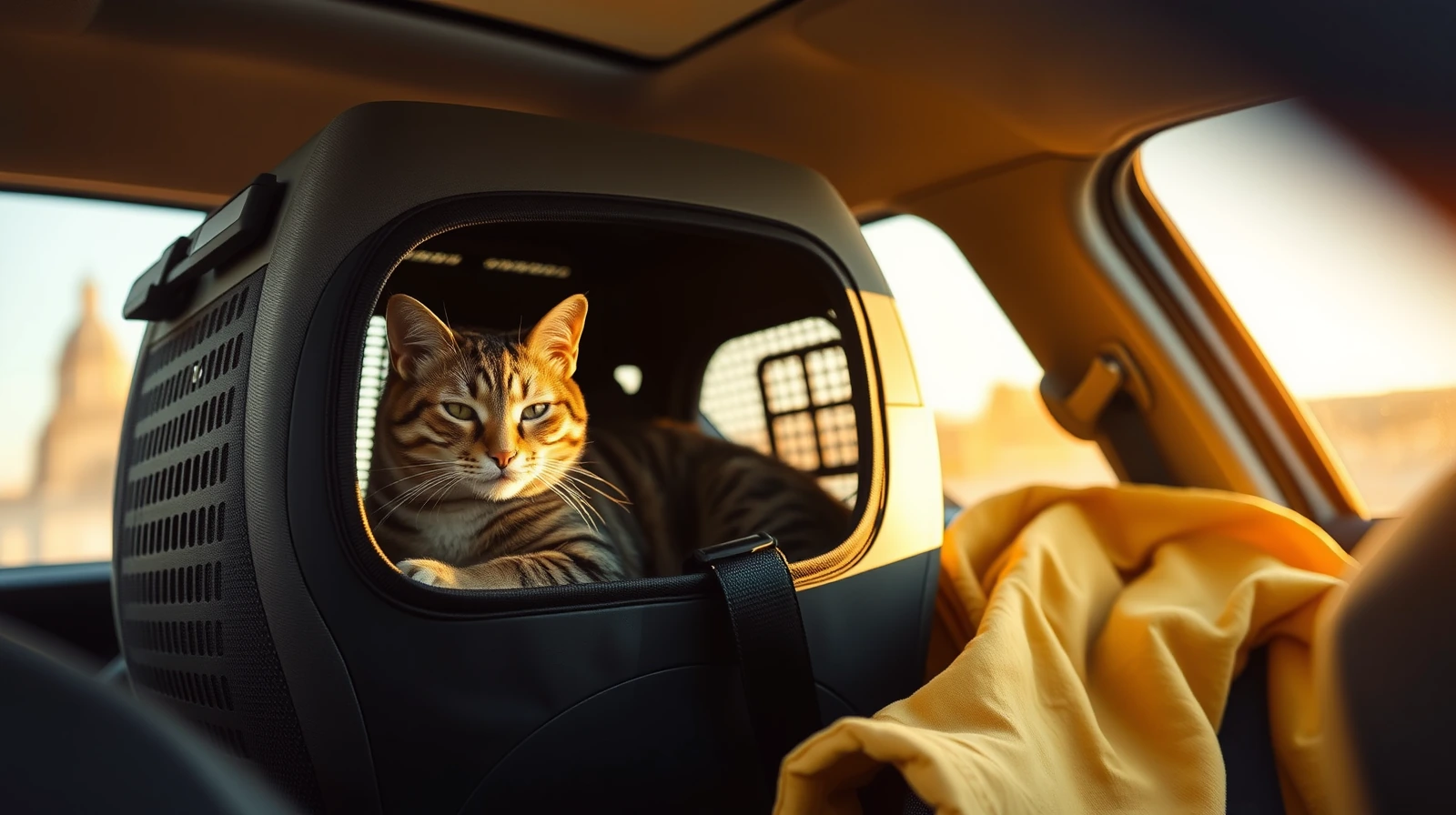
To travel long distance with a cat in a car, secure a familiar carrier with the seatbelt (never loose), withhold breakfast to prevent nausea, line the carrier with absorbent pads, offer water at breaks every two to four hours, keep the cabin cool, and plan pet-friendly lodging. Most cats tolerate roughly 4 to 6 hours of driving per day.
To travel long distance with a cat in a car, secure a familiar carrier with the seatbelt (never loose), withhold breakfast to prevent nausea, line the carrier with absorbent pads, offer water at breaks every two to four hours, keep the cabin cool, and plan pet-friendly lodging. Most cats tolerate roughly 4 to 6 hours of driving per day. Acclimate weeks ahead.
This is the do-it-yourself guide for owners who plan to drive their own cat a long way, not a guide to hiring a service. If you would rather hand the drive to a professional, see our companion piece on long-distance cat transport, which covers vetted door-to-door operators and what they charge. Everything below assumes you are behind the wheel, your cat is in the car, and you want the trip to be as calm and safe as a long drive with a cat can be.
Cats are not small dogs on the road. Dogs often enjoy the ride; most cats treat a moving car as a threat, which is why nearly every step here is about reducing stress and motion sickness rather than entertainment. We have leaned on guidance from veterinary sources including VCA Animal Hospitals, the American Veterinary Medical Association (AVMA), International Cat Care, Preventive Vet, and the Cornell Feline Health Center, and flagged where you should confirm specifics with your own vet.
Traveling with or caring for a cat? See our guide to How Long Can You Leave a Cat Alone? (And When You Need a Sitter).
Traveling with or caring for a cat? See our guide to How to Crate Train a Cat.
For a deeper look, see our guide to How to Introduce Two Cats.
For cats that ride in the car often, a secure harness adds a layer of safety. See our pick of the best cat harness for stops and stretch breaks.
For cat owners: our guide to How to Bathe a Cat Safely, Step by Step.
A parked car is one of the fastest ways a cat overheats, so read our guide on how to cool down a cat in summer before any warm-weather trip.
Start weeks ahead: acclimate the cat and the carrier
According to VCA Animal Hospitals, a successful road trip with a cat begins long before travel day. The single biggest predictor of a calm cat in the car is how the cat feels about the carrier. If the carrier only ever appears before a vet visit, your cat already associates it with bad outcomes. The fix is time, not force.
For cat owners: our guide to How to Keep Cats Off Counters.
Make the carrier an everyday object
VCA recommends leaving the carrier open and available in the home at all times so it becomes a normal place to nap rather than a trap. Feed meals or drop treats inside it. Add a piece of unwashed bedding that smells like you or the cat. Over a couple of weeks, most cats will start choosing the carrier on their own. For owners coming from the dog side of pet travel, the logic mirrors what we describe in crate training a dog for travel, though cats need a gentler, slower hand.
For cat owners: our guide to How to Stop a Kitten From Biting.
Build up to the car in small steps
Once the carrier is friendly, introduce the car gradually. VCA suggests starting with the cat in the carrier in a parked car, then short trips around the block, then progressively longer drives. The goal is to let your cat learn that car rides start and end uneventfully. Rushing straight from "never been in the car" to "eight-hour highway day" is the most common reason a road trip goes badly.
Book the vet check and gather paperwork
Before a long trip, VCA and the AVMA both advise a veterinary checkup to confirm your cat is healthy enough to travel and to update vaccinations. Gather vaccination records, the rabies tag, and any medications. The AVMA notes that some destinations and many airlines or border crossings require a health certificate, so if your route crosses state lines or you are relocating, ask your vet what documents you need. If your trip is part of a household move, our guide to moving across states with multiple pets walks through staging several animals at once.
Secure the carrier with a seatbelt, never loose
A loose carrier is a projectile in a crash and a distraction at every turn. International Cat Care and the AVMA both stress restraining the carrier in the vehicle. Run the seatbelt through or around the carrier handle so it cannot slide, tip, or fly forward under hard braking. The AVMA advises placing pets in the back seat to avoid airbag injuries, and never letting a cat ride loose in the cabin or in a driver's lap.
Choose a hard-sided or sturdy soft carrier that is well ventilated and just large enough for the cat to stand up and turn around. Position it on the back seat or footwell, level, away from direct sunlight and away from the blast of an air-conditioning vent. Many cats settle faster if you drape a light, breathable cloth over part of the carrier to create a den, leaving ventilation open. If you must remove your cat from the carrier at any point, Preventive Vet and VCA both warn never to do it in a moving car: fit a well-fitted harness and leash first, and only open up when the car is stopped and the doors are closed.
The same restraint discipline applies whatever the animal. If you also travel with a dog, the principle of "secured, not loose" is identical, as we cover in how to transport a dog in a car.
Feeding, water, and motion sickness
VCA's clearest day-of tip is to withhold breakfast on travel mornings. Driving on an empty stomach reduces the risk of nausea and vomiting, which is the most common car-travel problem in cats. VCA suggests feeding a small meal only once you reach your evening stop. Several veterinary sources, including Preventive Vet, suggest not feeding within roughly three to four hours of departure; a healthy adult cat can comfortably skip a meal, so an empty stomach for the drive is not a welfare concern. Confirm timing with your vet if your cat is diabetic, very young, very old, or on medication.
Water is different from food. Offer fresh water at rest stops, roughly every two to four hours, rather than leaving a bowl sloshing in the carrier. Many cats will not drink during the actual drive, and that is normal for the length of a single day; the point is to give the option whenever you stop. If your cat is a known car-sickness sufferer or visibly drools, paws, or vocalizes with distress, talk to your vet before the trip about anti-nausea or anti-anxiety medication. The Cornell Feline Health Center and Preventive Vet both note that travel anxiety and carsickness in cats are treatable, and a vet can prescribe options tested on your specific cat before you depend on them for a long haul.
Litter, pads, and cleanup logistics
Plan for the cat to relieve itself in the carrier, because many will. VCA recommends lining the carrier with an absorbent "potty pad" and carrying spares, plus zip-top bags, paper towels, and disposable gloves for cleanup. A stressed cat may urinate or vomit without warning, and a calm, prepared response keeps the trip from spiraling.
For longer multi-day drives, set up a portable litter box your cat can use at rest stops or overnight in lodging. Options range from disposable cardboard trays to collapsible silicone boxes. Bring a sealed container of your cat's usual litter so the scent is familiar. A useful rule from several travel-litter guides: offer the box during every meaningful stop and overnight, but do not expect your cat to use a litter box inside a small carrier on the move. If you have room for a large dog-style kennel rather than a small carrier, VCA notes you can fit a small litter pan inside for use during travel. Never let the cat out to roam the car to find a box.
Temperature, comfort, and break cadence
Cats overheat fast. The AVMA and VCA both warn that a car's interior can reach dangerous temperatures within minutes, so never leave your cat alone in a parked car, not even briefly with the windows cracked. Keep the cabin at a comfortable, steady temperature while driving and shield the carrier from direct sun. In summer, plan stops where you can keep the engine and air conditioning running while you stay with the cat, or take turns with a travel companion.
On cadence: a reasonable rhythm is a brief check-in stop every two to four hours, even if your cat does not eat, drink, or use the box. The stop lets you confirm the cat is comfortable, refresh water, and let a stressed cat reset in a quiet, parked car. Some cats do better with fewer disturbances and prefer to stay covered and undisturbed between longer gaps; you will learn your cat's preference on the acclimation drives.
How far can you realistically drive in a day?
There is no official feline mileage limit, but practical guidance from travel-vet sources lands around 4 to 6 hours of driving per day for most cats, broken up by stops, with the option to push further only for an unusually relaxed cat. Stress, not distance, is the limiting factor. A cat that hides quietly and rides calmly can handle more; a cat that pants, drools, or vocalizes continuously needs shorter days and more recovery time at each stop. Plan your route around overnight lodging rather than around a heroic single-day distance.
Daily-driving comfort guide
| Cat's road temperament | Realistic daily drive | What to do |
|---|---|---|
| Relaxed, sleeps in carrier | Up to 6-8 hours with breaks | Stop every 3-4 hours, water offered, keep it boring |
| Tense but quiet | 4-6 hours | Stop every 2-3 hours, partial cover, pheromone spray |
| Vocal, drools, or vomits | 2-4 hours max | Vet meds before trip, shorter days, more recovery stops |
| First long trip, unknown | Start at 4 hours | Treat the first day as a test, adjust the plan accordingly |
Always confirm your cat's tolerance on shorter practice drives before committing to a long-haul schedule. These ranges are general starting points, not medical advice.
Calming options: talk to your vet first
Calming aids exist on a spectrum, and the safe order is conservative first, medication last and only with veterinary input.
- Pheromones. Synthetic feline facial pheromone products such as Feliway are widely recommended by VCA and Preventive Vet. Spray the carrier or a blanket about 15 minutes before loading the cat so the alcohol carrier evaporates, and reapply per the label. They are low-risk and worth trying first.
- Familiar scent and a covered den. An unwashed item that smells like home, plus a partial cover, calms many cats more than any product.
- Prescription anti-anxiety or anti-nausea medication. For cats with real travel distress or carsickness, ask your vet. The Cornell Feline Health Center notes feline travel anxiety is manageable, but VCA and Preventive Vet both caution that you should never give human medications or improvise doses. Trial any prescribed medication on a short drive before the trip so you know how your cat responds.
Avoid over-the-counter sedatives marketed for cats unless your vet specifically approves them. Sedation without supervision can affect a cat's temperature regulation and balance, which is the opposite of what you want on a hot, moving car ride.
Lodging, ID, and the pack list
Book pet-friendly lodging in advance. The AVMA advises confirming, before you arrive, that a hotel, motel, or campground welcomes pets, whether there are size or breed restrictions, whether any paperwork is required, and what pet features they offer. Reserve ahead during busy travel seasons. At each overnight, set up the litter box, food, and water in a contained area, and keep the cat confined to one room so it cannot bolt out an unfamiliar door.
On identification: the AVMA recommends a collar with an ID tag plus a microchip with your contact details registered and current. A microchip dramatically improves the odds of reunion if a frightened cat escapes at a rest stop or motel. Update the registry with a phone number you will actually have on the road before you leave. If part of your plan involves boarding the cat at either end of the move, our guide to how to choose a cattery covers what to look for in a boarding facility.
Long-distance cat road-trip packing checklist
| Category | Items |
|---|---|
| Containment and safety | Sturdy ventilated carrier, seatbelt-secure setup, well-fitted harness and leash |
| Bathroom | Absorbent potty pads (plenty of spares), portable litter box, sealed bag of usual litter, scoop, waste bags |
| Cleanup | Paper towels, disposable gloves, zip-top bags, enzyme cleaner, spare bedding |
| Food and water | Usual food, collapsible bowls, bottled water, treats for arrival |
| Health and ID | Vet records and rabies tag, medications, microchip info, ID collar, recent photo of the cat |
| Comfort | Unwashed home-scented blanket, pheromone spray, light cover cloth |
How we sourced this
This guide draws on published veterinary guidance rather than marketing copy. The carrier-acclimation sequence, withhold-breakfast advice, potty-pad setup, and never-leave-the-cat-in-a-hot-car warning come from VCA Animal Hospitals' road-trip article. Restraint, microchipping, lodging, and health-certificate guidance come from the AVMA's pet-travel resources and International Cat Care. Anxiety and carsickness management reflects Preventive Vet and the Cornell Feline Health Center. We present temperatures, timings, and daily-distance figures as general ranges; confirm anything specific to your cat's health with your own veterinarian before you drive.
Should I withhold food before a long car trip with my cat?
How do I secure a cat carrier in the car?
How many hours a day can I drive with a cat?
How does my cat go to the bathroom during a long drive?
What calming options are safe for car travel?
How often should I stop on a cat road trip?
Do I need a microchip and ID for a road trip?
Is driving my own cat cheaper than hiring a transporter?
Sources & references
- vcahospitals.com https://vcahospitals.com/know-your-pet/road-trips-and-car-travel-with-your-cat
- avma.org https://www.avma.org/resources-tools/pet-owners/petcare/animal-travel-certificates-regulations-requirements/traveling-your-dog-cat
- icatcare.org https://icatcare.org/articles/travelling-with-your-cat
- preventivevet.com https://www.preventivevet.com/cats/how-to-help-your-cat-with-car-anxiety-carsickness
- vet.cornell.edu https://www.vet.cornell.edu/departments-centers-and-institutes/cornell-feline-health-center