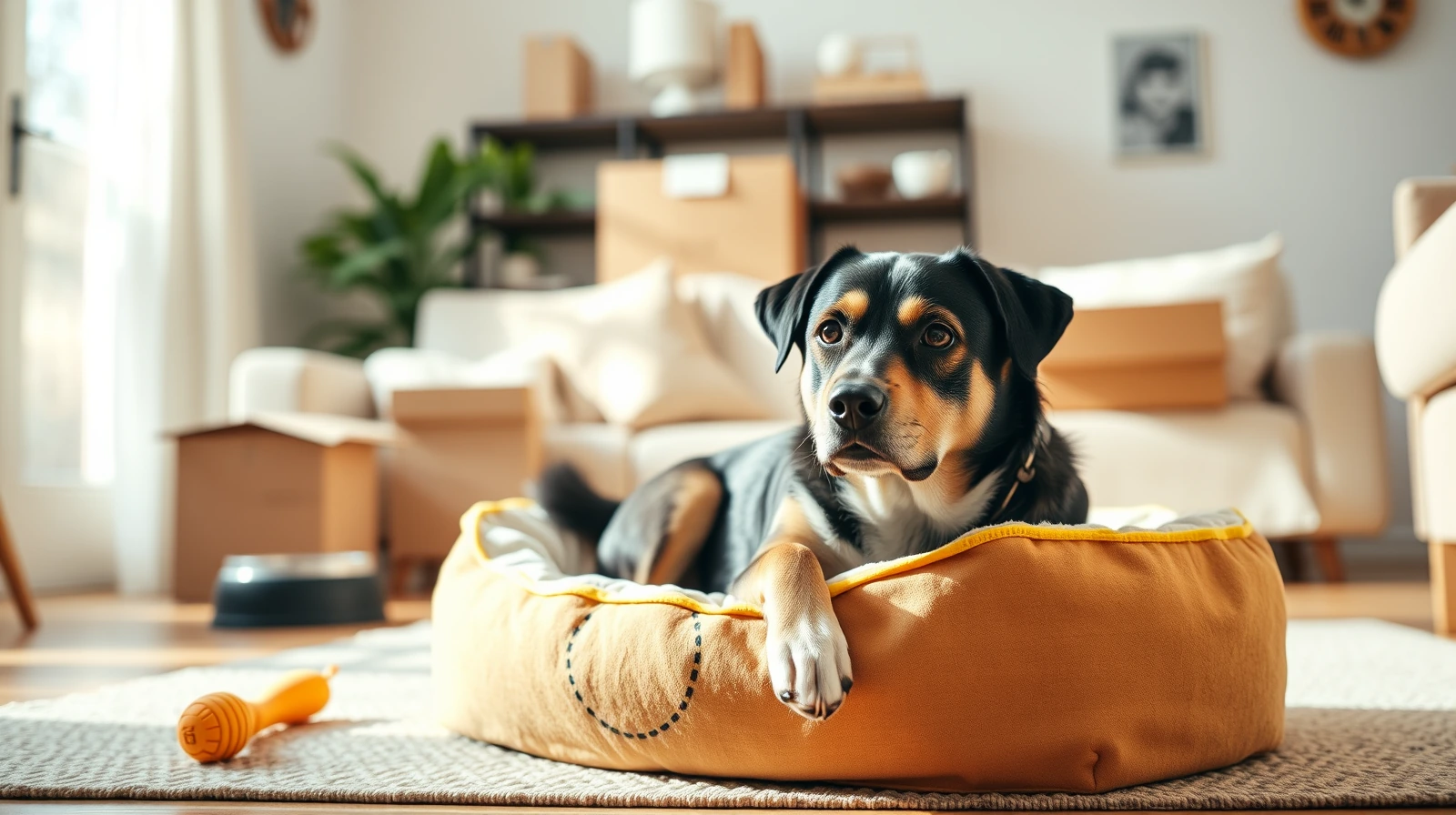
Most dogs need days to decompress and weeks or months to fully relax in a new home, though every dog differs. Keep routine and diet steady, set up one quiet safe room, bring familiar bedding, supervise closely, and update ID. Call a vet if stress signs persist.
A new house smells wrong, sounds wrong, and offers none of the familiar corners your dog had memorized. Whether you relocated across the country together or just brought home an adopted dog, the first days are about decompression, not training. This guide walks through what to expect, how to set the environment up for a calm start, the stress signs worth watching, and a simple settling-in checklist. The timelines here are general ranges drawn from veterinary and shelter sources: every dog adjusts at its own pace.
If there is already a dog at home, the settling-in plan changes. Follow how to introduce two dogs on neutral ground before they share space.
The 3-3-3 guideline: a helpful frame, not a rule
Many shelters describe adjustment in three rough phases, often called the "3-3-3 rule." As the ASPCA Pro adjustment-periods guide frames it: roughly the first 3 days are decompression, the first 3 weeks are when a dog learns your routines and shows more personality, and around 3 months is when most dogs feel genuinely at home. The ASPCA itself stresses that this is a general guideline, not a fixed schedule. A confident dog may settle in days; a fearful or previously neglected dog can take far longer. Treat 3-3-3 as a map of the journey, not a stopwatch.
- First few days (decompress): Your dog may eat little, hide, sleep a lot, or seem shut down. This is normal. Keep things quiet and low-pressure.
- First few weeks (settle): Routines start to click. You see more of the real personality, including any quirks that stress had masked.
- First few months (feel at home): Most dogs relax into the household, bond more deeply, and treat the space as theirs.
Keep routine and diet boringly consistent
Predictability is the single biggest comfort you can offer. The American Kennel Club notes that dogs thrive on routine, so set consistent times for feeding, potty breaks, walks, play, and sleep from day one. The more structured and repeatable the day, the faster a dog reads the new place as safe.
Keep the food the same, too. A move or adoption is already a gut-churning amount of change, and an abrupt diet switch on top of it invites diarrhea and refused meals. If you must change food, do it gradually over a week or more once the dog has settled, not in the first stressful days. Stress alone can cause loose stool or a temporary appetite dip, so removing one more variable helps you tell normal nerves apart from something that needs a vet.
Bring the old home with you: familiar items and scent
Scent is how dogs orient. VCA Animal Hospitals advises keeping a dog's familiar bed and blankets available right through the transition rather than washing or replacing them. Those smells are a portable piece of "home."
- Set out the same bed, crate, and a few well-loved toys before the dog arrives or explores.
- Bring an unwashed blanket or T-shirt carrying the scent of the old home (or, for a young pup, something that smells like the littermates or mother).
- Use the same food and water bowls in a consistent spot.
- Resist the urge to buy all-new gear at once. A clean slate of unfamiliar objects is the opposite of comforting.
Set up one quiet safe room
Do not turn the dog loose in the whole house on arrival. The AKC recommends a quiet, low-traffic area with a bed, water, and toys, and notes that dogs prefer the security of a den, which a crate can provide with positive encouragement. Pick one room, gate it off, and let that be the dog's base camp for the first day or two.
A crate set up as a cozy retreat (never as punishment) gives an anxious dog somewhere to decompress on its own terms. If your dog already associates the crate with car travel, that familiarity helps; our notes on crate training a dog for travel apply directly to building a calm den at home. Keep the safe room low-stimulation: soft lighting, minimal foot traffic, no parade of visitors. VCA notes that some dogs settle faster with a calming pheromone diffuser in their space, which can be worth a try for nervous dogs.
Reintroduce the house gradually
Once the dog seems settled in the safe room, open the house up one room at a time. VCA suggests letting your dog explore a single room at a time while you follow along to make sure it does not find anything dangerous to chew or swallow. This staged approach prevents the overwhelm of a whole unfamiliar building at once and lets you catch hazards (loose cords, gaps under fences, accessible trash) before they become problems.
The Cornell Riney Canine Health Center points out that the size of the change matters: a dog moving from a large home to a small apartment, or from a quiet rural property to a busy city block, may need longer to acclimate than a dog whose surroundings stayed broadly similar. Match your patience to the size of the leap.
Re-establish the potty routine and head off accidents
Even a fully house-trained dog can have accidents in a new home. The location cues it relied on are gone, stress can increase the urge to urinate or defecate, and it simply does not know yet where "outside" is. Treat the first weeks as a refresher, not a failure.
- Take the dog to the same designated potty spot on a leash, frequently and on a schedule (after waking, after meals, after play, before bed).
- Use a consistent cue word and praise or reward the moment the dog finishes outside, as the AKC advises.
- Supervise closely indoors or keep the dog in its safe space when you cannot watch, so you can interrupt and redirect rather than discover an accident later.
- Clean any accidents with an enzymatic cleaner so lingering scent does not mark the spot as a repeat target. Do not punish accidents: that adds anxiety and slows progress.
Stress signs: normal nerves vs. call-the-vet territory
Some unsettled behavior is expected. VCA's guide to canine stress lists panting without exercise, hiding or moving behind a trusted person, pacing, increased urgency to eliminate, and GI upset such as vomiting, diarrhea, or refusing food among common stress signals. In the first days of a move or adoption, mild versions of these are usually transition nerves, and VCA notes most dogs relax within a few days.
The line worth watching: short-lived, improving, and not affecting safety is generally normal. Persistent, worsening, or physically risky is a reason to get help. Contact your veterinarian or a qualified veterinary behaviorist if your dog refuses food and water for more than a day or two, has ongoing vomiting or diarrhea, shows signs of escalating fear or aggression, harms itself trying to escape, or simply is not improving over a couple of weeks. Sudden behavior changes can also have a medical cause, so a vet check rules that out before you assume it is purely emotional.
Don't leave a new dog alone too long at first
For the first week or two, plan to be around as much as you can. A dog that does not yet trust the space or know you can spiral into distress when left alone, and long absences early on can seed separation problems. If you must leave, start with very short departures and build up gradually, leaving the dog in its safe space with familiar bedding and something to chew. Arranging time off, a sitter, or a flexible schedule for the first stretch pays off in a smoother adjustment.
Secure the yard, escape-proof, and update ID first
A disoriented dog is a flight risk, and the period right after a move is exactly when dogs bolt and get lost. Handle this before anything else.
- Walk the fence line and check for gaps, loose boards, low spots a dog could dig under, or gates that do not latch. Do not trust a new yard until you have verified it.
- Keep the dog leashed in unfenced areas and near doors until you trust its recall and its sense of "home base."
- Update the microchip registration with your new address and phone number, and swap the ID tag the same day you move. A chip with an old address cannot reunite you.
- Mind doors and gates, especially during the move itself when they are propped open and the house is chaotic.
If the move involves a long drive, easing car stress beforehand helps the whole transition; see our guides on dog car anxiety and planning a road trip with a dog. For the logistics of getting your pet to the new home, our overview of how to transport a pet covers the options.
Reintroduce walks in the new neighborhood
Walks do double duty: they burn off nervous energy and they teach the dog the new territory. Start short and close to home, on a secure harness and leash, and keep the route consistent for the first while so the dog builds a mental map. Let it sniff: scent exploration is how a dog gets comfortable with a new area. Build distance and variety as confidence grows. Hold off on busy dog parks or crowded trails until your dog is settled and you can read its stress signals reliably in calmer settings first.
Newly adopted dogs vs. dogs that moved with you
The playbook overlaps, but the starting point differs. A dog that moved with you already trusts you and knows its own bed, toys, and routine. Its job is to map a new building onto an existing sense of safety, so leaning hard on familiar items and your steady presence usually carries it through. The AKC's guide for adult dogs and the San Diego Humane Society both emphasize patience and routine in either case.
A newly adopted dog is doing more at once: learning a new place, a new family, and new rules with no prior bond to lean on, often after the stress of a shelter and an unknown history. Expect a longer, more cautious decompression, keep introductions to people and other pets slow and one at a time, and do not read early quietness as the dog's true personality. If you are also blending pets, our notes on careful, gradual introductions in introducing a cat to a new home share the same go-slow logic. Households relocating several animals at once will find our guide to moving across states with multiple pets useful for staging the chaos.
Settling-in checklist and rough timeline
| Phase | Typical window (varies by dog) | What to focus on |
|---|---|---|
| Decompression | First few days | One quiet safe room, familiar bedding, consistent feeding and potty schedule, minimal visitors, close supervision. |
| Settling in | First few weeks | Open the house room by room, keep routine steady, start short neighborhood walks, build up short alone-time, watch for stress signs. |
| Feeling at home | Around three months | Expand walks and social outings, resume normal life, address any lingering anxiety with a trainer or vet behaviorist. |
First-week to-do list, in priority order:
- Update microchip address and swap the ID tag the day you arrive.
- Walk the fence line and escape-proof the yard before any off-leash time.
- Set up the safe room with the dog's own bed, crate, and unwashed scented item.
- Keep food, bowls, and feeding times identical to before.
- Re-establish a strict leashed potty routine with a cue word and praise.
- Stay home or arrange coverage; introduce short absences gradually.
- Start short, consistent neighborhood walks on a secure harness.
- Keep visitors and big outings to a minimum until the dog relaxes.
- Note appetite, stool, and behavior daily so you can flag anything that is not improving.
Above all, let the dog set the pace. The timelines here are averages, not deadlines, and a calm, predictable, patient first few months does more for a lasting bond than any single trick.
Frequently asked questions
What is the 3-3-3 rule for dogs?
How long does it take a dog to adjust to a new home?
Why is my dog not eating after moving?
Should I let my new dog explore the whole house right away?
Is it normal for a house-trained dog to have accidents in a new home?
How long should I take off work when I get a new dog?
What stress signs mean I should call a vet or behaviorist?
How is helping an adopted dog adjust different from a dog that moved with me?
Sources & references
- vcahospitals.com https://vcahospitals.com/know-your-pet/moving-with-your-dog
- vcahospitals.com https://vcahospitals.com/know-your-pet/signs-your-dog-is-stressed-and-how-to-relieve-it
- vet.cornell.edu https://www.vet.cornell.edu/departments-centers-and-institutes/riney-canine-health-center/canine-health-topics/moving-new-home-your-dog
- akc.org https://www.akc.org/expert-advice/home-living/how-to-help-an-adult-dog-adjust-to-a-new-home/
- akc.org https://www.akc.org/expert-advice/training/8-tips-to-help-your-new-puppy-adjust-to-new-home/
- aspcapro.org https://www.aspcapro.org/resource/pet-adjustment-periods-3-days-3-weeks-3-months-guide
- resources.sdhumane.org https://resources.sdhumane.org/Resource_Center/Behavior_and_Training/Dogs_and_Puppies/Adopting_a_Dog/Adopting:_Helping_a_Dog_Adjust_to_a_New_Home