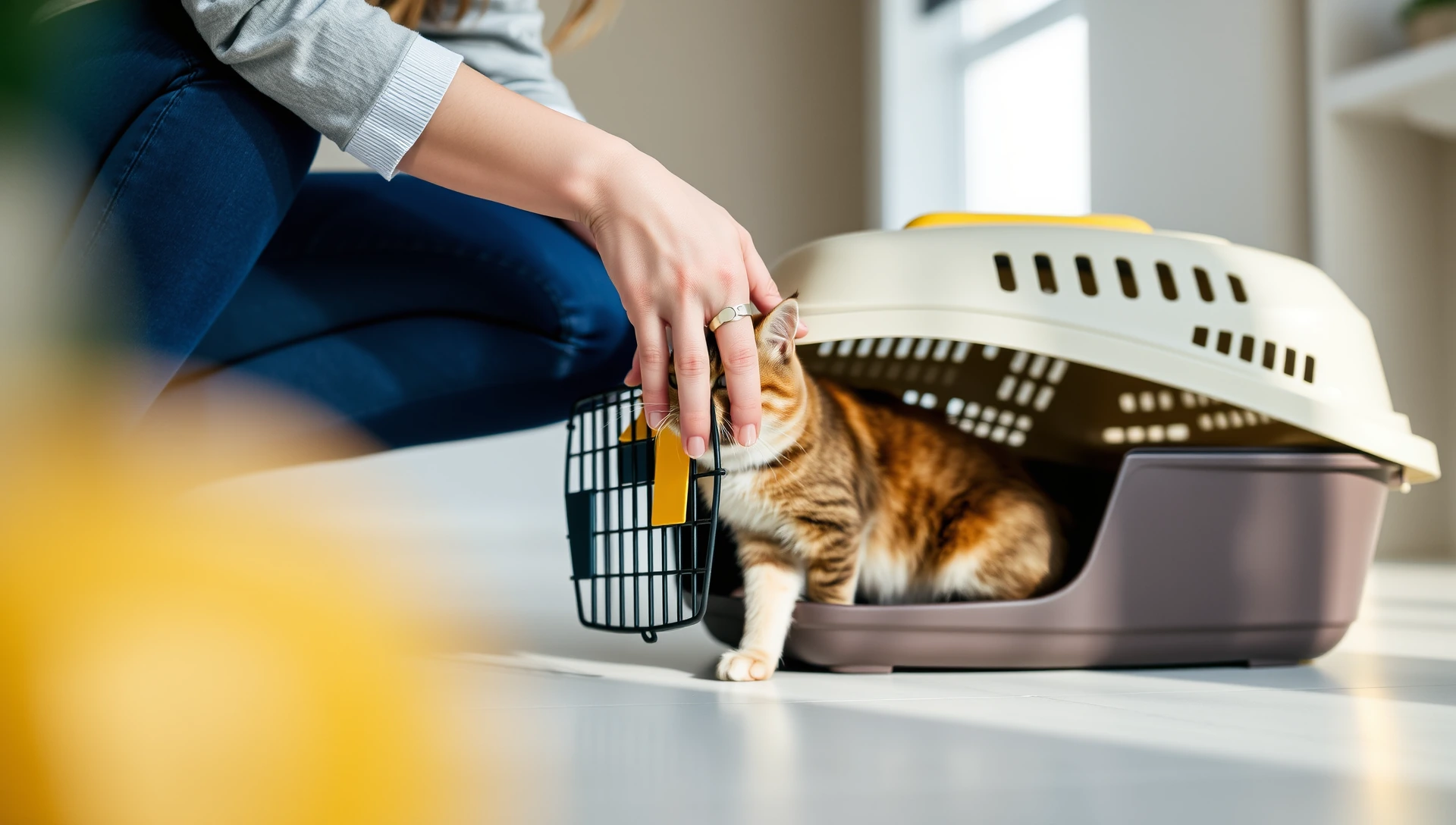
The fastest reliable way to get a resistant cat into a carrier is a hard-sided top-loading model, a calm voice, treats, and lowering the cat in rear-first or through the open top. For a scared or aggressive cat, a gentle towel wrap is the safe last resort. Never chase or grab.
The appointment is at 10, the carrier is on the floor, and your cat has just vanished under the bed like smoke. If this is you, you are not failing at cat ownership. Most cats resist the carrier because it almost always means a car ride and a vet table, so they have learned to associate it with fear. The good news: there is a calm method that works with a little notice, an emergency method for the cat who is already hiding, and a long-term fix that makes the whole fight disappear. Here is how to get a cat into a carrier without a wrestling match, drawn from feline-behavior and veterinary guidance.
Once your cat is inside, timing is the next question. Read how long a cat can stay in a carrier before a long trip so you plan enough breaks.
For cat owners: our guide to How to Trim Cat Nails.
Once the carrier battle is won, the next question is how often you should take a cat to the vet, and it changes with age.
Carrier practice pays off immediately at the first vet visit.
For short adventures and vet trips, a ventilated backpack suits some cats well. We compare the best cat backpack carriers.
Why your cat hates the carrier
Cats are creatures of routine and pattern. If the carrier only comes out of the closet on vet days, your cat connects the carrier itself to the entire stressful sequence that follows: the grab, the car, the strange smells, the handling. International Cat Care notes that cats can be helped to understand that entering and spending time in the carrier is a positive experience, which is really another way of saying the default association is a negative one. You are not fighting stubbornness. You are fighting a learned fear response, and that distinction changes how you should approach the problem.
That fear is also why force backfires. The more you chase, corner, or grab, the more the carrier (and sometimes you) becomes the thing to flee. The two goals for today are simple: get the cat safely contained, and do as little damage to that association as possible.
For cat owners: our guide to How to Stop a Cat From Spraying.
The real long-term fix: make the carrier furniture
If you have any lead time at all, the single most effective change is to stop hiding the carrier. Leave it out in a room your cat already likes, door open, with familiar bedding inside. Toss the occasional treat or favorite toy in so the cat discovers good things there on its own terms. Over days and weeks the carrier stops being a vet-day signal and becomes just another napping spot. Veterinary guidance from VCA Animal Hospitals and the Cornell Feline Health Center consistently points to this neutral, always-available approach as the foundation of low-stress travel.
This is the structured version of carrier acclimation, and it is worth doing properly. For the full step-by-step program, including feeding meals inside and building duration, see our guide to how to crate train a cat. That piece is about the patient, long-game retraining. The rest of this article is about what to do when the appointment is tomorrow and your cat has not read that guide yet.
Choose a carrier that does half the work for you
The hardest carrier to load a reluctant cat into is a soft or hard front-loading box: you are effectively asking the cat to walk face-first into a small dark cave. The easiest carrier is a hard-sided model that loads from the top, or one where the entire top half lifts or unscrews off. With a top-loader you simply lower the cat in. With a removable-top model you can set the cat in the bottom tray and then place the lid over it, which is far less of a fight than aiming a cat through a small door. International Cat Care specifically recommends a carrier that opens at the top so the cat can be gently lifted in or out.
A good travel carrier is also easy to clean, sturdy, and sized so the cat feels snug rather than sliding around. If you are shopping, our roundup of the best cat carrier for travel breaks down top-loading and twist-off-top designs that make loading a scared cat dramatically simpler. If you can only change one thing before the next vet trip, change the carrier.
The calm method, step by step
This is the approach to use when you have a few minutes and a reasonably cooperative (just nervous) cat. Work in a small, quiet room with the door shut so there is nowhere to bolt.
- Set the carrier on the floor (top-loader) or stand a front-loader on its back end so the opening faces the ceiling. Put a familiar towel or blanket inside.
- If your vet approves, spray a synthetic feline pheromone such as Feliway on the bedding 15 to 30 minutes beforehand to add a layer of calm.
- Have high-value treats ready and stay relaxed. Cats read your tension. Move slowly, speak softly.
- For a top-loader: lift the cat with one hand supporting the chest and one supporting the hindquarters, and lower it in rear-first so it does not see the opening coming. Close the lid smoothly.
- For a front-loader: back the cat in rear-first toward the door. Most cats accept this because they cannot see the carrier approaching. Tuck the hind legs as you go.
- For a removable-top carrier: place the cat in the open bottom tray and lower the top over it, then latch.
- The moment the door is shut, drape a towel over the carrier. Blocking the view calms most cats almost immediately.
The rear-first principle is the quiet hero here. A cat aimed head-first at a small dark opening braces and splays its legs. A cat backed in gently has nothing to push against and tends to slide in.
The emergency and last-resort method
When the cat is already terrified, hissing, or has a history of scratching and biting, the safest containment technique recommended across feline-handling sources is the towel wrap, often called the burrito. Done calmly, it protects both of you and gets the cat contained with minimal struggle. Pair it with a top-loading or removable-top carrier and it becomes far easier.
| Step | What to do | Why it helps |
|---|---|---|
| 1. Prep | Lay a large towel flat. Have the carrier open and within reach. | You will have only a short calm window once the cat is wrapped. |
| 2. Wrap | Place the cat on the towel and fold it snugly around the body, leaving only the head out, like a burrito. | Gentle, even pressure tends to settle a cat and protects you from claws. |
| 3. Lower in | Lower the wrapped cat into a top-loading or top-removed carrier, then ease the towel away or leave it as bedding. | No aiming through a small door, no chase. |
| 4. Cover | Close the carrier and drape a towel over the outside. | Darkness reduces the stress response during transport. |
One honest caveat from the behavior world: the burrito is a rescue technique, not a routine one. Being wrapped and bundled still carries some stress, and overusing it can teach a cat to fear towels, your hands, or the room where it happens. Treat it as the tool for the cat who is already too frightened for the calm method, not the everyday plan. The everyday plan is making the carrier neutral, which loops back to crate training.
What not to do
Fear Free and cat-friendly handling principles, promoted by groups like Fear Free Happy Homes and the ASPCA, are largely about what to avoid. The mistakes below make every future carrier trip harder.
- Do not chase the cat. Chasing triggers a full flight response and burns the trust you need. If the cat hides, close off the room early, before it knows what is coming.
- Do not push a cat head-first through a small front door. It braces, you both lose, and the struggle deepens the fear.
- Do not scruff roughly or dangle by the neck. Heavy-handed scruffing is uncomfortable and frightening for an adult cat and is widely discouraged in modern handling guidance.
- Do not yell, swat, or punish. The cat is scared, not defiant, and punishment only confirms the carrier means bad things.
- Do not tip a front-loader upright at the last second and drop the cat. Plan your carrier position before you pick the cat up.
Multi-cat homes: stagger and separate
If you have more than one cat, do not try to load them all in the same room at once. The commotion of catching the first cat alerts the others, who scatter and become much harder to reach. Catch and contain one cat at a time, ideally moving each loaded carrier to a separate quiet space (a closed bathroom or bedroom) before starting on the next. Give each cat its own carrier. Doubling cats into one carrier raises stress and can spark fighting when they are already frightened.
It also helps to bring the carriers out a day or two early so the scent of the routine does not tip every cat off at the same moment. The same staggering logic applies whether you are heading to the vet, the airport, or a kennel. If a boarding stay is what is prompting all this, our guide on how to prepare a cat for boarding covers the wider readiness checklist.
Once you are in: keep the calm going
Getting the cat in is only half the job. The second the door latches, cover the carrier with a towel or light blanket. Blocking the cat's view of the moving world is one of the simplest, most effective stress reducers, and it is recommended widely by veterinary sources. Carry the carrier level and supported from underneath, not swinging by the handle, and keep it stable in the car. For the drive itself, our guide to traveling with a cat in a car covers secure placement and temperature.
If the trip is a flight rather than a drive, the carrier rules change, since airline carriers must fit under the seat and meet size limits. See flying with a cat in cabin for those specifics, and moving with a cat if this is a relocation rather than a single appointment.
When to ask your vet about anxiety medication
For a small number of cats, no amount of patience, top-loading carriers, or towel technique is enough. Some cats experience such severe fear that the trip is genuinely traumatic. For those cats, veterinarians can prescribe situational anti-anxiety medication or a mild sedative to be given before travel. This is firmly a veterinary decision: dosing depends on the individual cat's health, age, and history, and the wrong product or amount can be unsafe. Never give a cat human medication or improvise a dose. If your cat falls into the severe category, talk to your vet well before the appointment so there is time to trial the medication safely at home first. Resources like the International Cat Care guidance on vet visits and your own clinic are the right starting points.
Frequently asked questions
What is the fastest way to get a cat into a carrier?
How do I get a scared or aggressive cat into a carrier?
Why does my cat hate the carrier so much?
What kind of carrier is easiest for a difficult cat?
Should I cover the carrier with a towel?
How do I get my cat to like the carrier long term?
How do I get two cats into carriers without chaos?
Can I give my cat a sedative to make this easier?
Sources & references
- icatcare.org https://icatcare.org/articles/taking-your-cat-to-the-vet
- fearfreehappyhomes.com https://fearfreehappyhomes.com/
- aspca.org https://www.aspca.org/pet-care/cat-care/general-cat-care
- vet.cornell.edu https://www.vet.cornell.edu/departments-centers-and-institutes/cornell-feline-health-center
- vcahospitals.com https://vcahospitals.com/know-your-pet/reducing-the-stress-of-veterinary-visits-for-cats