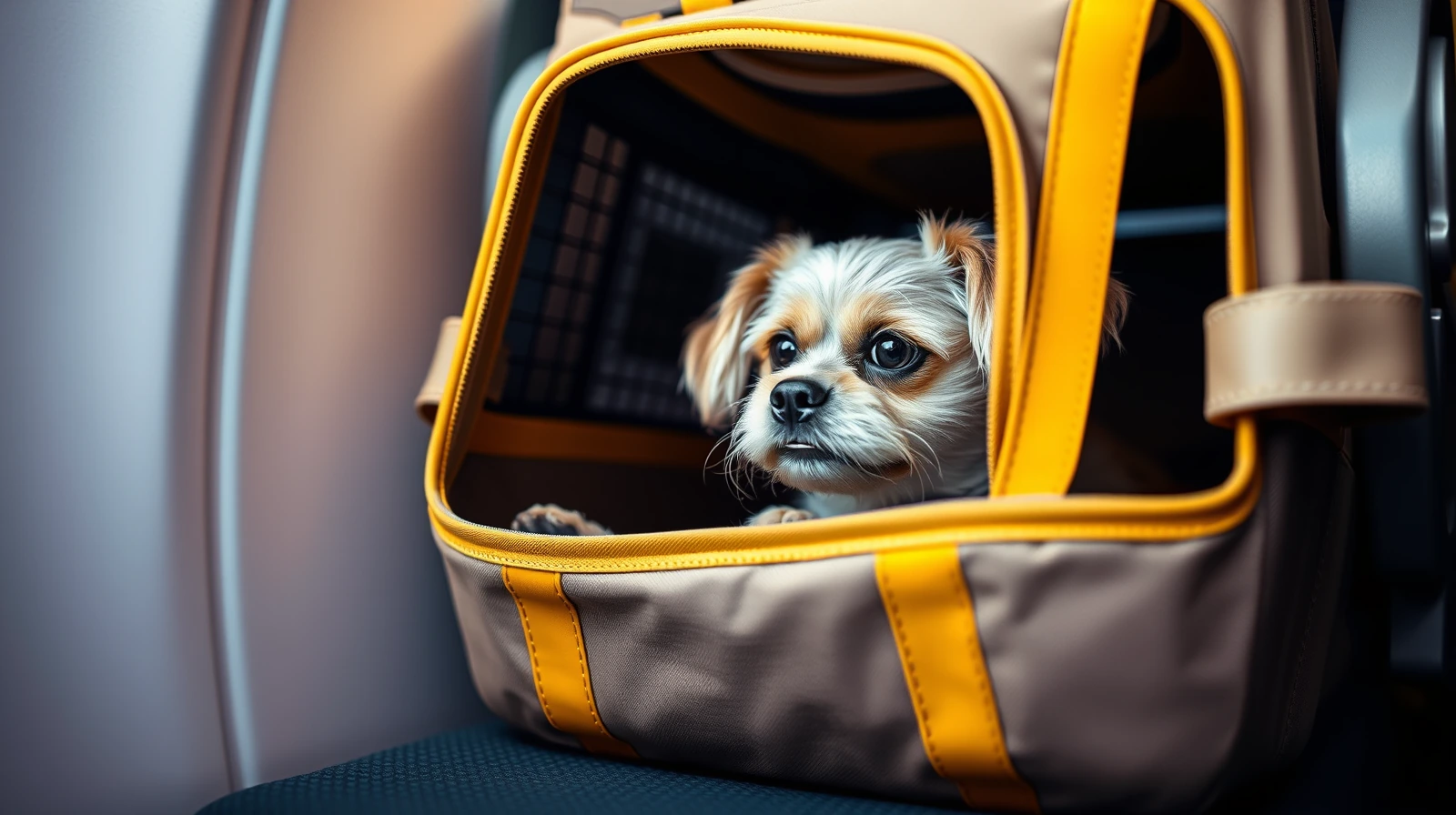
JetBlue carries pets in the cabin only, no cargo. You can fly a small dog or cat if pet plus carrier weighs 20 pounds or less, for about $150 each way (confirm at booking). JetPaws adds 300 TrueBlue points per segment. Medium and large pets need ground transport.
JetBlue carries pets in the cabin only, no cargo hold. You can fly a small dog or cat if your pet plus its carrier weighs no more than 20 pounds, for a fee of roughly $150 each way (confirm at booking). JetBlue's JetPaws program adds 300 TrueBlue points per segment. Medium and large pets need ground transport instead.
See also Flying With a Puppy.
JetBlue is in-cabin only: who actually qualifies
The single most important fact about flying JetBlue with a pet is that the airline does not operate a checked-pet or cargo program. According to JetBlue's traveling with pets page, only small dogs and cats can travel, and they ride in the cabin in an FAA-approved carrier that fits under the seat in front of you. There is no option to put a pet in the hold the way American or Delta historically did for larger animals.
That makes the eligibility test refreshingly simple but also strict. Your pet and its carrier together must weigh no more than 20 pounds, per JetBlue's published rules. There is no separate "pet alone" weight allowance: the 20 pounds is the combined figure, carrier included. A 12-pound cat in a 4-pound soft carrier is fine. A 22-pound French Bulldog is not, regardless of how it behaves. If your animal is over that line, JetBlue is simply not the airline for that trip, and you should look at ground options like a vetted pet transport route or a dedicated driver instead.
Pets travel in JetBlue's Core (economy) cabin. They are not permitted in Mint, JetBlue's premium product, because the lie-flat suites do not have the under-seat clearance a carrier needs. Your pet must stay inside the closed carrier and under the seat for the entire flight, including taxi, takeoff, and landing. It cannot occupy a seat or your lap.
JetBlue pet fees and the real cost of a flight
JetBlue charges a pet fee each direction. As of mid-2026 that fee is roughly $150 each way according to JetBlue's pet page, though some third-party guides still list an older $125 figure, so treat $150 as the current number and confirm it during booking. A round trip therefore costs about $300 in pet fees alone, on top of your own fare. There is no annual pass or discount for frequent pet flyers.
The fee is per pet, per direction. If you bring two pets (the per-traveler maximum, covered below), you pay the fee twice each way and you must purchase a second seat to hold the second carrier. Budget for that second seat as a real line item, not a footnote: it can easily exceed the pet fee itself on a transcontinental route.
One small offset: JetBlue does not double-dip your standard carry-on allowance. The pet carrier counts as your one personal item, so you can still bring a carry-on bag. If you do not own a compliant carrier, JetBlue sells a soft JetPaws carrier (around 16 in long by 10 in wide by 8.5 in high) online or at the ticket counter for roughly $55, per the airline's pet page. Confirm the current price before you rely on buying one at the airport.
Carrier rules: dimensions, one pet per bag, and the turn-around test
JetBlue's carrier limits are specific. The carrier must be FAA-approved (built to fit under an aircraft seat) and no larger than 17 inches long by 12.5 inches wide by 8.5 inches high, according to JetBlue. Soft-sided carriers are preferred because they flex into the under-seat space better than a rigid crate. The 8.5-inch height is the figure most owners trip over, since many "airline approved" carriers sold online are taller than that.
Three behavioral and packing rules sit alongside the dimensions:
- One pet per carrier. You cannot stack two small animals in a single bag to save a fee. Each pet needs its own compliant carrier.
- The pet must be able to turn around comfortably. JetBlue, echoing standard FAA and IATA live-animal guidance, requires that the animal can stand, turn, and lie down naturally inside the carrier. A bag that technically fits the dimensions but pins your dog in place will be refused at the gate.
- The carrier stays closed and stowed. No heads out, no carrier on the tray table, no holding the pet during the flight.
If you are shopping for a bag that clears these limits, our guide to a good airline-approved dog carrier walks through soft-sided models that meet the 8.5-inch height ceiling most airlines share.
How many pets fit on a JetBlue flight
JetBlue caps the cabin at a maximum of 6 pets per flight, according to the airline's pet policy. Because pet spots are first-come and capacity is small, you should add your pet to the reservation as early as possible and call JetBlue to confirm a slot rather than assuming one will be free.
Per traveler, the limit is 2 pets, and each must travel in its own carrier with its own paid fee and seat. So a single passenger can occupy two of the six flight-wide slots. Plan for the realistic chance that a flight is already at its pet cap, especially on popular leisure routes, and have a backup date in mind.
JetPaws: the loyalty perk and amenities
JetPaws is JetBlue's branded pet program, originally launched in 2008. Its headline benefit for TrueBlue loyalty members is 300 bonus TrueBlue points per flight segment when you add a pet to your booking, per JetBlue's program details. On a round trip with a connection, those segments add up, so the points partly offset the pet fee for members who actually redeem TrueBlue.
Beyond points, JetPaws is mostly a service-and-amenity wrapper. At check-in, crew members hand out a JetPaws bag tag to identify your pet carrier, and JetBlue sells the JetPaws-branded soft carrier mentioned earlier. The program has historically included "Pettiquette" travel tips for first-time pet flyers. None of this changes the hard rules on weight, carrier size, or fees, so treat JetPaws as a nice-to-have rather than a reason to choose JetBlue on its own.
The JFK WoofTop: a genuinely useful relief area
One concrete advantage of flying JetBlue out of New York is the WoofTop at JFK Terminal 5. It is a roughly 4,000-square-foot outdoor garden patio located near Gate 28 in the T5i concourse, open daily from about 6 a.m. to 11 p.m. and free to all passengers who have cleared security. It is, by most accounts, the only post-security outdoor space at a New York airport.
For pet owners the relief value is real: an enclosed corner of synthetic grass lets a dog stretch and relieve itself before a long flight, which matters because your pet cannot leave the carrier in flight. If you are connecting through or departing JFK, build in time to use it. Hours and access details can change, so confirm with JetBlue or the terminal before you count on it for a tight connection.
JetBlue pet rules at a glance
| Rule | JetBlue policy (confirm current figures at booking) |
|---|---|
| Travel method | In-cabin only, no cargo hold |
| Eligible animals | Small dogs and cats |
| Max combined weight | 20 lb (pet plus carrier) |
| Pet fee | About $150 each way |
| Max carrier size | 17 in L x 12.5 in W x 8.5 in H, FAA-approved |
| Pets per carrier | 1 |
| Pets per traveler | 2 (each needs own carrier, fee, and seat) |
| Pets per flight | 6 maximum |
| Cabin | Core only (not permitted in Mint) |
| JetPaws perk | 300 TrueBlue points per segment |
| Relief area | WoofTop at JFK Terminal 5 |
How JetBlue compares to other airlines
JetBlue sits squarely in the small-pet-only camp. Its 20-pound combined limit and in-cabin-only structure are similar to Southwest's approach and to the in-cabin programs at American, United, Delta, and Alaska. Where the legacy carriers differ is that several of them still offer cargo or checked-pet options for larger animals on certain routes, while JetBlue does not. JetBlue's roughly $150 each-way fee is in the typical $95 to $150 range for US in-cabin pets, and its JFK WoofTop and JetPaws points are modest extras the others mostly lack.
If your pet is too big for any cabin, the decision is not "which airline" but "in-cabin versus ground," which we break down in our guide to pet cargo versus in-cabin travel. To line up the numbers side by side, our airline pet policy comparison tool shows fees, weight limits, and carrier sizes across the major US carriers in one view.
How we sourced this
The fees, weight limits, carrier dimensions, and capacity rules above come from JetBlue's official traveling-with-pets page, cross-checked against JetBlue's JetPaws program materials. General air-travel guidance for pets is drawn from the American Veterinary Medical Association and IATA live-animal standards, and federal age rules from USDA APHIS. Airline pet policies and fees change frequently, so we present prices as approximate ranges and urge you to confirm the current figures with JetBlue at the time you book.
Before you fly: a quick checklist
A few practical steps make the day smoother:
- Weigh pet plus carrier at home. The 20-pound combined limit is checked at the airport, so verify it on your own scale first.
- Acclimate the carrier early. The AVMA recommends leaving the open carrier at home with a familiar blanket or toy so your pet is calm inside it before travel day.
- Confirm minimum age. USDA APHIS rules require dogs and cats to be at least 8 weeks old and weaned before flying.
- Book the pet slot early. With only 6 spots per flight, add your pet to the reservation and call to confirm.
- Skip sedatives unless your vet advises. The AVMA warns that tranquilizers can raise the risk of breathing problems at altitude.
Does JetBlue allow pets in cargo?
How much is the JetBlue pet fee?
What size carrier does JetBlue allow?
Can I fly JetBlue with a dog in the cabin?
What is JetPaws?
How many pets can fly on one JetBlue flight?
Is there a pet relief area at JetBlue's JFK terminal?
Can my pet ride in JetBlue Mint?
Sources & references
- jetblue.com https://www.jetblue.com/traveling-together/traveling-with-pets
- aphis.usda.gov https://www.aphis.usda.gov/pet-travel
- iata.org https://www.iata.org/en/programs/cargo/live-animals/pets/
- avma.org https://www.avma.org/resources-tools/pet-owners/petcare/animal-travel-certificates-regulations-requirements/traveling-your-dog-cat