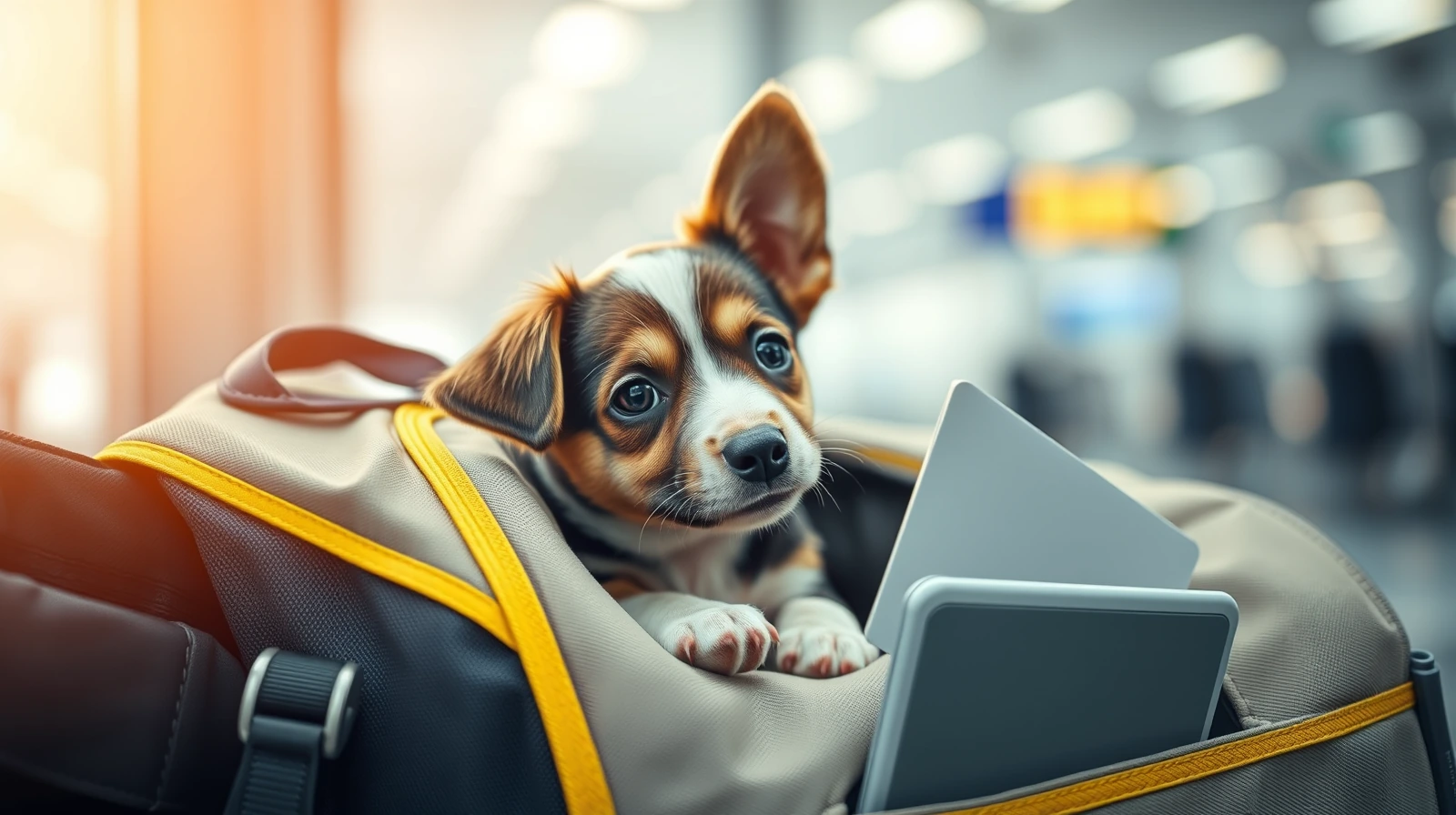
Most US airlines let puppies fly in cabin at 8 weeks, though Delta wants about 10 weeks and international trips often need 12 to 16 weeks for rabies. Many vets suggest waiting until 10 to 12 weeks. Always confirm your specific airline and destination rules before booking.
Flying with a puppy is not the same trip as flying with a grown dog. A young dog has an immature immune system, a half-finished vaccine schedule, and almost no experience of car rides, let alone a pressurized cabin. The rules are stricter too, and they change depending on the airline you book, the state you land in, and the country you started from. This guide walks through the puppy-specific parts of air travel: how old a puppy has to be, what paperwork the vet has to sign, how the cabin carrier rules work, and how to keep a nervous baby dog comfortable on travel day. Throughout, the same theme repeats: policies vary, so confirm the exact rules with your airline and your destination before you buy a ticket.
Puppies have their own age and vaccination rules that shape the cost to ship a puppy.
If this is genuinely your first time managing any part of this process, see our full walkthrough of flying with a pet for the first time.
How old does a puppy have to be to fly?
There is no single national minimum age for a puppy to fly. Each airline sets its own floor, and the destination can override it. As a rough rule, most major US carriers require puppies to be at least 8 weeks old for domestic in-cabin travel, but the specifics differ enough that you should never assume.
According to Delta's pet travel pages, the airline references puppies in cabin starting around 8 to 10 weeks of age, and a puppy under 10 weeks may not be accepted on some itineraries. JetBlue publishes pet carrier and health rules but is less prescriptive about a hard minimum age, tying international travel to the destination's import requirements instead. United has historically required puppies to be roughly 2 months old for domestic flights and older for international routes. Because these figures are adjusted periodically, treat the table below as a starting point and verify the current number on the carrier's own site before booking.
| Airline (US) | General minimum age guidance | Notes |
|---|---|---|
| Most major US carriers | About 8 weeks (domestic, in cabin) | Confirm current policy per airline |
| Delta | Around 10 weeks referenced | Some itineraries decline very young puppies |
| JetBlue | No widely stated hard minimum | International tied to destination import rules |
| United | Roughly 2 months domestic, older internationally | International requires an older puppy |
| International / long-haul | Often 12 to 16 weeks | Driven by rabies vaccine timing |
For a broader look at how the in-cabin process works once your puppy clears the age requirement, see our guide to flying with a dog in cabin.
Why many vets suggest waiting until 10 to 12 weeks
Meeting the airline's minimum age and choosing the best age to fly are two different questions. Just because a carrier will accept an 8-week-old puppy does not mean it is the ideal moment to travel. Many veterinarians suggest waiting a little longer, often until 10 to 12 weeks, for a few practical reasons.
- A puppy's core vaccine series is usually still in progress at 8 weeks, so immunity is incomplete.
- Very young puppies regulate body temperature and blood sugar less reliably, which matters in a long travel day.
- A few extra weeks of socialization make a puppy slightly more resilient to noise, motion, and handling.
- The puppy is bigger and a touch sturdier, which can ease the stress of being confined for hours.
This is general guidance, not a medical directive. Your own veterinarian knows your puppy's breed, size, and health history, so ask whether the dates you are considering are sensible for that individual animal.
Vaccinations and the health certificate timeline
Almost every airline requires a recent health certificate, and many destinations require proof of vaccination, especially rabies. The timing is the part travelers get wrong most often, because the certificate has a short validity window.
For travel within the United States, a USDA-accredited veterinarian typically issues a domestic health certificate (often the APHIS Form 7001) close to the travel date. Airlines commonly want the certificate dated within about 10 days of travel, though the exact window varies by carrier. The USDA APHIS pet travel hub is the authoritative source for which forms apply and how recently they must be signed.
Rabies is the sticking point for young puppies. The rabies vaccine is usually not given before 12 weeks of age, and it can take additional weeks to be considered valid for entry into many countries. That is why international and long-haul trips often effectively require a puppy to be 12 to 16 weeks old before it can legally travel. Build the vet visit, the vaccine, and any waiting period into your timeline well ahead of the flight. Our overview of the pet health certificate for travel explains the paperwork in more detail.
The new CDC rules for dogs entering the US
If your puppy will enter or return to the United States from abroad, the federal rules changed in 2024 and tightened again in 2025. Per the CDC's dog importation guidance, all dogs entering the US must now be at least 6 months old at the time of entry and must have a microchip that a universal scanner can detect.
The 6-month rule is a hard barrier for puppy imports. A dog that has been in a country the CDC classifies as high-risk for dog rabies within the past 6 months faces additional requirements, including rabies vaccination, a microchip, and in some cases a rabies serology titer test. Dogs coming only from rabies-free or low-risk countries face lighter documentation, but the 6-month age and microchip requirements still apply to every dog. If you are importing a puppy, read the current CDC requirements carefully, because a young dog simply cannot enter until it is old enough.
Hawaii and other strict destinations
Hawaii is rabies-free and enforces some of the strictest pet entry rules in the country. According to the Hawaii Animal Quarantine program, dogs generally need two rabies vaccinations within the required timeframe plus a passing rabies antibody (FAVN) blood test, with a waiting period of at least 30 days after the lab receives the sample. The fastest "5 Day Or Less" or direct-release options depend on completing all of that paperwork before arrival, otherwise the dog can face a longer quarantine.
For a young puppy, the rabies-vaccine and waiting-period math means it usually has to be several months old before a Hawaii trip is even possible. Other destinations, including many island nations and rabies-free countries, run similar programs. The takeaway is the same: the destination, not just the airline, sets the real minimum age, so research it first.
In-cabin carrier rules for a puppy that fits under the seat
The good news for puppy owners is that small dogs usually qualify for in-cabin travel, which is far less stressful than cargo. The catch is that the puppy plus its carrier must fit completely under the seat in front of you, and your puppy must be able to stand up and turn around inside.
- Use a soft-sided, airline-approved carrier that matches your airline's stated dimensions.
- The puppy counts as your carry-on or personal item on most carriers, and there is a per-pet fee.
- Cabin pet slots are limited per flight, so reserve the puppy's spot when you book, not at the gate.
- Your puppy must stay inside the carrier for the entire flight.
Picking the right bag matters more than people expect, since a carrier that is half an inch too tall can be refused at the gate. See our roundup of the best airline-approved dog carrier options before you buy. You will also pass through the checkpoint with your puppy out of the bag, so it helps to know what to expect when going through airport security with a dog.
Crate acclimation and managing first-flight stress
A puppy that has never been confined will not be calm in a carrier for the first time at the airport. Start carrier training at home days or weeks before the trip. Leave the open carrier out as a normal piece of furniture, feed meals inside it, and reward the puppy for settling. Build up from a few minutes to longer stretches, then add short car rides in the carrier so motion stops being a surprise.
On travel day, keep your own energy calm, because puppies read your stress. Bring a familiar blanket or a toy that smells like home, and resist the urge to over-handle a frightened puppy, which can reinforce the fear. Our guides to crate training a dog for travel and whether you can sedate a dog for travel cover this in depth. Note that many veterinarians and airlines discourage sedation for air travel, so do not give any medication without your vet's specific guidance.
Feeding, potty, and hydration on travel day
A puppy's small stomach and frequent potty needs make travel-day logistics important. Aim for a light meal a few hours before departure rather than right before, which lowers the chance of an upset stomach in the air. Offer water up until you go through security, and consider a spill-resistant clip-on water cup for the carrier.
- Use the airport pet relief area for a potty break right before boarding.
- Line the carrier with an absorbent pad in case of accidents.
- Pack a few extra pads, wipes, and a spare towel in your personal item.
- Avoid a big meal in the carrier, and skip new treats that could cause stomach upset.
Young puppies dehydrate and chill faster than adult dogs, so keep an eye on temperature at the gate and on the jet bridge, and confirm the airport pet relief locations in advance.
Brachycephalic puppies and cargo bans
Flat-faced, or brachycephalic, breeds such as pugs, French bulldogs, bulldogs, and Boston terriers face extra risk in the air. Per the American Veterinary Medical Association, these breeds are more prone to breathing problems and heat stress, which is why most airlines that still carry pets ban snub-nosed breeds from the cargo hold entirely.
For a small brachycephalic puppy, the practical answer is often in-cabin travel only, assuming the puppy fits under the seat. If your snub-nosed puppy is too large for cabin travel, flying may not be a safe option at all, and ground transport could be the better route. Our explainer on the snub-nosed dog breeds flying ban covers which breeds are affected and why.
Pre-flight checklist for flying with a puppy
- Confirm the puppy meets your specific airline's minimum age for the route.
- Verify destination rules, including any rabies, microchip, or quarantine requirements.
- Book the limited in-cabin pet slot when you reserve your seat.
- Schedule the vet visit so the health certificate falls inside the airline's validity window.
- Measure your puppy and the carrier against the airline's under-seat dimensions.
- Acclimate the puppy to the carrier for days or weeks beforehand.
- Pack pads, wipes, a spare towel, a familiar comfort item, and a water cup.
- Plan a potty break at the airport pet relief area before boarding.
- Confirm sedation guidance with your vet, since it is generally discouraged for flying.
- Keep all paperwork in your carry-on, not in checked luggage.
The US Department of Transportation's flying-with-a-pet page is a useful neutral starting point for understanding your rights and the broad federal framework. From there, every detail comes down to your individual airline and destination. Read their current pages, call if anything is unclear, and give yourself a comfortable margin, because the worst time to discover a rule is at the gate with a frightened puppy in your arms.
How old does a puppy have to be to fly?
Can a puppy fly in the cabin with me?
Do I need a health certificate to fly with a puppy?
What are the new CDC rules for dogs entering the US?
Can I fly with a puppy to Hawaii?
Should I sedate my puppy for the flight?
Can flat-faced puppy breeds fly?
How do I keep my puppy calm on its first flight?
Sources & references
- transportation.gov https://www.transportation.gov/airconsumer/flying_with_pet
- cdc.gov https://www.cdc.gov/importation/dogs/index.html
- aphis.usda.gov https://www.aphis.usda.gov/pet-travel
- delta.com https://www.delta.com/us/en/pet-travel/overview
- jetblue.com https://www.jetblue.com/help/traveling-with-pets
- avma.org https://www.avma.org/resources-tools/pet-owners/petcare/air-travel-and-short-nosed-dogs-faq
- dab.hawaii.gov https://dab.hawaii.gov/ai/aqs/aqs-info/