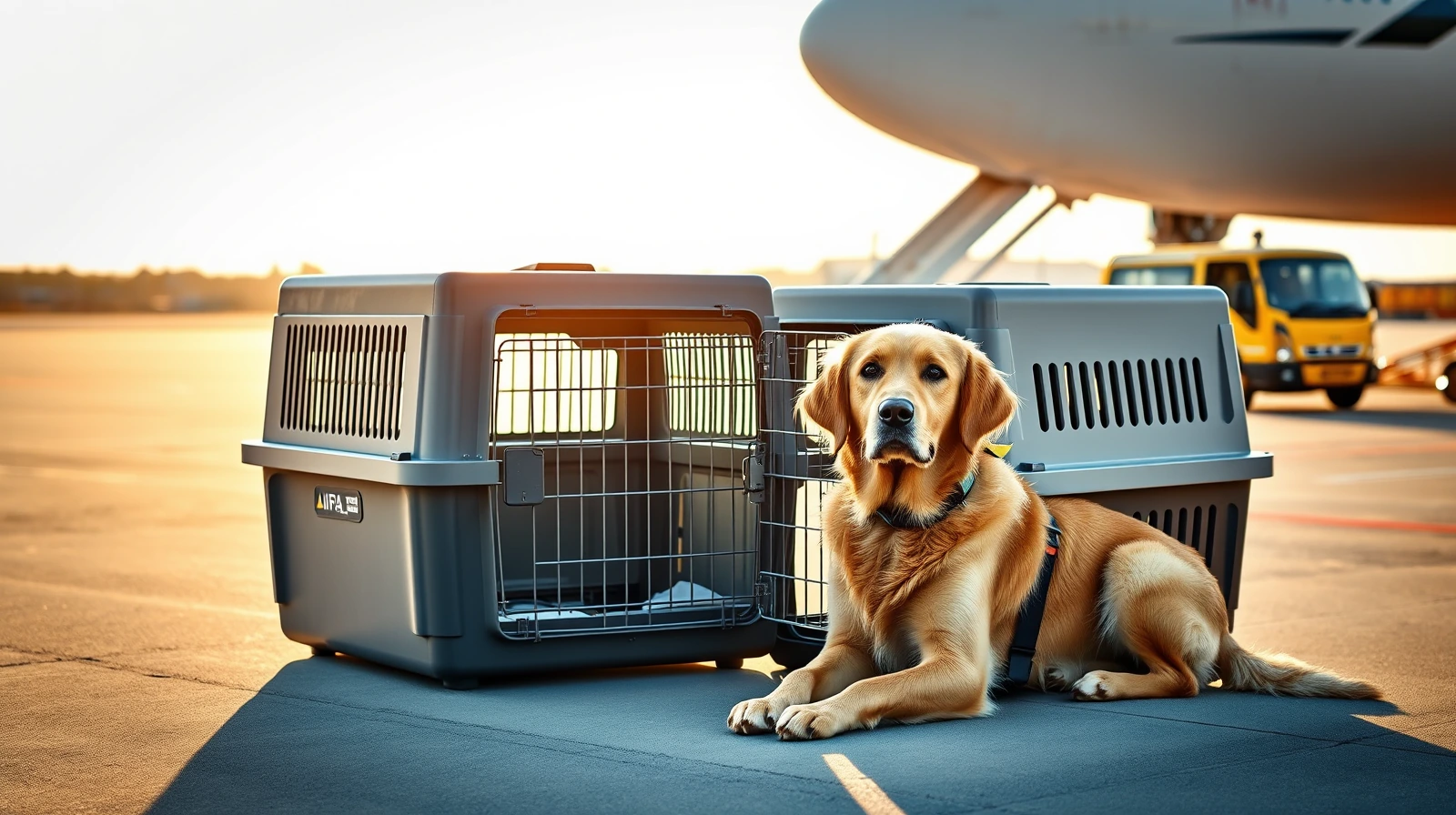
Qatar Airways does not allow pet dogs or cats in the cabin on any route. The only cabin animals are falcons (Economy only, up to one per passenger) and trained service dogs (free). All pet dogs and cats travel in the temperature-controlled hold, booked through Qatar Airways Cargo, so most owners use a pet shipping agent.
Qatar Airways does not allow pet dogs or cats in the cabin on any route. The only animals permitted in the cabin are falcons (Economy only, up to one per passenger) and trained service dogs (carried free). Every pet dog and cat travels in the temperature-controlled hold, booked through Qatar Airways Cargo rather than passenger reservations, so most owners use a pet shipping agent. Confirm current rules with Qatar Airways before booking.
You may also want our guide to Qantas Pet Policy.
See also Flying With a Dog in Cabin.
The short version: no cabin pets, hold only
If you are searching for the Qatar Airways pet policy hoping to tuck a small dog or cat under the seat, the answer is no. According to Qatar Airways' own "travelling with pets" guidance at qatarairways.com, the airline does not accept pet dogs or cats in the passenger cabin on any flight. This is consistent with how most Gulf carriers operate. There are exactly two exceptions to the no-animals-in-cabin rule: falcons, a long-standing regional quirk, and trained service dogs accompanying a passenger with a disability.
Everything else with four legs goes in the aircraft hold. The hold used for live animals is pressurized and temperature-controlled, separate from where suitcases get tossed around. Pet dogs and cats are handled either as checked baggage (when they travel on the same flight as you and the route allows it) or as manifest cargo through Qatar Airways Cargo. Because the cabin is off the table, the planning question is not "in-cabin or hold," it is "checked baggage or full cargo," and which of those you qualify for depends on the route, the season, and your pet's size and breed. Always confirm current figures and requirements directly with Qatar Airways before booking.
Cabin vs cargo: what each option actually means
Three transport modes get casually lumped together as "flying your pet." They are not the same, and on Qatar Airways only two of them apply to dogs and cats. Here is the plain-English breakdown.
- In-cabin: the pet rides in a soft carrier under the seat in front of you. Not available on Qatar Airways for dogs or cats. Only falcons and service dogs are allowed in the cabin.
- Checked baggage (accompanied): your pet flies in the temperature-controlled hold on the same aircraft as you, checked in under your ticket. Priced as an excess-baggage style fee. Subject to route, crate, weight, and seasonal heat embargoes.
- Manifest cargo (Qatar Airways Cargo): the pet flies as freight, booked through qrcargo.com or an authorized agent, and does not need to be on your flight. Required for larger animals, certain breeds, and many country pairs. Priced by weight and route.
The key takeaway for Qatar specifically: you do not get to choose cabin, so the real decision is whether your pet can go as accompanied checked baggage or has to move as standalone cargo.
The falcon exception, briefly
Qatar Airways is one of a handful of airlines worldwide that will carry a falcon in the passenger cabin, a nod to the bird's central role in Gulf falconry culture. Per Qatar Airways' published policy, falcons travel in Economy Class only, with a limit of one falcon per passenger and a cap on the total number of falcons allowed per aircraft (commonly cited as up to six). The bird sits hooded on a perch beside its handler. It is one of the more genuinely unusual sights in commercial aviation.
The falcon fare is charged separately from the handler's ticket. Reported figures put it roughly in the range of $115 to $630 USD per bird depending on the destination, though prices change and you should confirm the current falcon fare with Qatar Airways directly. We mention this mainly because it surprises people: yes, a trained bird of prey can ride in the cabin, but your Labrador cannot. That is the policy, and it traces back to regional custom rather than any inconsistency in how the airline assesses safety.
Service dogs fly free in the cabin
The second cabin exception is the trained service dog. Qatar Airways accepts service dogs accompanying passengers with a disability in the cabin, carried free of charge, subject to documentation and advance notice. This is distinct from "emotional support animals," which most international carriers, Qatar included, no longer recognize as a separate in-cabin category after the regulatory changes of recent years. If your dog is a task-trained service animal, contact Qatar Airways well ahead of travel to confirm the paperwork, behavior, and destination-entry requirements, because the import rules at your arrival country still apply regardless of the dog's working status.
Booking a pet through Qatar Airways Cargo: step by step
Because dogs and cats are not handled at the passenger desk, the booking path runs through Qatar Airways Cargo (the "QR Live" animal product) at qrcargo.com, not through your seat reservation. Here is the typical sequence. Treat it as a guide and verify each step with Qatar Airways Cargo or your agent, since procedures and embargoes change.
- Confirm the route accepts live animals. Not every origin, transit, or destination station is approved for pets. Check the specific city pair first.
- Check destination import rules early. Vaccinations, microchip, titer tests, and health-certificate timing are set by the arrival country, not the airline, and some need months of lead time.
- Get an IATA-compliant crate sized to your pet. The container must meet IATA Live Animals Regulations: rigid, ventilated, leak-proof, and large enough for the animal to stand, turn, and lie down naturally.
- Request a quote. Cargo pricing is by chargeable weight (crate plus animal) and route. There is no flat published price; you ask for a figure.
- Book and prepare documents. Lock the flight, then assemble the vet health certificate, vaccination records, and any export/import permits.
- Drop off at the cargo terminal. Live-animal cargo checks in at the freight facility on a set timeline before departure, not at the passenger terminal.
The crate step trips up more people than any other. A container that is too small, too flimsy, or poorly ventilated will be refused at acceptance, and you lose the booking. Our guide on how to choose a pet transport crate covers the IATA sizing math and the features acceptance staff actually inspect.
What it costs: checked baggage vs cargo fees
There is no single Qatar Airways pet price. What you pay depends on whether the pet moves as accompanied checked baggage or as manifest cargo, plus the route and your pet's chargeable weight. The figures below are rough ranges drawn from commonly reported owner experiences and agent quotes, not an official Qatar Airways fee schedule. Always get a written quote and confirm current pricing with Qatar Airways Cargo before booking.
| Method | Booked through | Typical price (rough) | Priced by | Best for |
|---|---|---|---|---|
| Falcon in cabin | Passenger reservations | ~$115 to $630 per bird | Destination, flat fare | Falcons only (Economy) |
| Service dog in cabin | Passenger reservations | Free | n/a | Trained service dogs |
| Dog/cat as checked baggage | Passenger reservations (where route allows) | ~$200 to $450 USD | Route and weight | Smaller pets, accompanied |
| Dog/cat as manifest cargo | Qatar Airways Cargo / agent | Quote only (by weight + route) | Chargeable weight, route | Larger pets, restricted breeds, many country pairs |
Two things to budget beyond the airline fee: the IATA crate (a one-time purchase that can run from tens to a few hundred dollars depending on size) and, if you use one, the pet shipping agent's service fee. For long international moves, the agent fee can rival or exceed the airline charge, but it buys you someone who handles permits, crate sourcing, and terminal logistics. Confirm all figures before you commit.
Crate, breed, and heat rules you cannot skip
Qatar Airways follows the IATA Live Animals Regulations, the global standard for shipping animals by air, published by the International Air Transport Association (iata.org). That governs crate construction, ventilation, labeling, and water provision. On top of that, two pet-specific cautions matter.
Snub-nosed breeds
Brachycephalic (flat-faced) dogs and cats, think French Bulldogs, Pugs, Boston Terriers, Persian cats, breathe less efficiently and are at elevated risk during air travel. Many airlines restrict or refuse these breeds in the hold outright, and the American Veterinary Medical Association (avma.org) flags them as higher-risk flyers. If you own one, read our breakdown of the snub-nosed dog breeds flying ban and confirm directly with Qatar Airways whether your specific breed is accepted, because policies vary and change seasonally.
Heat and seasonal embargoes
Doha summers are extreme, and live-animal acceptance can be embargoed or restricted when ground temperatures exceed safe thresholds. This affects routing through Hamad International Airport (DOH) during the hottest months. Plan summer moves with extra lead time and a backup date, and confirm any active heat embargo with Qatar Airways Cargo before you finalize anything.
Who needs a pet shipping agent
Because dogs and cats go through Qatar Airways Cargo rather than a simple add-on at check-in, most owners moving a pet internationally on Qatar end up using a licensed pet shipping agent. You very likely need one if any of the following is true:
- Your pet is too large to qualify as checked baggage and must move as manifest cargo.
- The destination has strict import rules (titer tests, quarantine windows, import permits) that take weeks or months to satisfy.
- You are not traveling on the same flight as your pet.
- Your breed faces restrictions and you need someone who knows which routes will accept it.
- You simply do not want to manage crate sourcing, customs paperwork, and freight-terminal timing yourself.
You can do it yourself for a straightforward accompanied-baggage move between two pet-friendly countries. For anything involving Gulf transit, restricted breeds, or demanding import regimes, an agent usually pays for itself in avoided refusals and missed deadlines. If your move runs through the region, our guide to pet transport to Dubai covers the UAE import specifics that often apply to Gulf-routed journeys.
Destination import rules apply separately
This is the part owners most often underestimate. The airline's acceptance is one gate; the arrival country's veterinary authority is a completely separate one. Whether you are landing in Doha, transiting the Gulf, or flying onward to the UK, EU, Australia, or the United States, the import requirements are set by the destination government, not Qatar Airways. They can include a microchip, a current rabies vaccination, a rabies antibody titer test with a mandated waiting period, an official health certificate issued within a tight window, and sometimes an import permit or quarantine.
For US pet owners, check the USDA APHIS Pet Travel pages (aphis.usda.gov/pet-travel) for export requirements and the destination country's specific rules, and confirm everything with that country's official veterinary authority before booking. If you are managing a full relocation rather than a single trip, our pet airlines hub links the route and relocation guides that map these requirements country by country. Build the import timeline first, then book the flight around it, never the other way round.
How Qatar compares to cabin-friendly carriers
If having your pet in the cabin is non-negotiable, Qatar Airways is not your airline, and neither is its Gulf neighbor Emirates, which also restricts pets to the hold on most routes. Some carriers do allow small dogs and cats in the cabin on many routes. Turkish Airlines is the best-known example for travel through Istanbul; our Turkish Airlines pet policy guide covers its in-cabin allowance. Lufthansa likewise permits small pets in the cabin on many of its flights, detailed in our Lufthansa pet transport guide.
The trade-off is rarely just policy. Cabin-friendly carriers cap the combined pet-plus-carrier weight low (often around 8 kg), so they only help small pets, and their network may not serve your exact route. Qatar's hold-only approach, paired with its wide Doha-hub network, can still be the most practical option for a medium or large dog moving between continents. Match the airline to your pet's size and your route, not to the policy headline alone, and always confirm current rules with each airline before booking.
How we sourced this
This guide draws on Qatar Airways' published "travelling with pets" policy and the Qatar Airways Cargo (QR Live) animal-shipping pages, cross-referenced with the IATA Live Animals Regulations framework and AVMA guidance on brachycephalic and hold travel. Price ranges reflect commonly reported owner experiences and agent quotes, not an official airline fee table, and are presented as rough figures. Airline fees, route eligibility, heat embargoes, and country import rules change frequently. Verify every figure and requirement directly with Qatar Airways, Qatar Airways Cargo, USDA APHIS, and your destination country's veterinary authority before booking.
Can I bring my dog or cat in the cabin on Qatar Airways?
How much does it cost to fly a pet on Qatar Airways?
Is it true a falcon can fly in the cabin but a dog cannot?
How do I book a pet on Qatar Airways?
Do I need a pet shipping agent?
Does Qatar Airways allow snub-nosed breeds in the hold?
What crate does Qatar Airways require for pets?
Are the destination import rules part of the Qatar Airways pet policy?
Sources & references
- qatarairways.com https://www.qatarairways.com
- qrcargo.com https://www.qrcargo.com
- iata.org https://www.iata.org
- avma.org https://www.avma.org
- aphis.usda.gov https://www.aphis.usda.gov/pet-travel