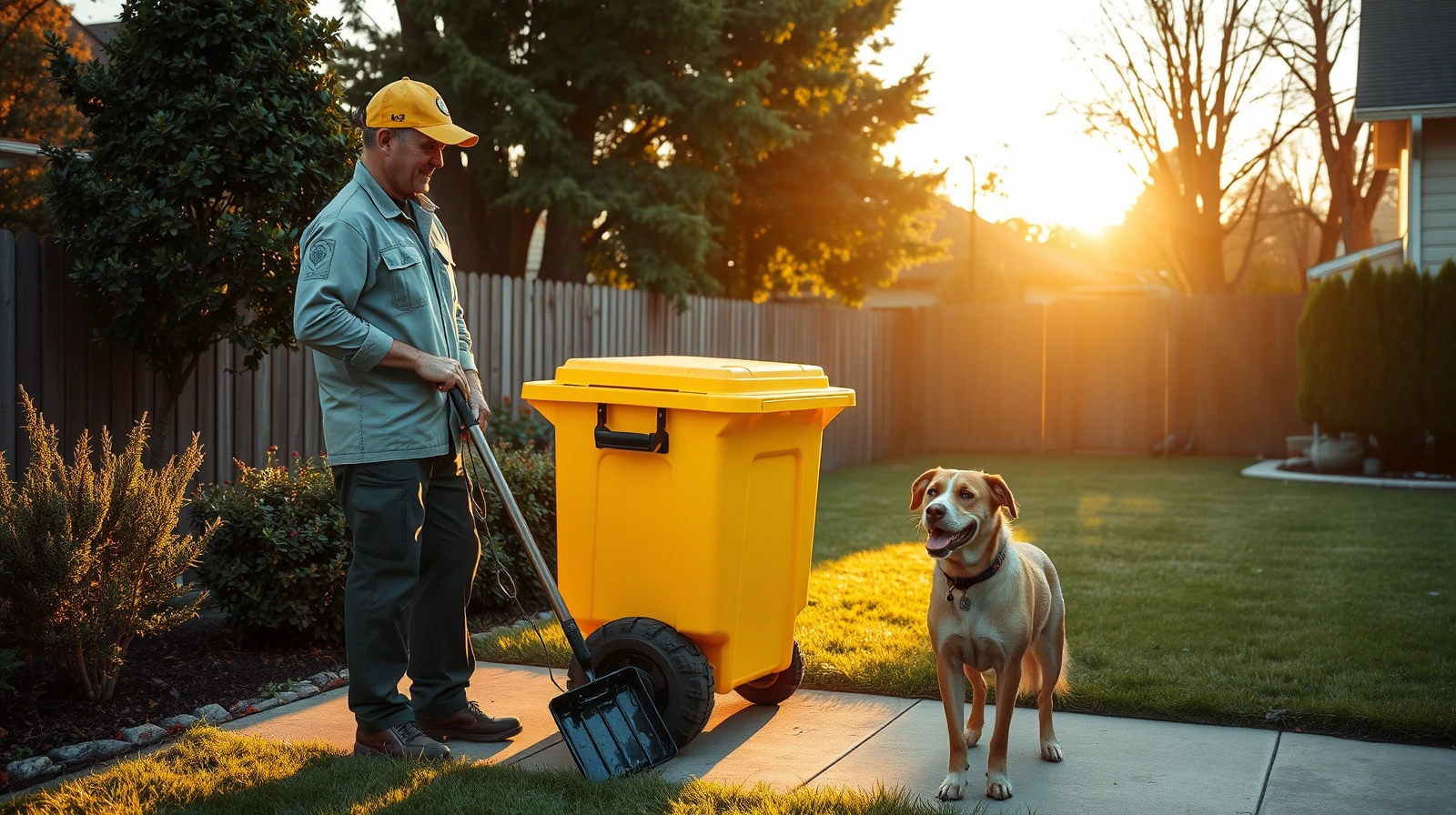
Most pooper scooper services charge roughly $15 to $30 per visit for a standard yard with one or two dogs on weekly service, often about $85 to $95 a month. One-time cleanups run higher, commonly $50 to $100 or more. Set your own rate from local labor, drive time, and disposal costs.
Most pooper scooper services charge roughly $15 to $30 per visit for a standard yard with one or two dogs on weekly service, which often works out to about $85 to $95 a month. One-time or initial cleanups run higher, commonly $50 to $100 or more depending on yard condition. Set your own rate from local labor, drive time, and disposal costs, not a copied number.
If you are starting or running a dog waste removal business, the question is not "what does this cost a customer" but "what should I charge to stay profitable." This guide is the operator's side of that equation. It covers typical market ranges, a cost-plus framework for setting your own prices, frequency and add-on tiers, the pricing mistakes that quietly kill margins, and how to raise rates and win commercial or HOA contracts. For the demand-side view of what customers actually pay and why, see our consumer guide on how much a pooper scooper service costs.
You may also want our guide to How to Dispose of Dog Poop.
On yard and waste cleanup, see our guide to How Often Should You Scoop Dog Poop?.
What the market typically charges
Before you set a price you need a reference point for what customers in this category already expect to pay. Published rates from operators and small-business pricing roundups, including the U.S. Small Business Administration's general guidance on pricing products and services, point to a fairly consistent band. Treat the figures below as ranges, not targets. Your local cost of living, drive distances, and competition will move them up or down.
- Standard weekly visit: roughly $15 to $30 for a typical yard with one to two dogs.
- Monthly billing for weekly service: commonly around $85 to $95 when bundled into a recurring plan.
- Per additional dog: usually a $5 to $15 add-on per extra dog beyond the first two.
- Initial or one-time cleanup: often $50 to $100 or more, scaled to how neglected the yard is.
These are starting reference points, not gospel. Confirm what local competitors charge before you commit to a rate card, and revisit it as your fuel, labor, and disposal costs change.
On yard and waste cleanup, see our guide to How to Get Rid of Dog Poop Smell in Your Yard.
Pricing tiers by frequency
Frequency is the single biggest lever on both your price and your route economics. Weekly service is the bread and butter of this business: it produces predictable, recurring revenue and keeps yards manageable so each visit stays short. Less frequent visits mean more waste to clear per stop, so the per-visit price climbs even though the monthly total may not. The table below shows typical ranges. Build your own card around them.
| Frequency | Typical per-visit | Typical monthly | Notes for operators |
|---|---|---|---|
| Twice weekly | $15 to $25 | $130 to $200 | Premium tier; good for multi-dog or daycare-style yards. |
| Weekly | $15 to $30 | $85 to $95 | The core plan. Best route density, shortest visits. |
| Biweekly (every 2 weeks) | $25 to $75 | $50 to $150 | More waste per visit, so per-stop price rises. |
| Monthly | $100 to $200 | $100 to $200 | One heavy visit. Price like a mini initial cleanup. |
| One-time / initial | $50 to $100+ | n/a | Scale to yard condition and time on site. |
Notice that the per-visit number rises as frequency drops. That is intentional. A monthly yard has roughly four times the accumulation of a weekly one, so it takes longer and produces more disposal volume. Price for the work in front of you on the day, not just the calendar.
On yard and waste cleanup, see our guide to How to Train a Dog to Poop in One Spot.
How to set YOUR prices: a cost-plus framework
Copying a competitor's $20 weekly rate is how operators go broke without noticing. Your costs are not their costs. The reliable method is cost-plus: add up everything a visit actually consumes, then add the margin you want to keep. The SBA's pricing guidance frames this the same way, total your costs first, then layer profit on top.
1. Cost out a single visit
- Labor: pay your time (or an employee's) at a real wage for the minutes on site. A typical weekly yard takes 10 to 20 minutes.
- Drive time: the minutes between stops are labor too, plus fuel and vehicle wear. This is the cost most operators forget.
- Disposal: bags, haul-away fees, or dump charges if you are not leaving waste in the customer's bin.
- Supplies and equipment: rakes, scoops, gloves, sanitizing spray, and a share of replacement and depreciation.
- Overhead: insurance, software, marketing, phone, and a slice of your fixed monthly costs spread across all visits.
2. Add the margin you want to keep
Once you know the fully loaded cost of a visit, add a profit margin on top. Many service operators target a healthy gross margin so there is room for slow weeks, equipment failures, and reinvestment. If a weekly visit truly costs you $11 all-in, a $20 price leaves real profit. If it costs you $16 because the yard is 25 minutes across town, that same $20 is barely break-even.
A simple way to sanity-check your card is to work backward from your target hourly take-home. If you want to clear, say, $45 an hour after fuel and disposal, and a weekly yard takes 15 minutes on site plus 5 minutes of drive time, that visit needs to net about $15 just to hit your hourly goal. Add your supplies, overhead, and margin and you arrive at a price floor. Anything below it means you are subsidizing the customer. Anything comfortably above it is a healthy account worth keeping.
3. Price for route density, not just the yard
This is the concept that separates profitable operators from busy ones. A yard 30 minutes away that pays $25 is worse than a yard 4 minutes away that pays $18, because drive time is unpaid production time. Cluster customers geographically. Charge a premium, or politely decline, for one-off stops far outside your routes. When you quote, ask the address first, then price against how it fits your existing day.
Add-ons and upsells that lift average revenue
Your base scooping rate sets the floor. Add-ons raise the average revenue per customer without adding a new client to acquire. The most common ones:
- Per additional dog: $5 to $15 each beyond the first two. More dogs means more waste and more time.
- Deodorizing and sanitizing: an enzyme or pet-safe sanitizer treatment, often $10 to $25 per application or as a monthly add-on.
- Haul-away: taking the waste off site rather than binning it on the property, billed as a recurring surcharge.
- Initial deep cleanup: the one-time fee that resets a neglected yard before recurring service begins. Never skip this.
- Litter box or small-pet service: a natural extension for clients with multiple pets.
- Larger-yard surcharge: a tier bump for properties well above a standard quarter-acre lot.
Bundle these into named plans rather than nickel-and-diming. A "Premium" tier that includes deodorizing and haul-away is easier to sell than six line items. For more on building the service menu and operations side, see our guide on how to start a pooper scooper business.
Common pricing mistakes that kill margins
Most failed or stalled scooper businesses share the same handful of pricing errors. Avoid these and you are ahead of much of the local field.
- Underpricing to win every quote. Racing to the bottom fills your week with low-margin work and no capacity for profitable clients. You cannot out-cheap your way to a sustainable business.
- No initial-cleanup fee. A neglected yard can take an hour or more on the first visit. Folding that into a $20 weekly rate means you work the first month for free.
- Ignoring drive time. Pricing only the yard, not the travel to it, is the silent margin killer. Far-flung customers feel profitable and are not.
- Never raising prices. Costs rise every year. If your rates do not, your margin shrinks invisibly until the business stops being worth running.
- One flat rate for every yard. A single-dog quarter-acre lot and a four-dog half-acre yard are not the same job. Tier by dogs, size, and frequency.
- Quoting before seeing the address. Without knowing where a yard sits relative to your route, you cannot price the drive time honestly.
If you are still deciding whether the economics work at all for your market, our breakdown of dog waste removal cost and the pooper scooper service vs DIY comparison can help you frame the value you are actually selling against a customer's free-but-unpleasant alternative.
Raising prices without losing clients
Price increases are routine in any service business, and most loyal customers expect them. The key is to communicate clearly and early. Give at least 30 days' notice in writing, keep the increase modest (a few dollars per visit or a single-digit percentage is rarely contested), and frame it around continued reliable service rather than apologizing for it. Grandfathering your earliest clients at a slightly lower rate for a season can soften the change while you bring new customers in at current pricing. Expect to lose a small number; the math still favors you when the rest pay more.
Commercial and HOA contracts
Residential weekly plans build a base, but commercial and homeowners-association (HOA) contracts are where route density and predictable revenue compound. Apartment complexes, dog parks, and HOAs often need multiple weekly visits to common areas and pet-waste stations, which means one stop with many billable minutes instead of many scattered stops. Price these on a contract basis tied to square footage, station count, and visit frequency, and build in the cost of stocking and maintaining pet waste stations for apartments and HOAs. These accounts usually carry insurance and contract requirements, so factor that overhead into the rate. A handful of solid commercial contracts can stabilize an entire route.
One operational note before you sign anything: pick a business identity that reads as professional to a property manager. If you are still in the naming stage, our list of pet care business name ideas can help you land something credible for contracts and invoices.
How we sourced this
The price ranges here are synthesized from published operator rate cards, small-business pricing methodology from the U.S. Small Business Administration, and the consistent bands reported across dog-waste-removal service listings. They are ranges for orientation, not quotes. Local labor, fuel, disposal, and competition vary widely, so confirm current figures for your own market and rebuild your cost-plus math before setting a rate card. Pricing strategy is your decision; this is a framework, not financial advice.
How much should I charge for a weekly pooper scooper service?
Should I charge an initial cleanup fee?
How much extra should I charge per additional dog?
Why does biweekly cost more per visit than weekly?
How do I price for drive time?
How often should I raise my prices?
Are commercial or HOA contracts worth pursuing?
What is the most common pricing mistake new operators make?
Sources & references
- sba.gov https://www.sba.gov/business-guide/manage-your-business/pricing-your-products-services